


Armchair for Reupholstery
An armchair for reupholstery gives you a sturdy timber frame ready for new fabric and webbing.
Armchair for Reupholstery
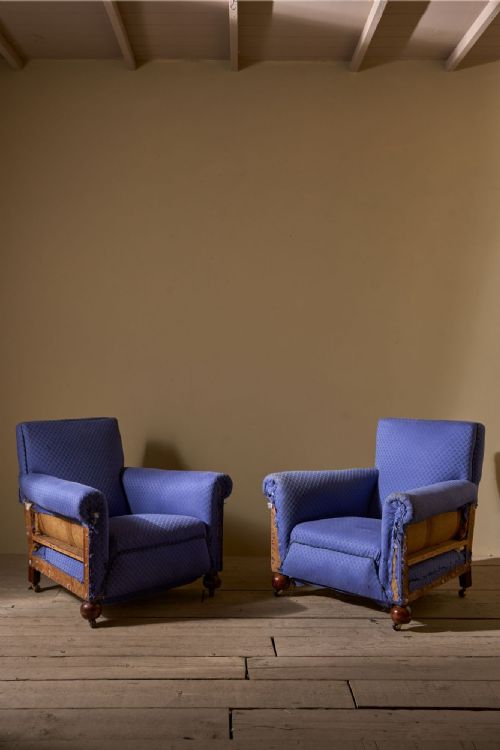
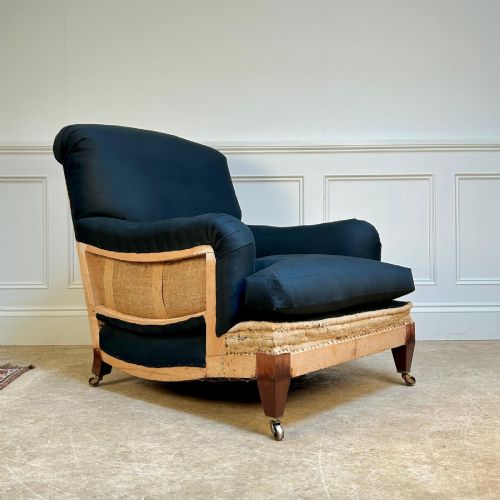
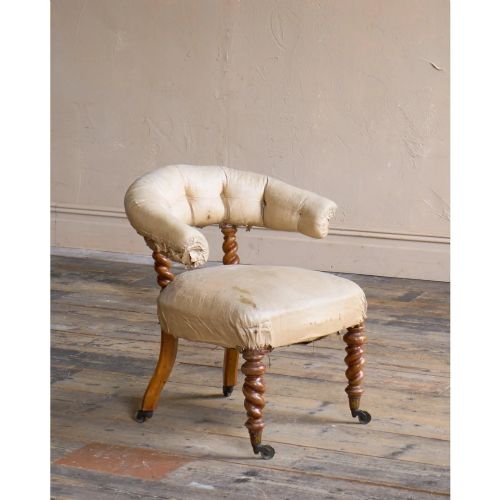
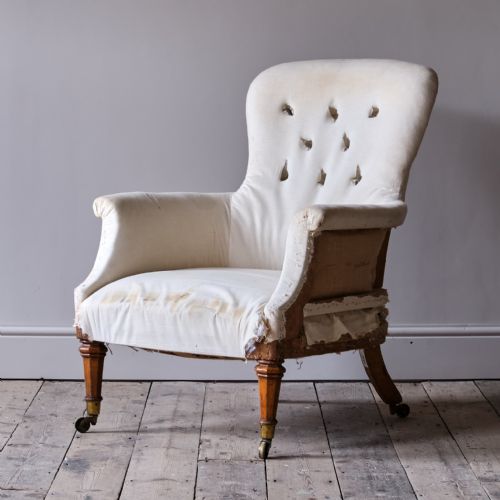
An armchair for reupholstery is a seating piece offered in its bare or partially stripped state, exposing the underlying frame and stuffing. When you search for this phrase, you find armchairs and salon chairs originating from the 19th Century, Victorian period, Regency, Edwardian era, and the 1930s.
The most common forms on this page include deep-seated country house armchairs, Howard style chairs, and button-back occasional chairs. These pieces originate from English and French traditions, spanning styles from William IV and Napoleon III to Art Deco.
Buyers select these chairs to choose their own textiles and finish the piece to match a specific interior. Each frame demonstrates period joinery and proportions that set the baseline for the finished seat.
How they were made
Makers constructed these frames using solid timbers such as mahogany, walnut, and general wood or timber. Structural strength relied on traditional joinery within the arms, legs, and backrests.
Traditional stuffing relied on natural materials held together by hessian, webbing, and calico linings. Metal elements such as brass castors and internal springs provided mobility and support.
Armchair for Reupholstery Retail Price Guide 2026
Typical asking prices for armchair for reupholstery among the pieces listed under this phrase on Sellingantiques today, from the lower quarter to the upper quarter. They describe what is for sale here now, not the wider market.
Listings feature frames in mahogany, walnut, and mixed timber, spanning the Victorian period, the 19th Century, and 1930.
What varies in quality
Quality rests in the integrity of the wooden frame and the precision of the initial cabinetmaking. Heavier timber frames with refined carving or balanced proportions distinguish finer workshop output from simpler utilitarian seating.
The sophistication of the armchair's silhouette dictates its standing. Generous upholstery depths and well-sprung profiles, particularly in Howard style or deep-seated country house designs, mark the more substantial examples.
SF Cullen·Morison and Co·C Hindley and Sons·Robert Strahan·Trollope and Sons
The Armchair for Reupholstery Glossary
- Hessian
- A coarse woven fabric typically used as a foundation layer for stuffing and springs in traditional upholstery. It provides a stable base before the final top fabric is applied.
- Calico
- A plain-woven cotton fabric stretched over the stuffing to create a smooth, taut layer beneath the decorative outer cover. It holds the internal materials firmly in shape.
- Webbing
- Strong woven bands stretched tightly across the seat frame to support the weight of the springs and padding. Traditional webbing is made from jute or hemp.
- Button back
- A style of upholstery where indentations are formed by pulling strings or twine tightly through the padding to secure buttons in a geometric pattern. This technique creates distinct tufting across the backrest.
- Scroll back
- A chair back featuring arms or a top rail that curves outward in a tight scroll shape. It is characteristic of 19th-century French and Victorian designs.
Armchair for Reupholstery: Frequently Asked Questions
What does reupholstery involve for these chairs?
Reupholstery involves stripping the chair back to its bare wooden frame, replacing worn webbing and springs, and applying fresh internal stuffing protected by calico.
Once the foundational layers are secure, the final decorative fabric is fitted and secured by hand with tacks or piping.
How do I choose the right fabric?
Consider the scale of the pattern and the weight of the material in relation to the proportions of the wooden frame. Heavy country house chairs suit robust weaves, while occasional chairs accommodate lighter textiles.
Durability ratings matter if the armchair will see daily use in a busy room.
Are these frames sturdy enough for daily use?
Period frames built from solid mahogany or walnut generally offer robust structural integrity after decades of service. Traditional joinery ensures the skeleton remains sound once properly restored.
Re webbing and tightening the joints during the reupholstery process restores full stability.
How can I tell a Victorian chair from an Art Deco one?
Victorian pieces often feature turned mahogany legs, carved woodwork, and deep buttoning associated with traditional drawing room comfort. They emphasise curves and ornamental detail.
Art Deco chairs from the 1930s favor streamlined club shapes, bold geometric proportions, and minimal ornamentation.