

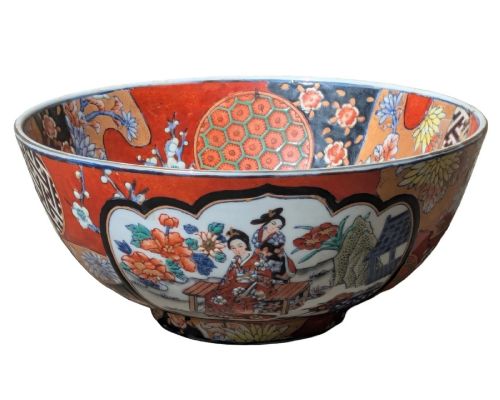




Arita Imari Charger Bowl
An arita imari charger bowl brings rich Japanese porcelain history into a room, offering striking colours and traditional forms that collectors prize.
Arita Imari Charger Bowl
When you search for an arita imari charger bowl, you encounter Japanese ceramics spanning from the seventeenth century through the Meiji period and into the twentieth century. These pieces include large decorative plates, scallop edge bowls, and shallow dishes shaped in traditional Japanese kilns.
The selections on this page lean heavily towards nineteenth-century examples and items dated around nineteen hundred, alongside late seventeenth-century Arita pieces. Forms range from broad chargers and deep decorative bowls to plates with shaped or scalloped edges.
Materials and construction
Makers shaped these items from ceramic and porcelain, applying cobalt blue underglaze to establish the primary patterns before firing. Artisans then added enamel colours and gold leaf over the glaze to build up the complex surface designs.
Hand painting characterises the decoration across the periods seen, creating individual finishes on every porcelain dish and bowl. Firing techniques in Arita kilns allowed for large chargers and deep bowls to hold intricate pigments without losing structural integrity.
Listings feature porcelain pieces spanning the seventeenth century, the Meiji period, nineteen hundred, and the nineteen-thirties.
Distinctions in quality
Quality rests in the precision of the hand-painted brushwork and the vibrancy of the enamel and gold leaf applied over the cobalt glaze. Pieces described as quality or large examples display finer control in the pictorial motifs and cleaner porcelain bodies.
Age also creates variation, with seventeenth-century pieces carrying historical weight distinct from Meiji period or Edwardian-era output. The crispness of scalloped edges and the richness of the cobalt underglaze separate standard production from superior work.
The Arita Imari Charger Bowl Glossary
- Arita
- A Japanese town and production centre renowned for porcelain manufacture since the early Edo period. Kilns in this region produced the ceramic bodies decorated in the Imari style.
- Charger
- A large decorative plate or shallow bowl intended for display rather than everyday dining. These sizeable pieces showcase expansive painted designs across the surface.
- Meiji Period
- The era in Japanese history spanning from eighteen sixty-eight to nineteen twelve. Pieces from this time often exhibit detailed hand-painted decoration.
- Cobalt Underglaze
- A blue pigment applied to the raw porcelain body before glazing and firing. This durable blue forms the foundational layer of traditional Imari patterns.
Arita Imari Charger Bowl: Frequently Asked Questions
What is an arita imari charger bowl?
These items are Japanese ceramic and porcelain vessels created for display and decoration. They encompass large plates, shallow bowls, and deep chargers.
Craftsmen produced them across multiple centuries, using cobalt blue, enamel, and gold leaf to decorate the porcelain bodies.
How were these bowls used historically?
Chargers and large decorative bowls served primarily as display pieces in homes rather than functional tableware. Their substantial size and colourful designs suited placement on tables or sideboards.
Exported from Japanese ports, they became popular decorative objects in European and Western interiors.
How do I date an imari bowl?
Dating relies on stylistic markers, period attribution, and ceramic characteristics recorded in the listings. Seventeenth-century Arita pieces differ in body and brushwork from Meiji period or nineteen-hundred examples.
Examining the cobalt underglaze, enamel application, and potting style helps place a piece in its correct era.
How should I display an antique charger?
Large chargers and decorative bowls require stable placement due to their weight and porcelain composition. Many collectors use specialised wall mounts or sturdy plate stands for safe presentation.
Keeping them away from high-traffic edges protects the hand-painted enamel and gold leaf details.