
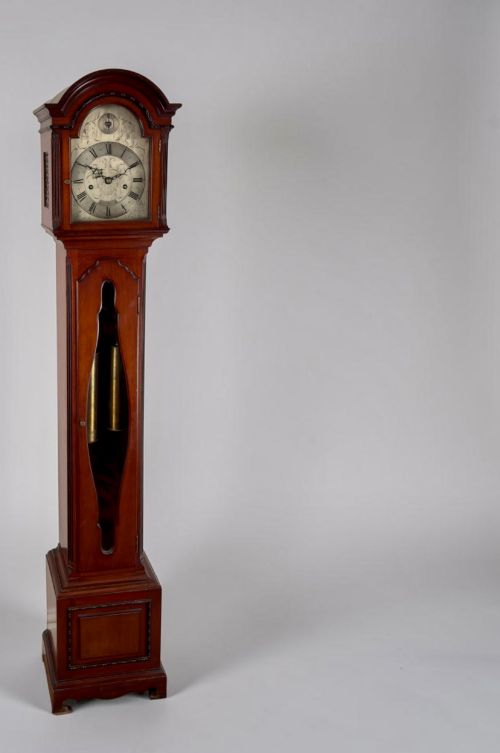
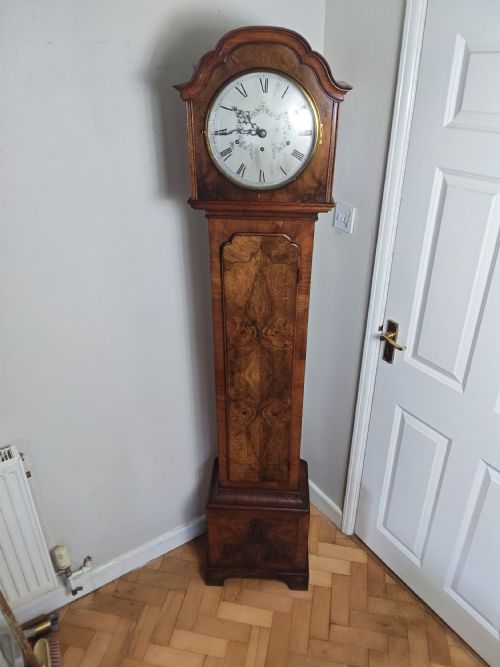


Arched Top Longcase Clock
An arched top longcase clock brings architectural presence and steady mechanical rhythm into a room.
Arched Top Longcase Clock
An arched top longcase clock is a tall floor-standing timepiece featuring a curved upper dial hood, enclosing a weight-driven movement. These pieces span centuries of British cabinet-making, originating from Georgian workshops and continuing through Victorian and Edwardian revivals.
The selection here includes full-scale grandfather clocks alongside more compact grandmother clocks and smaller proportions suited to modern rooms. Oak and mahogany dominate the structural timberwork, accompanied by walnut and burr varieties.
Makers housed within these cases range from 18th-century regional horologists to early 20th-century specialists, incorporating quarter-chiming functions, moonphase dials, and musical movements.
How they were made
Cabinet-makers constructed the tall cases using solid and veneered hardwoods, selecting mahogany, oak, and walnut to form the trunk, base, and arched hood. Burr walnut and burr mahogany veneers were applied to add rich figuring to the primary surfaces.
Glazing protected the dial face beneath the arched top, while brass and steel components formed the intricate gear trains, weights, and striking mechanisms housed within the trunk.
The listings span from 1750 through the Georgian, Victorian, and Edwardian eras into 1930s revivals, utilising mahogany, oak, walnut, and brass.
What varies in quality
Quality rests in the harmony between the cabinet proportions and the complexity of the internal movement, from simple hour strikes to intricate quarter-chiming musical systems. The choice of timber grain, particularly the depth of burr walnut or figured mahogany, distinguishes standard vernacular pieces from finer examples.
The crispness of dial engraving and the reputation of the original horologist elevate the stature of a clock, reflecting the skill invested at the workbench.
Gillett & Johnston of Croydon·Thomas Goddard London·JAMES COSTER OF HENLEY·French Royal Exchange·THOMAS HALL ROMSEY
The Arched Top Longcase Clock Glossary
- Longcase clock
- A tall freestanding pendulum clock enclosed in a wooden case, commonly known as a grandfather clock.
- Grandmother clock
- A smaller, more slender version of the traditional longcase clock, typically produced during the 20th century.
- Moonphase
- A dial mechanism that tracks the phases of the lunar cycle across a rotating painted disk.
- Regulator
- A precision pendulum clock designed for high accuracy, often featuring a simplified dial layout for easy reading.
- Quarter chiming
- A movement mechanism that strikes the bells or gongs every fifteen minutes to mark the progression of the hour.
Arched Top Longcase Clock: Frequently Asked Questions
What is a grandmother clock?
A grandmother clock is a scaled-down version of the traditional longcase clock, built with a shorter and narrower trunk. These smaller proportions make them practical for rooms with lower ceilings.
They emerged strongly during the early twentieth century alongside revival styles, offering the same mechanical movement in a compact footprint.
How do I wind the weights?
Winding involves using a crank key to raise the heavy metal weights suspended inside the trunk by cords or chains. Each weight must be pulled upward carefully until it reaches the top of its descent.
Timing this maintenance depends on whether the movement is an eight-day or thirty-hour design.
Where should I place the clock?
Position the piece against a solid internal wall away from direct sunlight, central heating vents, and damp exterior walls. Stable floorboards ensure the cabinet remains upright and plumb.
Level footing is essential for the pendulum to swing evenly and keep accurate time.
How do I date an arched top longcase clock?
Dating relies on examining the timber species, the construction methods of the case, and the signature inscribed on the brass or painted dial. Georgian examples display different cabinet proportions compared to Edwardian or 1930s revivals.
Movement technology and style details help narrow the period of origin.