
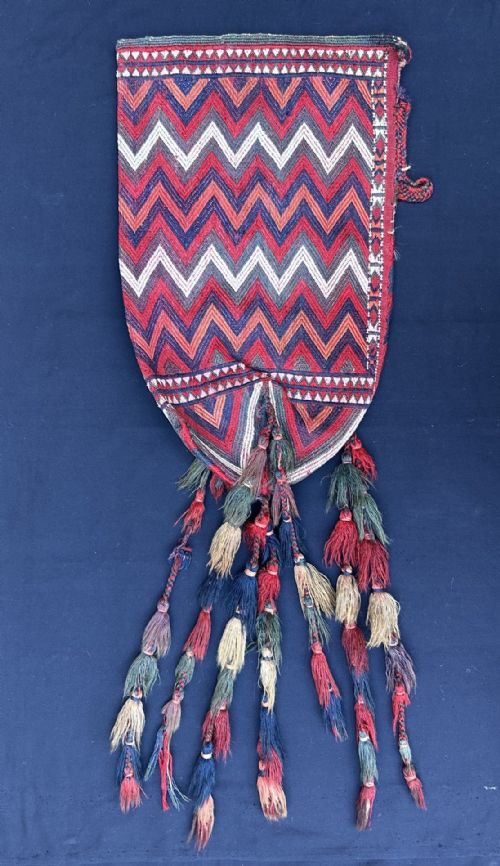


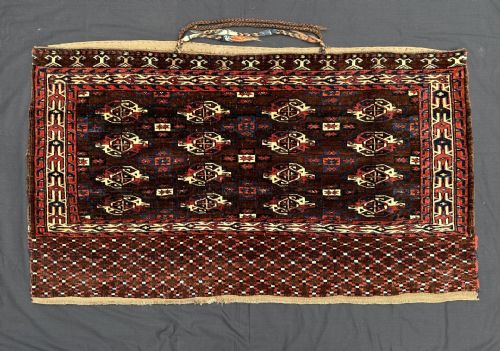


Antique Yomut Tent Bag
An antique yomut tent bag brings the tactile warmth of Central Asian nomadic weaving straight to your walls or interior scheme.
Antique Yomut Tent Bag
When you search for an antique yomut tent bag, you are looking at tribal textiles woven by Turkmen groups across the Trans-Caspian steppes. These pieces include utilitarian forms such as torba faces, chuval storage bags, and tent-pole covers like the uk bash or okbash.
The version you are most likely to meet on this page is a torba or storage bag dating from the late nineteenth century. These tribal textiles showcase distinctive geometric motifs rooted in Central Asian nomadic traditions.
Materials and construction
These textiles rely entirely on hand-spun wool combined with natural dyes to achieve their rich visual depth. Artisans built the structures using durable wool foundations alongside occasional cotton elements.
The weaving technique demands immense precision to create crisp geometric patterns and repeating guls. Complete examples sometimes retain their original wool backs, preserving the textile in its functional format.
Available pieces span the late nineteenth century to nineteen hundred, originating from Turkmenistan and the Trans-Caspian steppes.
Assessing quality and structure
The fineness of the weave distinguishes the most accomplished weaving from standard examples. Closely packed knots allow intricate gul designs, such as the kepse or aishk patterns, to appear sharp and well-defined.
Preservation of the original structure also dictates the calibre of a piece. Examples that retain their complete backs or retain tent-pole attachments demonstrate greater integrity than isolated fragments.
The Antique Yomut Tent Bag Glossary
- Torba
- A small Turkmen storage bag traditionally used inside the yurt for household possessions. These face panels are frequently collected as decorative wall hangings today.
- Chuval
- A large tent storage bag produced by nomadic tribes for bedding and heavy items. They feature wide formats and dense repeating motifs.
- Gul
- A primary medallion or repeating heraldic motif found across Turkmen tribal rugs and trappings. Different tribes utilised distinct gul patterns to signal their lineage.
- Uk Bash
- A specialised tent-pole bag, also written as okbash, designed to cover the ends of the wooden struts that form the yurt dome. They typically possess a distinctive triangular shape.
- Kepse Gul
- A specific diamond-shaped lattice motif frequently seen on Yomut torbas. This repeating design creates an orderly rhythm across the central field.
Antique Yomut Tent Bag: Frequently Asked Questions
What is an antique yomut tent bag?
These pieces are hand-woven tribal textiles created by nomadic Yomut groups in Central Asia. They served practical storage functions within traditional yurt dwellings.
Today, collectors appreciate them as textile art that displays centuries-old indigenous design traditions and natural dyeing methods.
How do I date these textiles?
Dating relies on assessing the handle of the wool, the chemical composition of the natural dyes, and the structural style of the weave. Most examples date from the latter half of the nineteenth century up to nineteen hundred.
Examining the complexity of the gul motifs and the preparation of the hand-spun wool helps establish the likely decade of production.
How do I display a tent bag?
These textiles adapt readily to interior display as wall hangings due to their flat, tapestry-like construction. Mounting them carefully distributes tension evenly across the wool foundation.
Keeping them away from direct sunlight preserves the stability of the natural dyes and the integrity of the hand-spun fibres.