
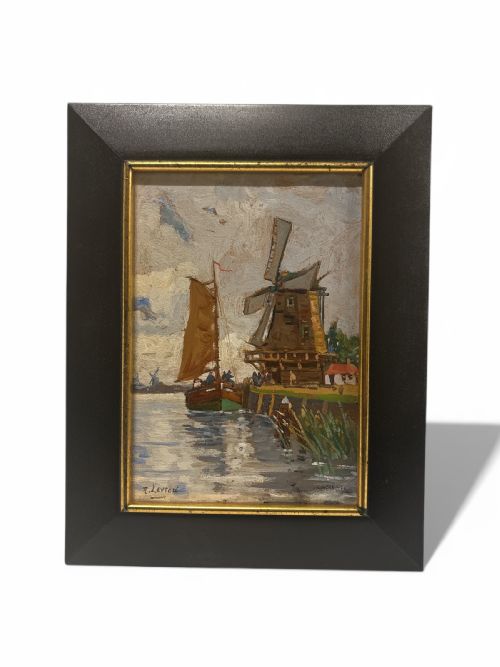
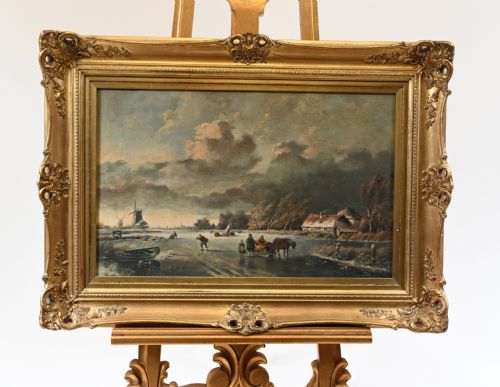
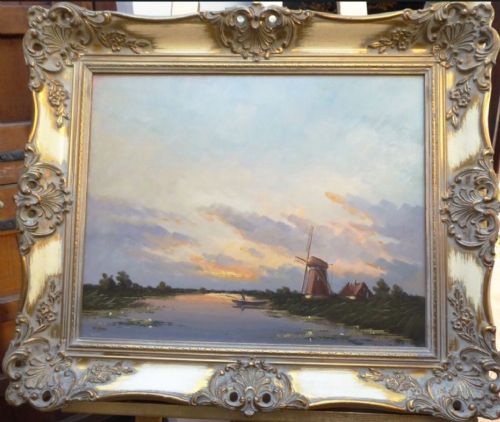


Antique Windmill Painting
An antique windmill painting captures the enduring industrial romance of river flats, polders and coastal horizons across Britain and the Low Countries.
Antique Windmill Painting
When you search for an antique windmill painting, you encounter a focused category of topographical art depicting rural mills across English and continental landscapes. These pieces record local agricultural and drainage structures that once dominated flat horizons long before modern mechanisation altered the countryside.
The selections available here lean heavily toward nineteenth-century watercolours on paper and oil paintings executed on canvas or wood panel. You find works originating from distinct regional traditions, including the Norwich School, the Dutch School and various British coastal and river views.
Beyond pure paintings, the record includes related wall art and paper works that share the same rural iconography. Most pieces date from the Victorian and Edwardian eras, though earlier eighteenth-century topographical views and later twentieth-century interpretations also appear.
Materials and methods
Painters relied primarily on oil paint applied to canvas, wood panels or card, utilising the viscosity of the medium to build rich textures in skies and water. Watercolours on paper provide a lighter, more translucent record, frequently heightened with gum arabic or bodycolour to capture atmospheric effects.
Supports varied according to the scale and school of the work, with continental scenes often painted on cradled oak panels and British landscapes commonly set on stretched canvas. Original gilt wood frames frequently accompany these panels, completing the historical presentation of the artwork.
Among the rural vistas, an automaton quietly ticks away alongside miniature furniture painted with traditional blue and white motifs.
Distinctions in execution
Quality in these rural scenes rests upon the artist's handling of light, atmosphere and perspective across expansive flat landscapes. Stronger examples demonstrate confident brushwork and precise topographical observation rather than formulaic repetition of standard rustic motifs.
The depth of the palette and the preservation of the original support material significantly influence the visual impact of the piece. Works that retain their initial surface vibrancy without excessive restoration command closer attention from collectors.
Thomas Bush Hardy·Charles Harmony Harrison·Edward Seago·Pieter Cornelis Dommersen·Kershaw Schofield
The Antique Windmill Painting Glossary
- Norwich School
- A regional group of artists inspired by the Norfolk landscape, known for painting local rivers, flatlands and agricultural structures. Their output forms a cornerstone of nineteenth-century British topographical art.
- Polder
- A low-lying tract of land enclosed by dikes that forms an artificial hydrological entity, frequently depicted in Dutch landscape art alongside drainage mills. The term defines both the terrain and the specific compositional setting.
- Faience
- Tinned-glazed earthenware produced in various European centres, particularly associated with blue and white decorative pieces. This ceramic technique appears in domestic objects linked by theme to the wider collection.
- Grisaille
- A painting executed entirely in shades of grey or neutral monochrome, designed to simulate relief sculpture or achieve a solemn tonal effect. Artists utilised this method for atmospheric topographical studies.
Antique Windmill Painting: Frequently Asked Questions
How do I care for antique watercolours?
Watercolour paintings on paper require careful protection from direct sunlight to prevent the fading of delicate pigments. Keep them away from damp environments to avoid foxing and paper degradation.
Displaying them under UV-filtering glass helps preserve the integrity of the original paper and pigments for the future.
What defines the Dutch School style?
The Dutch School encompasses artists who focused on realistic landscape rendering, atmospheric weather conditions and maritime or river settings. These compositions often emphasise expansive cloudy skies above flat horizons.
Subtle tonal gradations and careful observation of daily rural life distinguish these paintings from more theatrical romantic compositions.
How can I date an oil painting on wood panel?
Dating panel paintings involves examining the preparation of the wood, tool marks on the reverse and the ageing patterns of the oil ground. Thicker panels often indicate earlier origins, while standardised nineteenth-century commercial boards show specific manufacturer stamps.
Stylistic cues within the clothing of figures or the architectural details of the mills provide additional chronological markers.
Where should I hang a landscape painting?
Select an interior wall with stable temperature and humidity levels away from direct heat sources and strong sunlight. Proper placement protects both the canvas or paper support and the historical frame.
Mounting the artwork at eye level allows the viewer to appreciate the fine brushwork and atmospheric depth of the rural scene.