

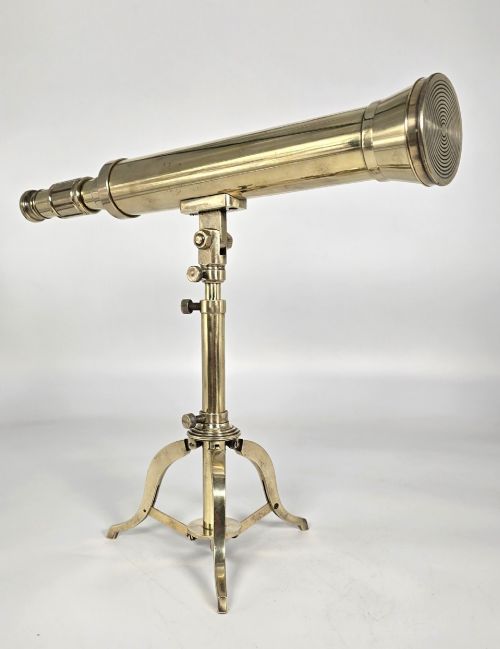


Antique Tripod Telescope
An antique tripod telescope brings the brass-bound mechanics of navigation and stargazing directly into a room, offering a functional window to the horizon.
Antique Tripod Telescope
When you search for an antique tripod telescope, you encounter precision optical instruments designed for terrestrial observation or astronomy, typically mounted on collapsible three-legged stands. These instruments emerge primarily from the Georgian, Victorian, and Edwardian eras, spanning the eighteenth, nineteenth, and early twentieth centuries.
The pieces on this page lean heavily toward library telescopes, table top variants, and larger brass instruments housed in original wooden cases or paired with military campaign mounts. Makers such as Dollond, Broadhurst Clarkson, and Negretti and Zambra anchor many of the surviving examples in this tradition.
Forms range from compact table top instruments to large library pieces requiring sturdy floor-standing tripods made of mahogany, bronze, or cast iron. A buyer finds both terrestrial scopes meant for viewing distant landscapes and astronomical refractors built for charting the night sky.
Judging optical and mechanical quality
Quality rests in the integrity of the optical train and the smoothness of the focusing mechanism, where superior makers achieved crisp, clear images across the field of view. The weight and stability of the tripod stand, alongside the precision of the brass work, separate standard production pieces from workshop masterpieces.
Signed barrels bearing the names of renowned London opticians carry historical weight, reflecting the exacting standards of firms that supplied instruments to navies and observatories. The survival of original components, from lens caps to fitted mahogany boxes, preserves the integrity of the instrument.
The inventory records both terrestrial library scopes and astronomical refractors paired with original wooden tripods and storage boxes.
W. and T. Gilbert·Clarkson·Steward of London·Negretti and Zambra·S and B Solomons·Matthew Berge·G. Adams·Broadhurst and Co·Broadhurst Clarkson and Co·Dollond·Aitchison and Co·T Cooke and Sons
The Antique Tripod Telescope Glossary
- Library telescope
- A large brass optical instrument traditionally mounted on a tall floor tripod for indoor use in a study or observatory. These pieces provide high magnification for both terrestrial and celestial viewing.
- Refractor
- An optical telescope design that uses a lens to form an image. Light passes through the primary objective lens to bend and focus at the eyepiece.
- Terrestrial telescope
- An optical instrument configured with an erecting lens system to present an upright image for viewing land objects. Observers use these for spotting ships and distant landscapes.
- Campaign mount
- A folding tripod or stand engineered for portability and stability in the field. These compact supports suit military officers and travelling surveyors.
- Objective lens
- The primary glass lens at the front of the telescope that gathers light. Its diameter determines the light-gathering power of the instrument.
Antique Tripod Telescope: Frequently Asked Questions
Were these telescopes used at sea?
Some shorter portable instruments served aboard ships for navigation and signalling, while heavier library models remained fixed inside homes or land-based observatories. Military campaign variants offered officers a sturdy portable solution for field operations.
The tripod mount itself suited stationary observation from a balcony, window, or deck rather than active handheld use in rough conditions.
How do I clean the brass and lenses?
Dust the brass surfaces gently with a soft, dry microfiber cloth to remove surface particles without scratching the metal. Avoid abrasive commercial metal polishes that can strip away the historical patina or damage maker signatures.
Leave optical glass cleaning to specialists unless dust accumulation severely impairs viewing, in which case use a photographic air blower very carefully.
How can I tell the period of a telescope?
Examine the engraved signature on the draw tube, as makers often included addresses that help date the workshop's active years. The style of the tripod woodwork, lettering fonts, and box construction also offer clear clues to the decade of manufacture.
Georgian and Regency instruments tend to feature simpler, robust lines, whereas Victorian and Edwardian examples often incorporate more complex rack-and-pinion focusing assemblies.