


Vintage Standing Telescope
A vintage standing telescope offers a tangible link to optical history, bringing brass work and maritime observation directly into a room.
Vintage Standing Telescope
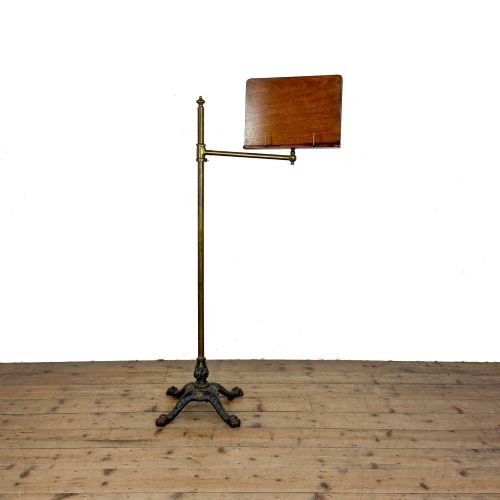
A vintage standing telescope is an instrument designed for observation, appearing in forms such as library telescopes on stands, marine telescopes, and reading stands across this page. These pieces span periods from the Georgian era through Victorian and Edwardian decades up to the mid-twentieth century.
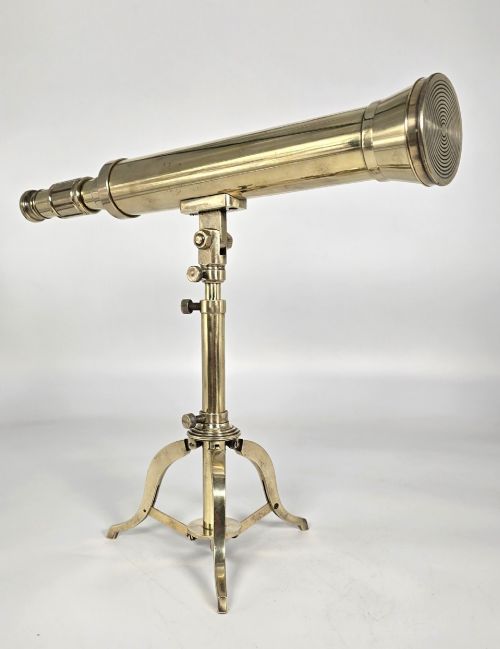
The most common versions encountered here are polished brass telescopes mounted on folding brass tripods or wooden stands. Alongside these, the selection includes related scientific and maritime instruments such as theodolites and rangefinder binoculars.
Originating largely from English makers and workshops, these instruments combine practical optical utility with the decorative presence of nineteenth-century scientific apparatus. Buyers typically select them for display in studies, libraries, or rooms oriented toward a view.
How they were made
Makers constructed these instruments primarily from polished brass for the optical tubes and mountings, paired with glass lenses and occasionally wood or leather dressings. Brass components were cast, turned, and polished to achieve precise concentric draws for focusing.
Supporting structures utilise brass tripods, mahogany, or oak, often incorporating mechanical adjustments such as rack and pinion focusing or folding tripod legs. Leather dressing on specific spyglasses and terrestrial tubes provided a tactile grip for field use.
Some nineteenth-century explorers apparently preferred leather-dressed tubes to keep their hands from sticking to freezing brass at sea.
What varies in quality
Quality in a vintage standing telescope rests upon the precision of its optical maker and the completeness of its mounting hardware. Instruments bearing signed inscriptions from established opticians reflect higher standards of lens grinding and brass fabrication.
The degree of original preservation in the mechanical stands and focusing draws distinguishes standard production items from specialised library pieces. Surviving fitted cases and original folding tripods enhance the integrity of the apparatus.
Ross of London·W. & T. Gilbert London·Clarkson London·Steward of London·Chadburn Brothers of Sheffield·Matthew Berge London·G. Adams of London·Negretti & Zambra
The Vintage Standing Telescope Glossary
- Single Draw
- A telescope comprising two tubes where one slides directly within the other to focus the image. This simpler configuration appears frequently in marine and field instruments.
- Four Draw
- An optical instrument featuring four telescoping brass sections that collapse into a compact length for transport. When extended, these sections lock into position to maintain alignment.
- Library Telescope
- A larger terrestrial instrument designed for indoor use, mounted on a sturdy table stand rather than handheld. These pieces allowed detailed observation without the instability of field tripods.
- Theodolite
- A precision scientific instrument used for measuring angles in horizontal and vertical planes. It employs a telescope mounted on a graduated scale and leveling base.
- Rangefinder
- An optical device used to calculate distance to a target through dual optical paths. Military versions utilise heavy steel casings and robust mechanical adjustments.
Vintage Standing Telescope: Frequently Asked Questions
What is a standing telescope?
A standing telescope is an optical instrument mounted upon a dedicated tripod or table stand for stable viewing. These pieces allow users to observe distant terrestrial or celestial targets without holding the weight.
Most examples combine polished brass tubes with adjustable wooden or metal stands designed for interior display.
How do you use a vintage telescope?
Operation involves extending the draw tubes to adjust the focal length while sighting through the eyepiece. Fine focusing is achieved by turning the rack and pinion mechanism where fitted.
Care should be taken to support the brass barrel securely when extending the draws to prevent sudden drops.
Where were these telescopes made?
The majority of instruments on this page originate from English workshops and scientific makers based in London and Sheffield. These manufacturing centres produced optical equipment for maritime navigation, surveying, and domestic study use.
Occasional pieces from other European makers also appear within scientific and maritime categories.
How do I date a brass telescope?
Dating relies upon maker signatures, the style of the mounting stand, and the number of draw tubes used in the construction. Earlier nineteenth-century examples often feature signed inscriptions near the eyepiece alongside mahogany storage cases.
Later Victorian and Edwardian iterations show shifts toward standardised brass tripods and industrial finishes.