




Antique Three Piece Garniture
An antique three piece garniture brings balance to a mantelpiece, matching a central clock with flanking candelabra or vases.
Antique Three Piece Garniture
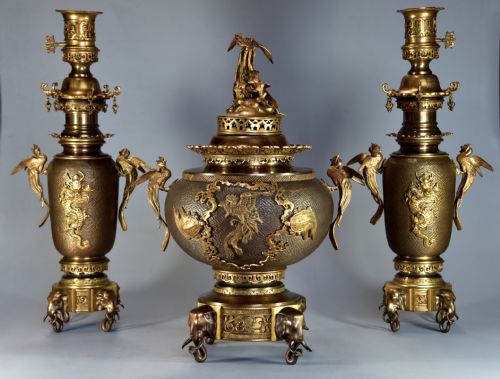
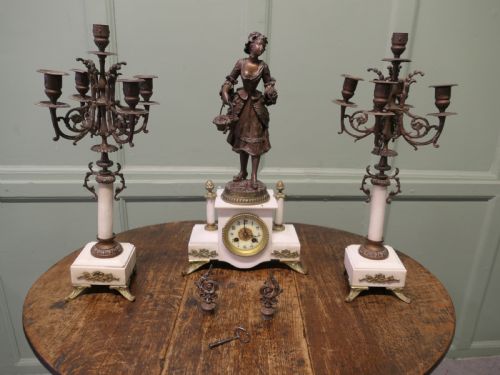
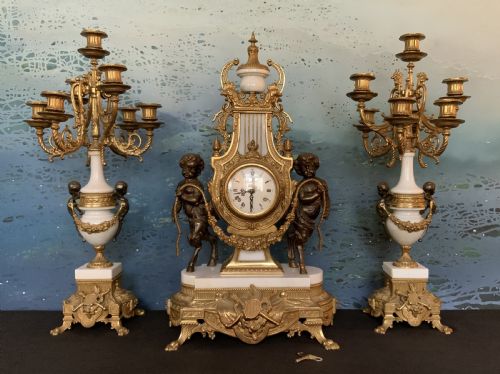
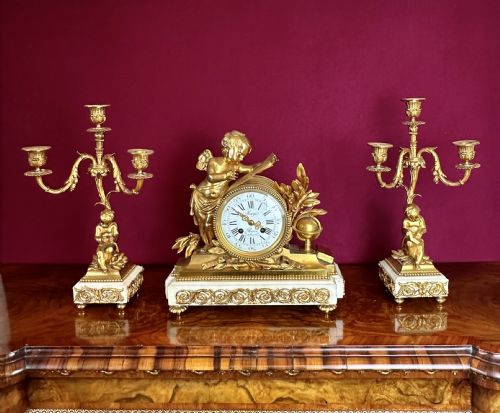
An antique three piece garniture consists of a central timepiece flanked by two matching ornamental pieces such as candelabra, urns, or vases. These decorative suites emerged primarily during the nineteenth century to create symmetry on drawing room mantelpieces and sideboards.
The most common configurations on this page combine a clock with a pair of matching candelabra or vases. These sets draw heavily on French design vocabularies, ranging from ornate Rococo revival curves to restrained neoclassical symmetry.
Materials and construction
Maker workshops utilised substantial natural stones including white marble, black slate, onyx, and grey breccia marble for the architectural bodies of the clocks and side pieces. These heavy stone mounts frequently combine with cast bronze, brass, or ormolu mounts.
Surface decoration incorporates gilt bronze, silver plating, hand-painted porcelain panels, and enamel details. Many pieces employ cast patinated bronze figures or mounts fixed securely to stone bases.
Listings feature periods spanning from the eighteenth century through the Art Deco era, utilising marble, bronze, porcelain, and slate.
Assessing quality and execution
Superior examples display crispness in the metal casting and chasing, where foliage, figures, and scrollwork retain sharp relief rather than soft edges. The weight and selection of the stone body, such as unblemished marble or dense onyx, also signal higher grade production.
Integration between the central clock and the flanking side pieces distinguishes finer suites. When the mounts, proportions, and decorative motifs match with absolute precision, the garniture succeeds as a unified interior ornament.
Ferdinand Berthoud·Japy Freres
The Antique Three Piece Garniture Glossary
- Garniture
- A set of matching decorative objects designed to be displayed together on a mantelpiece or sideboard, typically comprising a clock and two side pieces.
- Ormolu
- Gilded bronze created through a mercury amalgamation process, producing a rich gold-coloured surface finish on decorative mounts.
- Candelabra
- Branched candlesticks designed to hold multiple candles, frequently used as the flanking components in a three-piece clock set.
- Breccia marble
- A composite stone made of broken fragments cemented together in a fine-grained matrix, creating a distinctive mottled surface pattern.
- Spelter
- A zinc alloy frequently cast as a cost-effective alternative to bronze and then painted or bronzed to simulate heavier metal.
Antique Three Piece Garniture: Frequently Asked Questions
What is an antique three piece garniture?
A three-piece garniture is a matched decorative set designed for display, typically featuring a central mantel clock accompanied by two identical side ornaments such as candelabra or vases.
These suites were arranged on mantelpieces to create visual balance and symmetry in formal nineteenth-century interiors.
How were garniture sets used?
Garniture sets functioned primarily as decorative centerpieces for the hearth, placing a working clock between matching candle holders or ornamental vessels.
They served as status symbols in period drawing rooms, reflecting the owner's taste through elaborate materials like marble, bronze, and porcelain.
How do I date a garniture clock?
Dating relies on stylistic clues, materials, and mechanical signatures. Neoclassical and Empire designs point towards the earlier nineteenth century, while slate and onyx bodies often indicate later Victorian production.
Maker signatures on the clock movement or bronze mounts also provide direct chronological reference points.
How do I clean marble and ormolu?
Cleaning requires gentle methods that protect delicate gilt surfaces and porous stone. Dusting with a soft dry cloth prevents grime buildup without risking abrasion to the metal gilding.
Harsh chemical cleaners should be avoided entirely, as they strip the historical patination and damage the protective lacquer on bronze mounts.