


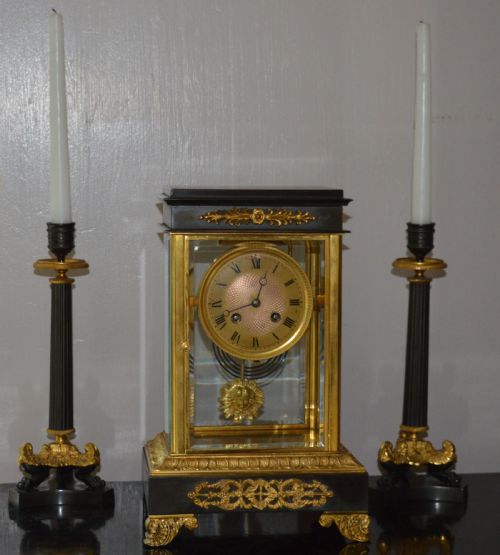

Napoleon III Clock Garniture
A napoleon iii clock garniture brings the opulent brass, marble and gilt bronze of the Second Empire straight onto the mantelpiece.
Napoleon III Clock Garniture
A napoleon iii clock garniture is a matching set composed of a central mantel clock accompanied by matching sidepieces such as urns or candelabra. These matched assemblies dominate the nineteenth century selection, arriving from French workshops in combinations of three matching units.
The dominant forms span mantel clocks, clock garniture sets, and four glass clocks paired with matching side ornaments. Buyers encounter nineteenth century items, Victorian entries, and specific dates like eighteen seventy or eighteen eighty.
Origins remain firmly French, with styles reflecting the Napoleon III, French Empire, and French Rococo Revival aesthetics. Pieces frequently incorporate Sevres style porcelain, enamel dials, and glass domes protecting the entire display.
How they were made
Maker workshops utilised heavy casting methods to shape ormolu, gilt bronze, and standard bronze into elaborate mounts and figures. These metal elements were frequently gilded to achieve the bright metallic sheen characteristic of the period.
Listings feature nineteenth century periods, incorporating materials such as ormolu, gilt bronze, enamel, glass, brass, porcelain, marble, and bronze across French styles.
What varies in quality
Quality separates through the crispness of the bronze casting and the depth of the subsequent gilding. Superior examples display sharply chased detailing on metal mounts, whereas simpler versions rely on softer definition and flatter surfaces.
The choice of materials dictates the upper tier of the range, particularly solid marble or onyx bodies combined with hand painted Sevres porcelain panels. Secondary pieces utilise simpler brass or standard glass enclosures without the ornate ceramic decoration.
The Napoleon III Clock Garniture Glossary
- Garniture
- A set of ornamental objects designed to match and sit alongside a central mantel clock. These sidepieces usually take the form of urns, vases, or candelabra.
- Ormolu
- Gilding technique involving finely ground high-carat gold applied to a bronze base. This process creates a rich golden finish typical of nineteenth century French decorative arts.
- Sevres style
- Ceramic decoration mimicking the soft paste porcelain produced by the royal French factory. Items feature painted panels, often depicting pastoral scenes framed by gilded borders.
- Four glass clock
- Mantel timepiece housed in a brass or gilt bronze frame with glass panels on all four sides. This construction allows light to pass through and reveals the movement inside.
- Enamel dial
- Clock face formed by fusing powdered glass onto a metal plate at high temperatures. Numbers and markings are painted onto the smooth vitrified surface.
Napoleon III Clock Garniture: Frequently Asked Questions
What is a clock garniture?
A clock garniture is a matched set consisting of a central mantel clock and two matching side ornaments. These pieces were designed to be displayed together on a mantelpiece or sideboard.
The matching sidepieces typically take the form of urns, vases, or candelabra that echo the decorative motifs and materials of the clock itself.
How do I clean ormolu?
Ormolu requires gentle dusting with a soft, dry brush to prevent the accumulation of dirt in the recesses of the casting. Moisture and commercial metal polishes should be avoided.
Harsh chemical cleaners strip away the thin layer of gold gilding. Professional conservation advice is recommended if deeper cleaning becomes necessary.
Where were these clocks made?
These clock sets originated in France during the nineteenth century, particularly within the Second Empire and Napoleon III periods. Parisian workshops produced the majority of these gilt bronze and marble assemblies.
Stylistic influences often draw from earlier French Empire and Rococo Revival traditions. Many pieces incorporate porcelain elements inspired by the Sevres factory.
How do I protect glass domes?
Glass domes require stable placement away from high traffic areas and edges of furniture where accidental knocks might occur. Lifting the dome should be done using both hands beneath the base.
Standard glass cleaner applied to a cloth rather than sprayed directly avoids moisture seeping onto the antique base or clock mechanism. The glass can then be wiped clean gently.