


Antique Schoolhouse Clock
An antique schoolhouse clock delivers the robust utility of public timekeeping straight to a domestic wall with enduring authority.
Antique Schoolhouse Clock
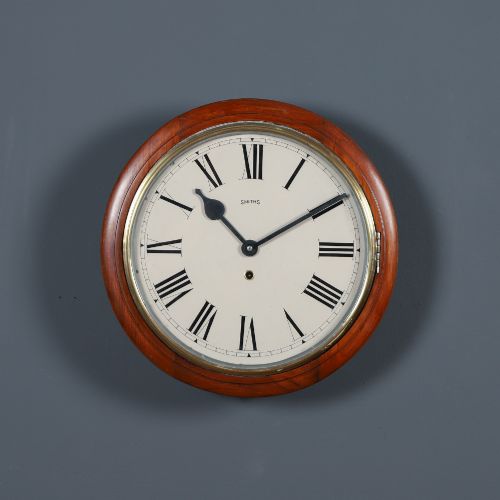
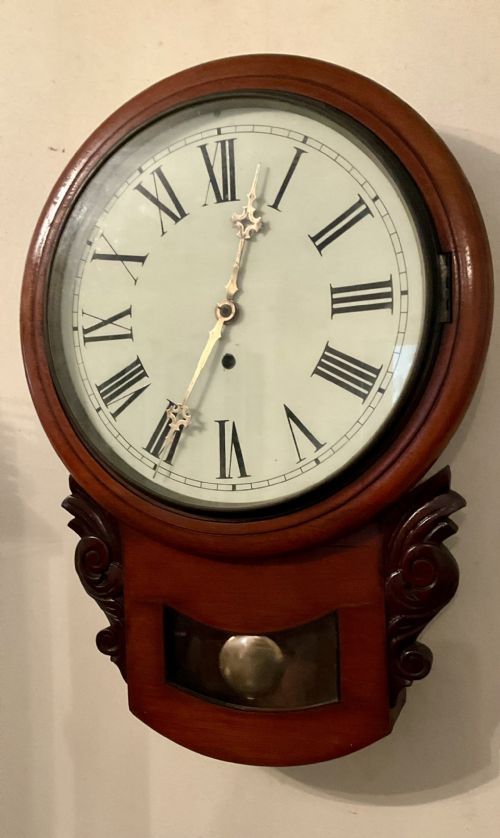
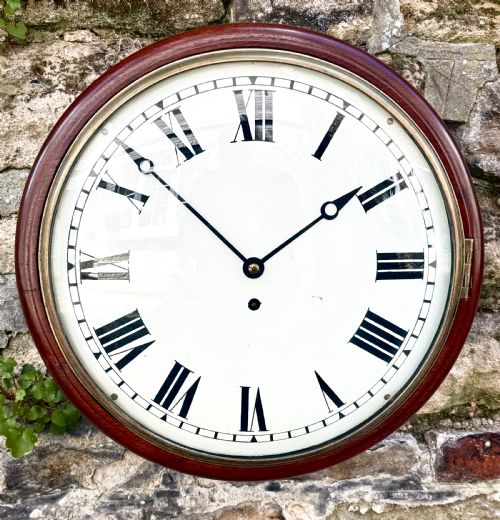
An antique schoolhouse clock is a wall-mounted timepiece designed for institutional legibility, characterised by a bold round dial and often a lower drop-case for the pendulum. You will frequently meet mahogany and oak cased examples on this page, originating from the nineteenth and early twentieth centuries.
The selection here encompasses both English fusee movements and American eight-day mechanisms, alongside utilitarian specimens marked by railway, postal, or municipal service. These pieces bridge domestic comfort with civic purpose, offering a commanding visual presence in any room.
Materials and construction
Cabinetmakers housed these movements in robust timber cases, predominantly utilising rich mahogany and light oak, paired with glazed bezels to protect the paper or painted dials. Brass components underpin the intricate fusee and gear mechanisms that regulate the swing.
Dial faces combined painted wood or metal with clear Arabic or Roman numerals, designed to be read from across a large room. Iron and glass reinforced the structural integrity of these heavy wall pieces.
Listings feature mahogany and oak cases housing nineteenth and twentieth century fusee and eight-day movements behind glass dials.
Judging quality in dial clocks
Quality rests heavily on the sophistication of the movement inside, where a well-maintained fusee mechanism ensures steady power delivery compared to simpler spring-driven alternatives. The crispness of the timber framing and the preservation of the original painted dial further separate standard utility pieces from finer examples.
Maker signatures inscribed upon the dial or movement add a layer of distinction, tying the clock to notable regional clockmakers or institutional contractors. The integrity of the wood case, free from excessive adaptation, dictates the overall architectural merit.
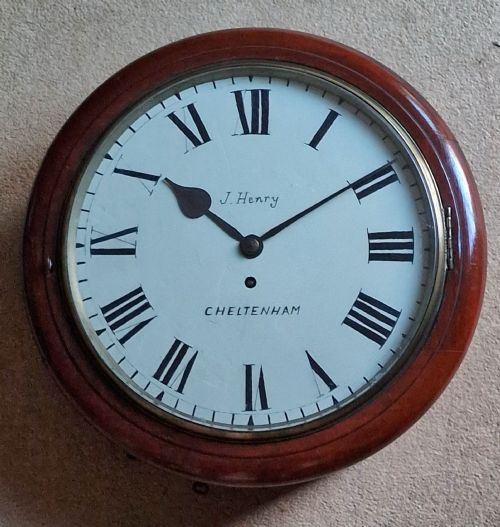
J Henry Cheltenham·Payne of Tunbridge Wells·Smiths
The Antique Schoolhouse Clock Glossary
- Fusee
- A conical pulley used in better quality clocks to maintain an even pull on the movement as the mainspring unwinds. This clever device compensates for the decreasing power of a relaxing spring.
- Drop dial
- A clock case featuring an extended lower portion designed to house the swinging pendulum below the main dial. This configuration became standard for municipal and railway timepieces.
- Timepiece
- A clock that tells the time without a striking mechanism for the hours. Most wall-mounted station and school clocks were built solely as timepieces for straightforward utility.
- Dial
- The visible face of the clock where the numbers and hands are displayed. On these wall clocks, dials are protected by hinged glass bezels in brass or wooden rims.
Antique Schoolhouse Clock: Frequently Asked Questions
What defines a schoolhouse clock?
A schoolhouse clock is generally recognised by its simple wall-mounted wooden case, clear circular dial, and often a drop-down lower body enclosing the pendulum. They were built for legibility and reliability in public buildings.
These clocks strip away superfluous ornamentation in favour of stark utility, making them versatile for modern domestic interiors while retaining their institutional pedigree.
How do fusee movements work?
A fusee movement uses a conical drum and a cord or chain to equalise the force of the mainspring as it runs down. This ensures the clock maintains consistent accuracy throughout its running cycle.
Clocks equipped with this mechanism represent a higher standard of clockmaking craftsmanship compared to standard spring-driven alternatives.
Where were these clocks originally used?
These wall clocks served in institutional spaces such as railway stations, government offices, postal sorting rooms, and classrooms. Their primary function was keeping coordinated time for the public and workers.
Today, hanging one in a hallway or kitchen carries that legacy of functional punctuality into a residential setting.
How do I wind a wall clock?
Winding involves inserting a key into the winding hole on the dial face and turning it gently until the spring reaches full tension. Care must be taken not to overwind the mechanism.
Regular winding ensures the pendulum maintains its steady beat and the movement keeps accurate time.