
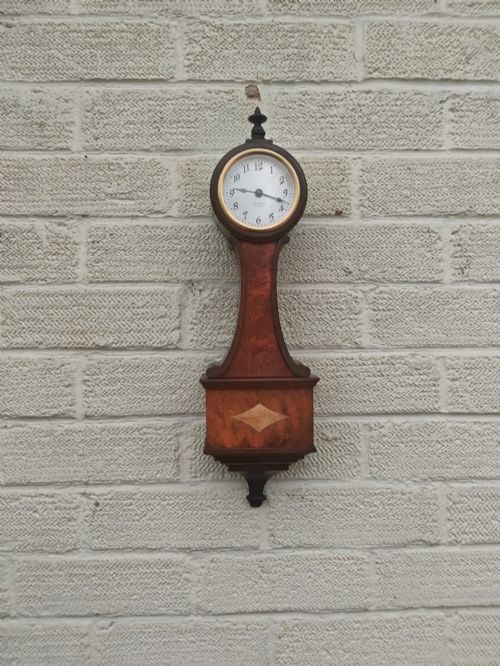
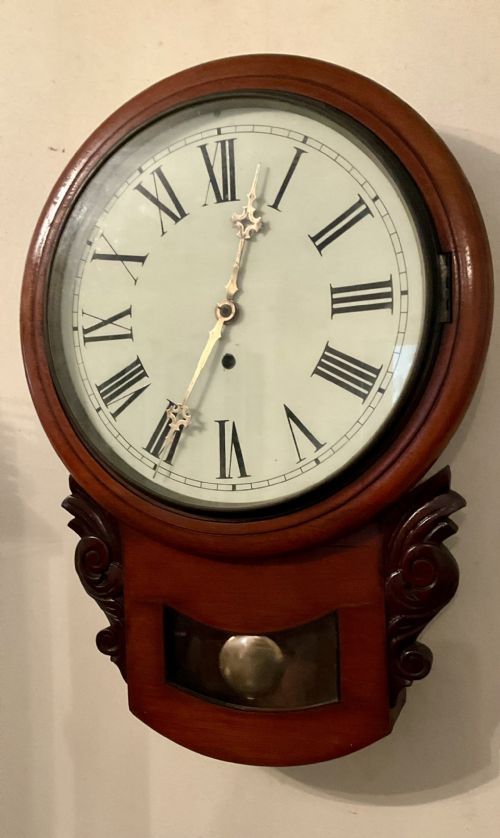


8 Day Wall Clock
An 8 day wall clock organises time by requiring winding only once a week, combining practical utility with refined cabinet-making.
8 Day Wall Clock
An 8 day wall clock is a timekeeping device designed to run for eight days on a single winding, freeing the owner from daily maintenance. Buyers seeking an 8 day wall clock encounter diverse regional forms, from British fusee dial clocks to Austrian weight-driven Vienna regulators.
The selection ranges from robust nineteenth-century mahogany drop dial pieces to striking Art Deco walnut designs and industrial railway timepieces. Victorian variants predominate, often featuring brass bezels and painted circular dials intended for domestic or commercial interiors.
Materials and construction
Cabinet makers utilised dense hardwoods such as mahogany, walnut, and oak to house the brass gear trains, often applying ebonised finishes or carved decorative details. Dial surrounds incorporated glass panels, cast brass bezels, and silvered or enamelled metal faces marked with Roman or Arabic numerals.
Movements relied on either weight-driven gravity or spring-driven power, transmitted through chains, cords, or fusee cones to maintain even tension. Railway and utility pieces integrated simpler metal cases with wooden or painted panels suited to heavy usage.
8 Day Wall Clock Retail Price Guide 2026
Typical asking prices for 8 day wall clock among the pieces listed under this phrase on Sellingantiques today, from the lower quarter to the upper quarter. They describe what is for sale here now, not the wider market.
Signal box clocks worked hard on the railways, timing steam locomotives while station masters boiled their kettles.
Variations in quality
Quality rests primarily in the precision of the movement and the integrity of the timber housing, where secondary pine or deal linings meet select mahogany or figured walnut veneers. Finely executed brass gear trains, signed backplates by known makers, and well-proportioned drop dial cases distinguish superior examples from utilitarian pieces.
The legibility and original condition of the dial face, alongside crispness in the wood carving or brass casting, mark the distinction between standard production items and master horological work.
Dent of London·Smith·Gustaf Becker·Thwaites and Reed·Junghans
The 8 Day Wall Clock Glossary
- Fusee
- A conical pulley used in clock movements to maintain equal force on the gear train as the mainspring unwinds. This mechanism ensures more accurate timekeeping throughout the eight-day cycle.
- Drop dial
- A wall clock configuration where the circular dial sits above an extended wooden box or trunk that houses the pendulum. This form became particularly popular in nineteenth-century British public and domestic spaces.
- Vienna regulator
- A precision timepiece developed in Austria, driven by hanging weights visible behind a glazed door. These clocks are known for their slender wooden cases and accurate movement.
- Timepiece
- A clock that indicates the time without striking bells or gongs on the hour. Such movements focus purely on tracking hours and minutes.
- Grandfather or Grandmother longcase clock
- A tall floor-standing timepiece enclosing weights and a pendulum within a wooden case. Though distinct from wall clocks, similar movements and dial configurations appear across both formats.
8 Day Wall Clock: Frequently Asked Questions
How often do I need to wind it?
These movements require winding once every eight days using a specialised key that fits the winding squares on the dial face. Regular winding maintains steady tension on the mainspring or weights to keep accurate time.
Neglecting to wind the clock before the eight days elapse simply lets it stop safely without causing mechanical harm to the gear train.
Where should I hang a heavy wall clock?
Mount the clock directly onto a solid wall stud or masonry anchor capable of supporting the combined weight of the hardwood case and movement. Secure fixing prevents vibrations from the wall from interfering with the delicate swing of the pendulum.
Positioning the piece away from direct sunlight and damp areas preserves the polished wood veneer and paper or enamel dial surfaces.
Why does my clock have a slow and fast adjuster?
The small regulation square on the dial face alters the effective length of the pendulum or the balance spring to correct timing gains or losses. Turning the key slightly shifts the regulating mechanism to speed up or slow down the beat.
Allow the clock to run for a full week after adjustment before making further minor corrections.