


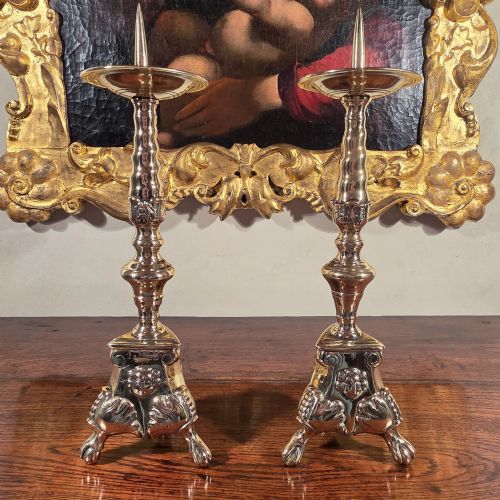
Antique Pricket Holders
Antique pricket holders are spike-topped candle supports designed to secure tapers in churches and homes, offering centuries of ecclesiastical and domestic illumination.
Antique Pricket Holders
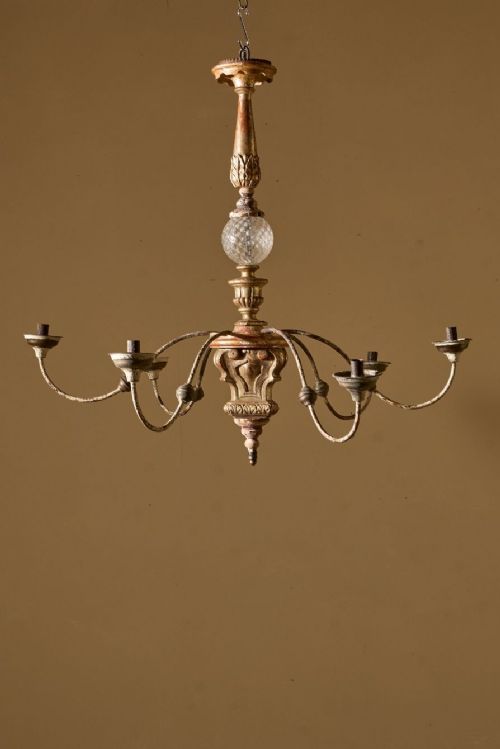
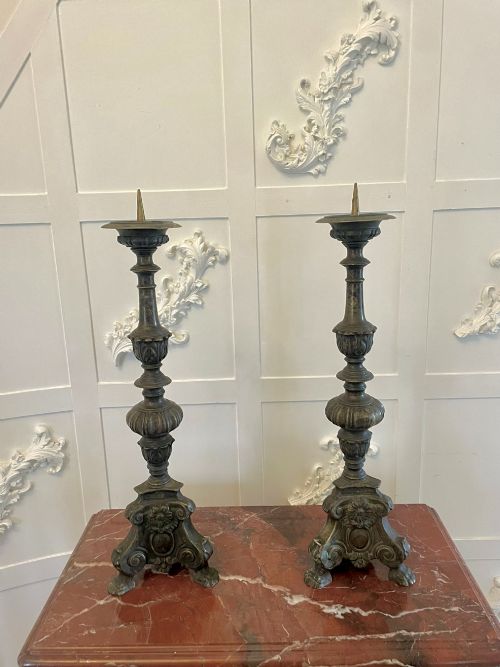
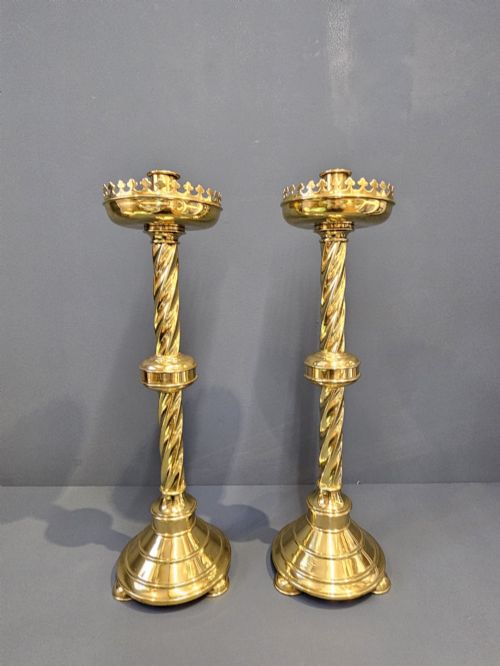
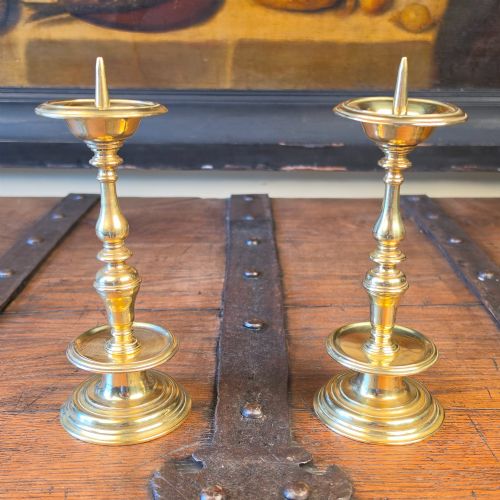
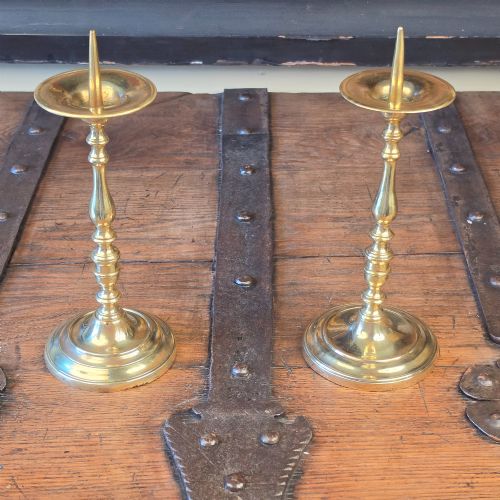
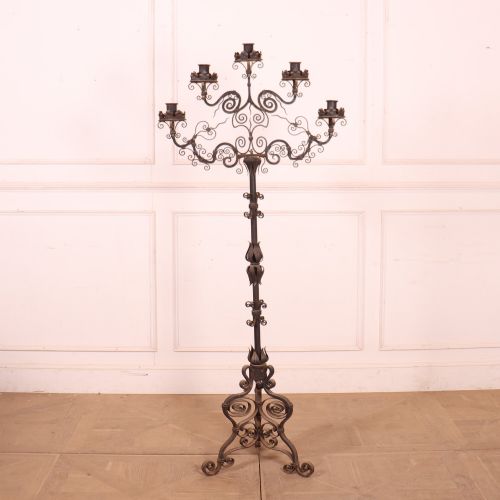
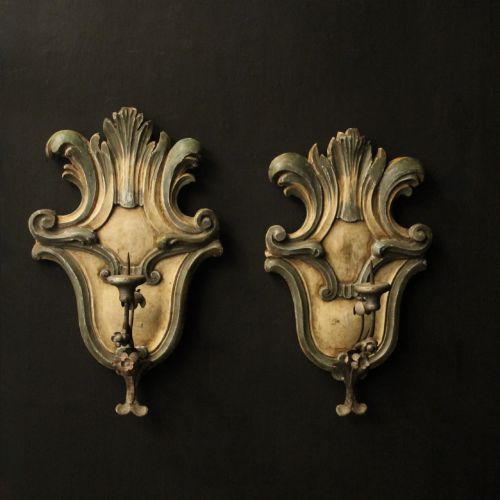
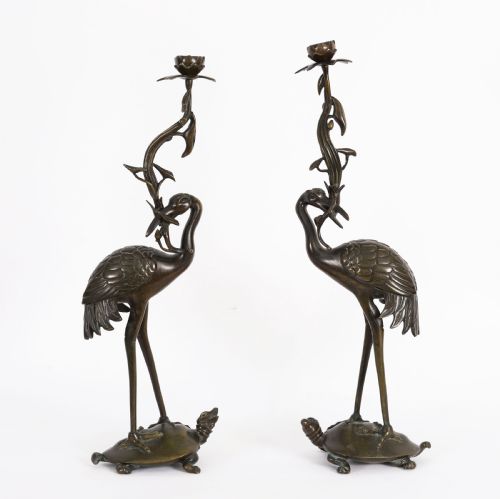
Antique pricket holders encompass a variety of altar pieces, church candlesticks, wall sconces, and floor-standing torcheres that utilise a vertical central spike to hold candles in place rather than a socket. When searching for antique pricket holders, collectors encounter items ranging from modest domestic table pieces to large ecclesiastical furnishings created for liturgical settings.
The material origins span continental European workshops and domestic production, with many examples originating from Italy, the Netherlands, and Britain. Pieces on this page represent periods extending from the seventeenth century through the Victorian era and into the early twentieth century.
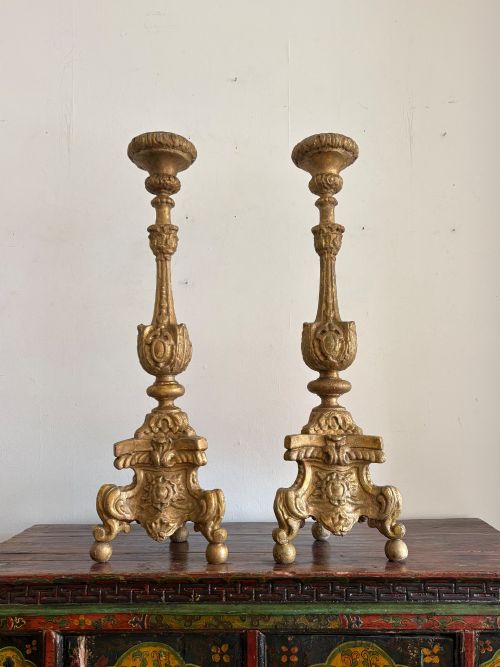
Forms vary from compact desk stands to monumental floor standards, including paired church altar sticks and chandelier configurations. The overarching design centres on the upright spike, a practical medieval adaptation that persisted across Baroque, Gothic Revival, and Amsterdam School aesthetics.
How they were made
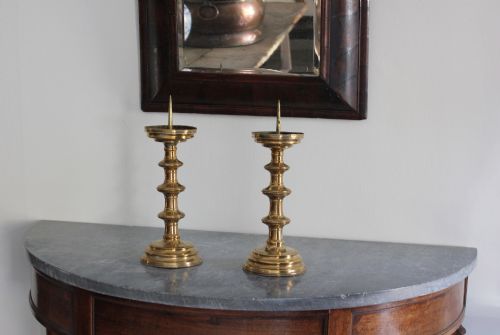
Metal examples rely on foundry casting and hand-finishing, primarily utilising brass, bronze, copper, and iron. Artisans shaped molten metal into sockets, drip pans, and shafts, often incorporating patinated or gilt surfaces to catch the flickering light.
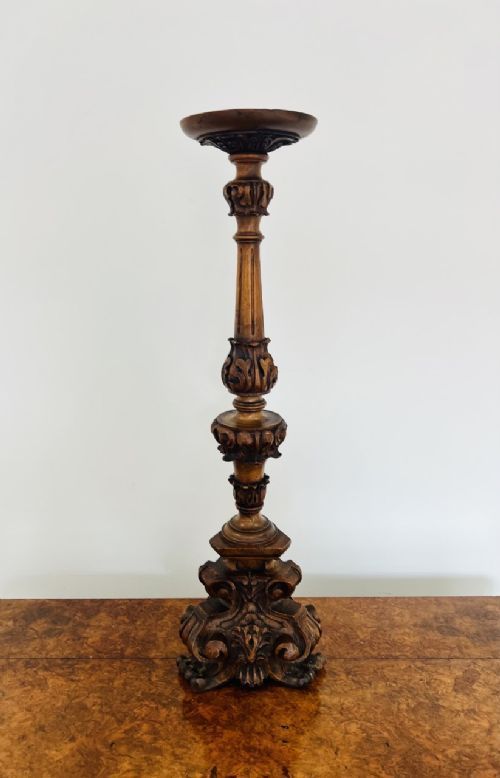
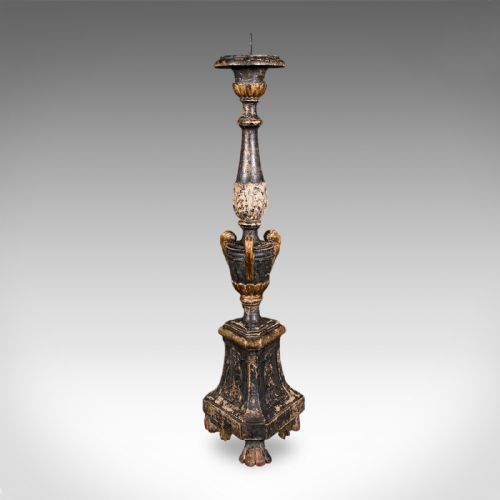
Wooden pieces demonstrate traditional carpentry and joinery, employing carved walnut, pinewood, treen, and fruitwood. These timber supports frequently received gesso, silver leaf, or polychrome paint applications to mimic more costly materials or to align with ecclesiastical decor.
Construction techniques combine structural ironwork with decorative wood carving or cast metal elements, particularly in floor-standing torcheres and heavy church furnishings. Individual components were turned on lathes or forged by hand before assembly into the final silhouette.
Listings feature items spanning the seventeenth to the twentieth centuries, utilising brass, bronze, iron, and carved wood across diverse styles.
What varies in quality
The calibre of an antique pricket holder depends significantly on the crispness of the casting in metalwork or the depth and precision of hand-carving in wooden examples. Superior specimens retain their original surface treatments, whether fire gilding, early patination, or original polychrome paint.
Proportion and scale dictate the architectural presence of larger floor standards and altar sticks, where balanced turning and substantial weight denote superior workshop output. Secondary details, such as the shaping of the drip pan and the integration of the central spike, reveal the maker's competence.
Provenance and stylistic purity distinguish standard ecclesiastical production from exceptional artistic output, particularly in pieces bearing distinct regional characteristics like Amsterdam School metalwork or Italian Baroque giltwood.
The Antique Pricket Holders Glossary
- Pricket
- A sharp vertical spike fitted to the top of a candlestick to impale and secure a candle. This form predates the standard socket cup.
- Torchere
- A tall decorative stand or candlestick designed to support a light source at an elevated position. These pieces often feature carved wooden columns or forged iron shafts.
- Altar candlestick
- A large ecclesiastical candle holder placed upon or near a church altar, frequently produced in matched pairs. They often display elaborate Baroque or Gothic Revival ornamentation.
- Giltwood
- Timber that has been coated with a thin layer of gold leaf or powder. This finish was widely utilised on church furnishings to create a luxurious appearance under candlelight.
- Drip pan
- A wide collar or tray positioned beneath the candle spike to catch melting wax. This feature protects the shaft and underlying surfaces from wax accumulation.
Antique Pricket Holders: Frequently Asked Questions
How do I use an antique pricket holder?
Using a pricket holder requires a candle with a matching base indentation or a soft enough base to be pressed gently onto the upright metal spike. The spike holds the wax taper steady during burning.
Because these pieces lack modern drip sockets, placing a protective mat underneath helps catch any wax run-off during use.
What is the difference between a socket and a pricket?
A socket candlestick cups the base of the candle to keep it upright, whereas a pricket employs a sharp spike that pierces the candle from below. Prickets represent an older technology traditional in medieval and ecclesiastical lighting.
Many church and altar pieces retained the pricket design long after domestic candlesticks transitioned to sockets.
How do I clean an antique brass pricket?
Dusting with a soft, dry cloth preserves the historical patina and accumulated age of antique metalwork. Avoid harsh chemical polishes that strip away desirable surface oxidation.
Gentle cleaning maintains the integrity of the metal while removing surface debris safely.
Where were pricket holders originally placed?
Pricket holders historically stood on church altars, within chapels, and on large tables in wealthy domestic halls. Floor-standing versions illuminated chancels and grand room corners.
Their substantial scale reflected their primary function as important sources of ecclesiastical and domestic illumination.