


Antique Plique a Jour
These antique plique a jour pieces capture light through translucent enamel cells like stained glass held in miniature.
Antique Plique a Jour
Antique plique a jour jewellery and decorative objects bring together delicate metal frameworks and suspended coloured enamel without a solid backing. When you search for antique plique a jour, you encounter pendants, brooches, necklaces, charms, and decorative bowls spanning from the late nineteenth century into the twentieth.
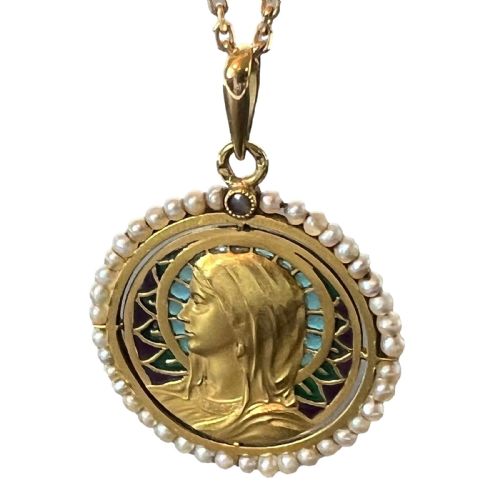
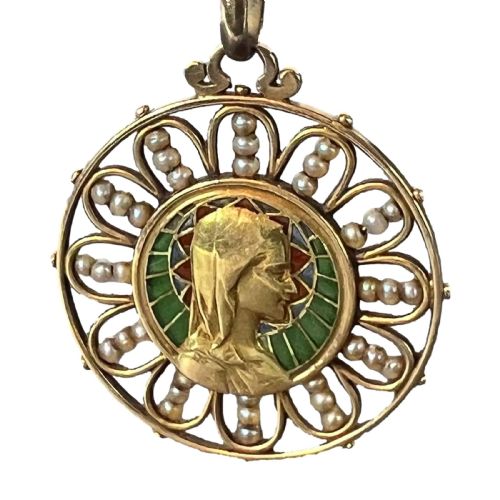
The pieces on this page lean heavily into the organic curves of Art Nouveau and Jugendstil, alongside French religious medals and Arts and Crafts designs. Pendants form the largest share of what you see here, often depicting floral motifs, butterflies, or religious figures framed in gold or silver.
How they were made
Craftsmen built these items by soldering thin wires to a metal base to form compartments, applying vitreous enamel into each open cell, and firing the piece. Once the coloured glass melted and cooled, the temporary backing was removed or etched away so light could pass directly through the translucent enamel.
Makers set these translucent panels in 18k yellow gold, silver gilt, and silver, frequently accentuating the metalwork with pearls, seed pearls, diamonds, peridot, amethyst, chrysoprase, and citrine.
Gemstones paired with the enamel work include pearls, diamonds, amethysts, peridot, and chrysoprase.
What varies in quality
The distinction between average and exceptional pieces rests upon the precision of the wirework and the clarity of the fired enamel. Superior examples maintain intact enamel membranes across wide cells without cloudiness or accidental opaque spots.
The choice of accompanying gemstones and the complexity of the figural or botanical design elevate certain items. Pieces signed by notable workshops demonstrate finer metal gauge control and more balanced colour distribution across the translucent panels.
Heinrich Levinger·Meyle and Mayer·Eduard Loss·Martin Mayer·Ludwig Knupfer·Theodor Fahrner·Liberty and Co·Sellier·Monier
The Antique Plique a Jour Glossary
- Plique-a-jour
- An enamelling technique resembling miniature stained glass where transparent enamel fills open wire cells without a metal backing. Light shines directly through the coloured glass.
- Vitreous Enamel
- Glass powder fused to metal through high-temperature firing. It provides the translucent colour in these antique designs.
- Silver Gilt
- Silver coated with a thin layer of gold. This finish adds warmth to the metal framework supporting the enamel.
- Jugendstil
- The German and Central European variant of Art Nouveau. It shares the flowing, nature-inspired lines seen in French pieces of the same era.
Antique Plique a Jour: Frequently Asked Questions
How do I clean antique plique a jour enamel?
Clean these delicate items gently with a soft cloth and lukewarm water, avoiding harsh chemical dips or ultrasonic cleaners that can fracture the unsupported enamel cells.
Dry the piece thoroughly immediately after wiping to protect the surrounding gold or silver settings from moisture damage.
Can I wear plique a jour jewellery every day?
These items require careful handling because the suspended enamel lacks a solid backing and can crack under sharp impacts or pressure.
Reserve them for occasional wear and store them in individual padded boxes away from heavier jewellery.
How can I tell Art Nouveau pieces from later periods?
Art Nouveau and Jugendstil creations from around nineteen hundred rely on asymmetrical, flowing lines derived from plant stems, insect wings, and female hair.
Later decades introduced more geometric frameworks and simplified motifs that depart from organic curves.
What metals were typically used for these settings?
Goldsmiths and silversmiths utilised eighteen karat yellow gold, silver, and silver gilt to frame the translucent enamel panels.
Gold appears frequently in French religious pendants, while silver and silver gilt support many German and English designs.