


Plique a Jour Jewellery
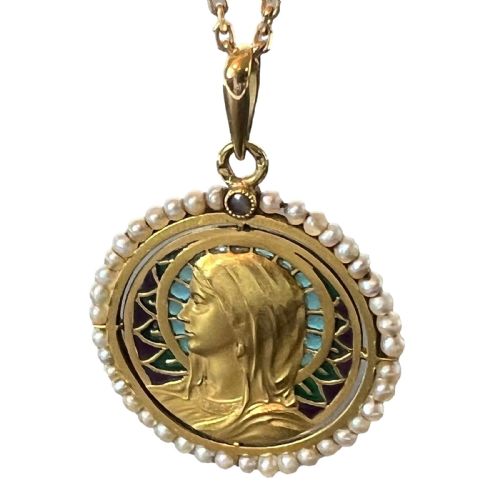
Plique a jour jewellery brings together translucent enamel and delicate metalwork to let light pass directly through the design.
Plique a Jour Jewellery
Plique a jour jewellery comprises pendants, brooches, necklaces, and charms produced primarily during the early twentieth century. Pieces matching this search span the Art Nouveau, Jugendstil, French Art Nouveau, and Arts and Crafts styles, reflecting a period of highly decorative metalwork.
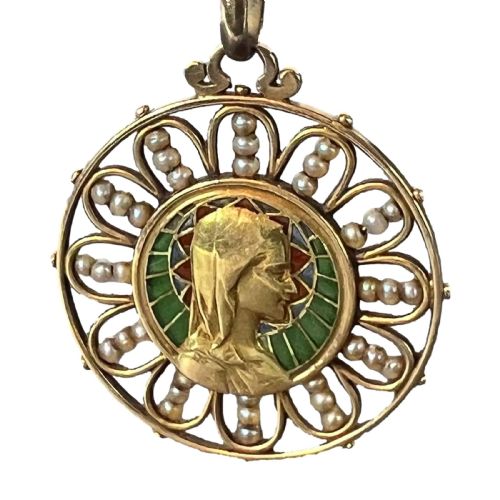
The work frequently pairs the distinctive stained glass effect of translucent enamel with settings of seed pearls, peridot, amethyst, citrine, chrysoprase, and diamonds. Examples range from French devotional medals to English Arts and Crafts designs.
How they were made
Makers constructed these pieces using vitreous enamel suspended within open wirework cells, omitting a backing metal plate to allow light to pass through the coloured glass. Frameworks were fashioned from silver, silver gilt, and yellow gold.
Designs were frequently enhanced by mounting gemstones such as pearls, seed pearls, peridot, amethyst, citrine, chrysoprase, and diamonds directly into the precious metal mountings alongside the translucent enamel panels.
Plique a Jour Jewellery Retail Price Guide 2026
Typical asking prices for plique a jour jewellery among the pieces listed under this phrase on Sellingantiques today, from the lower quarter to the upper quarter. They describe what is for sale here now, not the wider market.
Listings span four distinct decades from nineteen hundred to nineteen thirty, incorporating silver, gold, and vitreous enamel.
What varies in quality
Quality varies according to the precision of the metal cells and the clarity of the translucent enamel filling them. Superior examples display even thickness across the enamel windows and secure setting of accompanying pearls and gemstones.
The sophistication of the design and the prestige of the maker or workshop influence the standing of an item. Pieces bearing documented attributions to notable firms command particular attention.
Levinger and Bissinger·Heinrich Levinger·Meyle and Mayer·Eduard Loss·Martin Mayer·Theodor Fahrner·Liberty and Co
The Plique a Jour Jewellery Glossary
- Plique a jour
- An enamelling technique where enamel is applied in cells without a backing, resembling miniature stained glass. This method allows light to shine straight through the coloured material.
- Art Nouveau
- A decorative style prevalent around nineteen hundred characterised by fluid, organic lines and floral motifs. Much of the jewellery in this category adopts these sinuous natural forms.
- Silver gilt
- Silver that has been coated with a thin layer of gold. This treatment provides the warmth of gold while maintaining a silver base metal structure.
- Vitreous enamel
- A material made by fusing powdered glass to a metallic substrate through firing. In these pieces, it forms the translucent panels held within the wire framework.
- Seed pearl
- A very small, naturally occurring pearl often used as accent decoration in cluster settings. They appear frequently alongside enamel panels in pendants and brooches.
Plique a Jour Jewellery: Frequently Asked Questions
What is plique a jour jewellery?
Plique a jour jewellery is ornamental work featuring vitreous enamel set without a backing, creating a translucent effect similar to stained glass. The technique lets light pass through the coloured sections.
Items in this group primarily date from the early twentieth century and include pendants, brooches, charms, and necklaces executed in silver and gold.
How should I wear a pendant?
These pendants are typically suspended from fine metal chains that complement the silver or gold framework of the piece. Because the enamel relies on transmitted light to show its colour fully, wearing them against lighter fabrics often enhances their visual depth.
Care should be taken to avoid impact against hard surfaces, as the openwork enamel construction lacks a solid metal backing for structural support.
How can I identify Art Nouveau pieces?
Art Nouveau examples are marked by flowing organic lines, natural forms such as flowers and insects, and symmetrical or asymmetrical botanical motifs. These characteristics reflect the dominant design ethos around nineteen hundred.
Makers from this period often combined the distinctive enamel work with cabochon stones, pearls, and stylized figurative subjects.
What periods do these pieces come from?
The available items span the early decades of the twentieth century, with production dates concentrated around nineteen hundred, nineteen ten, nineteen twenty, and nineteen thirty.
Styles shift from continental Art Nouveau and Jugendstil to British Arts and Crafts and later French devotional jewellery, all utilising the same characteristic enamelling method.