


Art Nouveau Amethyst Necklace
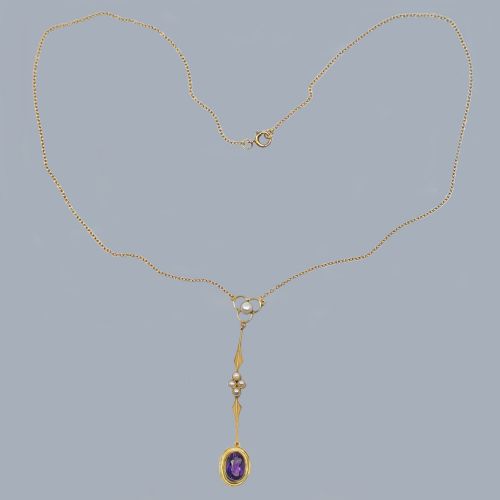
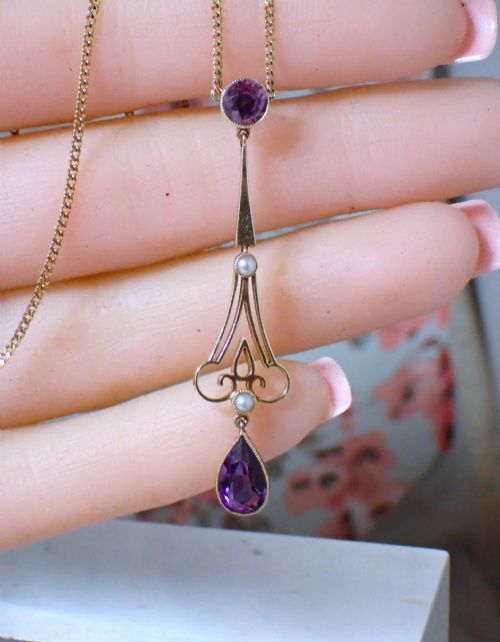
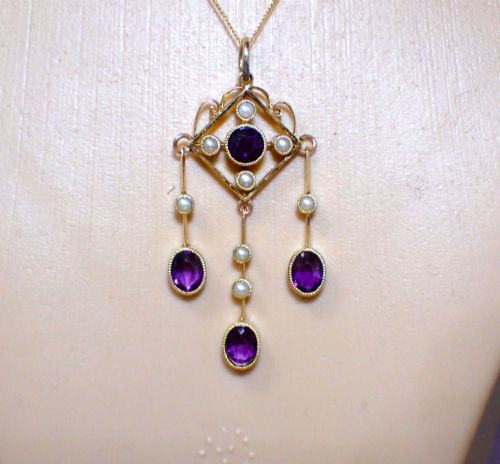
An art nouveau amethyst necklace brings organic curves and deep purple stones together, offering the fluid metalwork typical of the early twentieth century.
Art Nouveau Amethyst Necklace
An art nouveau amethyst necklace combines the sweeping, nature-inspired lines of the turn of the twentieth century with the rich violet tones of quartz. These pieces appear primarily from the decades around nineteen hundred, alongside Edwardian and Arts and Crafts examples.
The dominant forms on this page include pendant necklaces, lavalieres, and festoon designs set in yellow gold or silver. Many incorporate seed pearls alongside the central amethyst to contrast the purple stone with soft lustre.
Makers working within these styles utilised silver and gold to frame amethysts in asymmetrical or fan motifs. Buyers encounter both delicate daily wear pieces and elaborate enamelled works.
How they were made
Goldsmiths worked with nine carat and fifteen carat yellow and rose gold, alongside silver and silver gilt, shaping metal into whiplash curves and floral drops. Stones were hand-set into collets or bezels that followed the natural contours of the design.
Pearls and seed pearls were drilled and strung or pegged onto wire frames, while enamel workers applied plique-a-jour and guilloche techniques to catch the light behind translucent colour. Amethysts were typically cut as oval or cushion stones to maximise depth of hue.
An eighteenth-century superstition held that amethysts kept the wearer clear-headed, which explains why Victorian and Edwardian revivals used them so freely.
What varies in quality
The sophistication of the metalwork distinguishes standard production from finer studio output, particularly where hand-chasing and organic symmetry define the pendant drop. Heavier fifteen carat gold mounts and intact enamel panels indicate higher original tier pieces.
The saturation and cut of the amethyst itself alter the visual impact, alongside the matching and survival of delicate seed pearls. Maker attribution, such as work by Eduard Loss or Georg Jensen, raises the distinction of a piece.
Eduard Loss·Georg Jensen
The Art Nouveau Amethyst Necklace Glossary
- Lavaliere
- A pendant necklace featuring a central drop that suspends further stones or motifs below the main line. This style became popular during the Edwardian period.
- Plique-a-jour
- An enamelling technique where pigment is fired without a backing, creating a translucent, stained-glass effect that lets light pass through the metal cells.
- Seed pearl
- A very small, naturally formed or cultured pearl used in clusters or fringes. These accent stones are frequently found bordering amethysts in period pendants.
- Festoon
- A necklace design featuring draped chains, swags, or suspended elements that sit across the collarbone. This arrangement often incorporates multiple gemstones and pearls.
Art Nouveau Amethyst Necklace: Frequently Asked Questions
What is an art nouveau amethyst necklace?
These pieces are period items from around nineteen hundred featuring flowing, organic metalwork paired with purple quartz crystals. They reflect the design movements that rejected rigid industrial symmetry in favour of natural forms.
Collectors find them mounted in yellow gold or silver, frequently accompanied by pearls or enamel work. They represent a distinct shift in jewellery design toward artistic expression.
How do I care for an antique gold necklace?
These items require gentle handling due to their age and the delicate nature of seed pearls or enamel. Store them flat in a lined box to prevent chain kinks and stone friction.
Cleaning should involve only a soft, dry cloth rather than harsh chemical dips that might damage softer stones or fragile metal gilt.
How do I distinguish Edwardian from art nouveau pieces?
Edwardian jewellery often relies on platinum or white gold with lighter, lace-like diamond work, while art nouveau focuses on organic plant motifs and coloured stones like amethyst in yellow gold or silver.
Many pieces overlap in style and date, combining Edwardian refinement with the flowing curves characteristic of the turn of the century.
Can I wear an antique necklace daily?
Daily wear is possible with careful attention, though delicate festoon chains and seed pearls need protection from heavy impact. Ninth and fifteenth carat gold mounts offer durability for regular use.
Owners should remove such items during vigorous activity or sleep to preserve the original settings and delicate drops.