






Antique Persia Saddle Bag
An antique persia saddle bag carries the nomadic history of weavers across southern and western regions in durable wool and natural dyes.
Antique Persia Saddle Bag
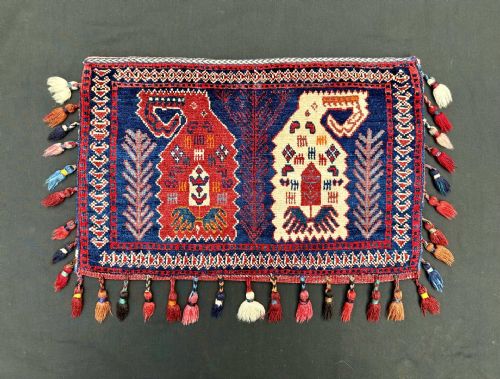
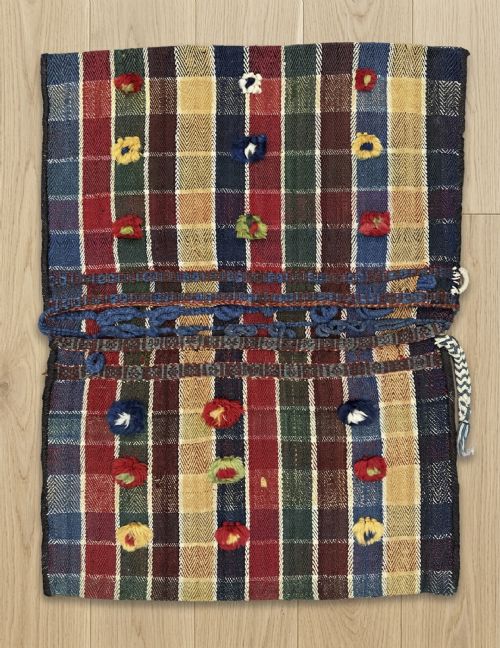
When you search for an antique persia saddle bag, you encounter functional tribal weavings made by nomadic confederacies and village groups across regions like Fars, Luristan, and Kerman. These pieces range from complete twin pouches connected by a web to single bag faces preserved after decades of use.
You are most likely to meet individual bag faces or half bags on this page, often woven with distinctive geometric medallions, boteh motifs, or repeating tribal patterns. Many examples reflect the specific handiwork of groups such as the Qashqa'i, Afshar, Luri, and Shahsevan tribes dating from the late nineteenth and early twentieth centuries.
The utility of these textiles dictated their sturdy construction, as they were originally designed to hang across pack animals for migration and trade. Today, they survive either as intact double pouches or as flat decorative panels utilised in domestic interiors.
Materials and construction
The foundation of these textiles relies predominantly on hand-spun wool for both the pile and the flat-woven backs, occasionally supported by cotton or metal elements. Natural dyes provide the enduring palette, drawn from regional plants and minerals that yield deep reds, blues, and earth tones.
Weavers employed traditional warp-faced and symmetrical or asymmetrical knotting techniques depending on the tribal affiliation, often incorporating supplementary weft-wrapping. Leather reinforcements and sturdy side finishes were added to withstand the rigorous daily demands of nomadic transport.
Antique Persia Saddle Bag Retail Price Guide 2026
Typical asking prices for persia saddle bag among the pieces listed under this phrase on Sellingantiques today, from the lower quarter to the upper quarter. They describe what is for sale here now, not the wider market.
Listings feature pieces utilising wool, hand-spun wool, cotton, leather, and metal components dating between 1880 and 1920.
Distinctions in quality
Quality rests upon the fineness of the knotting, the crispness of the tribal design execution, and the depth achieved by natural dyestuffs. Tighter foundations and well-balanced proportions indicate superior control by the weaver.
The integrity of the remaining wool pile, the survival of complete original side cords, and the complexity of regional iconography separate standard utility pieces from exceptional tribal examples.
Afshar Nomads·Qashqa'i Tribes·Luri Tribes·Shahsavan Tribes·Bakhtiari Tribes·Timuri Tribes
The Antique Persia Saddle Bag Glossary
- Khorjin
- The traditional Persian term for a double saddle-bag used by nomadic tribes for carrying household goods during migrations.
- Boteh
- A recurring paisley or almond-shaped motif symbolizing life and eternity, frequently found in Afshar and other tribal designs.
- Face
- The decorative front panel of a saddle bag, often preserved independently after the connecting web and reverse side have worn away.
- Soumak
- A flat-weave technique where coloured weft threads are wrapped wrap-wise over the warp threads to create a sturdy, textured surface.
- Natural Dyes
- Colorants extracted from plants, insects, and minerals before the introduction of synthetic aniline dyes in the late nineteenth century.
Antique Persia Saddle Bag: Frequently Asked Questions
What is a saddle bag face?
A saddle bag face is the decorative front panel of a traditional nomadic storage bag. These panels were often salvaged when the plain utilitarian backs wore out from years of friction against pack animals.
Today, these surviving faces are mounted or displayed as flat textile art because their intricate tribal patterns remained well preserved.
How were these bags used originally?
Nomadic families utilised these twin pouches draped over horses, donkeys, or camels to transport personal belongings during seasonal migrations. They served as portable closets and storage units for bedding, clothing, and provisions.
When camp was pitched, the bags were unloaded and used inside tents as containers or casual seating cushions.
How do I tell tribal groups apart?
Tribal attribution relies on specific structural traits, colour palettes, and characteristic motifs unique to each region. For instance, Luri and Bakhtiari pieces often display bold geometric layouts, while Afshar work frequently highlights repeating boteh designs.
Examining the selvedge finishes and end-border construction also offers strong clues regarding whether a piece originated in Fars, Kerman, or northwest Persia.
Can I use these on the floor?
Complete saddle bags and sturdy bag faces with good wool pile can handle light foot traffic in low-impact areas. Many collectors prefer to place them in spaces where they avoid heavy wear, such as hallways or as wall hangings.
Using a proper rug underlay helps prevent slipping and protects the aged wool foundation from premature abrasion.