




Antique Metal Advertising Sign
An antique metal advertising sign carries the commercial history of the street into the room.
Antique Metal Advertising Sign
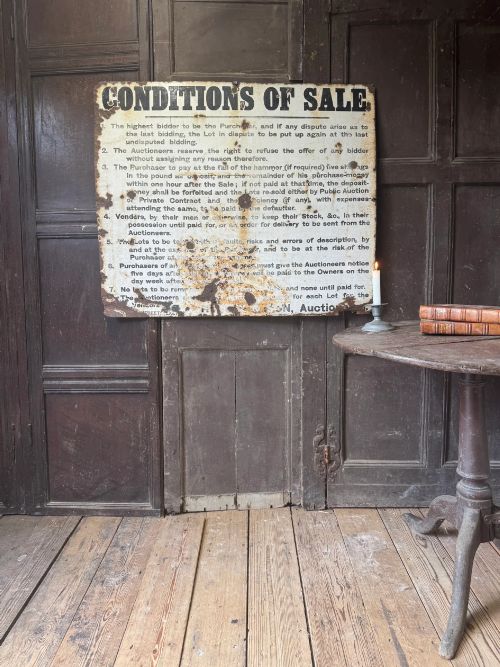
An antique metal advertising sign serves as a commercial marker or trade indicator, taking the form of wall signs, trade signs, advertising signage, wall signage, plaques, wall mirrors, and wall clocks. These objects emerge from the Victorian era, the nineteenth century, and through the decades of the early twentieth century up to the mid-twentieth century.
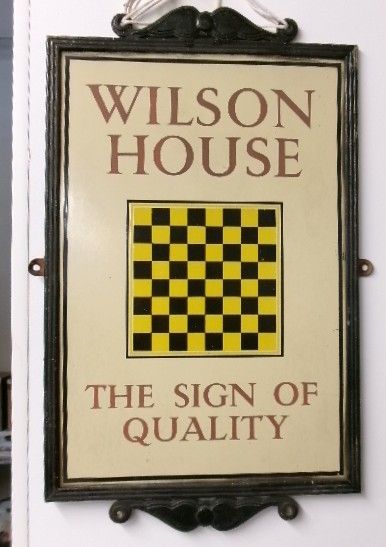
The most common examples you will encounter here include painted metal auctioneer conditions of sale, enamel telephone notices, framed quality signs, newspaper notices, and specific trade indicators for coopers, painters, pharmacies, dentists, and jewellers.
How they were made
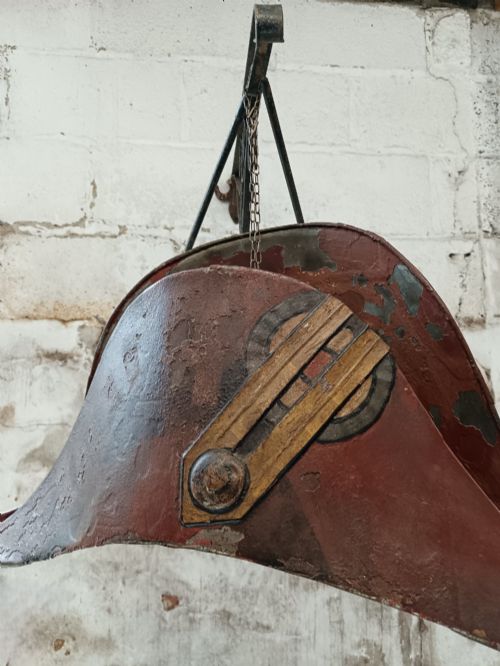
The construction of these pieces relies heavily on iron, sheet metal, and cast iron, shaped into flat plates, hanging markers, and dimensional objects such as pocket watches and bicorn hats. Metal provides a rigid base suited to both interior shop settings and exterior street exposure.
Surfaces receive treatments of paint and vitreous enamel. Enamel applications involve fusing powdered glass to metal under high heat to create a durable, glossy finish that resists weathering, while traditional paint layers define lettering and pictorial details on iron and sheet metal.
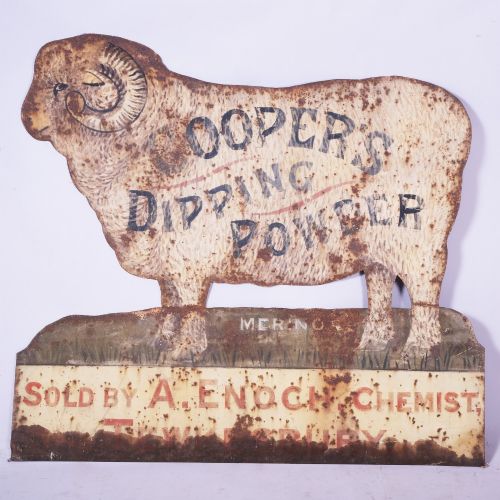
A nineteenth-century cooper needed a sheep dip sign to reach customers before the flock got restless.
What varies in quality
The distinction between tiers rests in the crispness of the original typography, the complexity of the pictorial elements, and the depth of the modelling in dimensional trade signs shaped as pocket watches or hats. Superior examples retain their original painted or enamelled surfaces with clear, legible lettering that defines the trade or product.
Construction robustness and the presence of original framing or mounting brackets also separate standard utilitarian markers from exceptional display pieces. Better pieces maintain their structural integrity in the iron or sheet metal without excessive loss to the vitreous enamel or painted layers.
Smiths of London·J. and H. Keyworth and Co·Tann’s Defiance·Josef Herzog
The Antique Metal Advertising Sign Glossary
- Vitreous enamel
- A material made by fusing powdered glass to a substrate by firing, typically between seven hundred and nine hundred degrees Celsius. This technique produces a hard, durable, and chemical-resistant surface ideal for outdoor advertising.
- Toleware
- Metalware painted in a japanning technique or decorated with enamel paints, often associated with nineteenth-century trade signs and domestic objects. The term derives from the French phrase for painted sheet metal.
- Trade sign
- A physical object or board displayed outside a shop or business to indicate the trade practised within, frequently shaped as the commodity sold or the tool used. These items include pocket watches, bicorn hats, and specific occupational plaques.
- Sheet metal
- Metal formed into thin, flat pieces by an industrial process, commonly utilised for twentieth-century wall signs and advertising panels. It offers a lightweight yet sturdy canvas for painted and enamelled lettering.
Antique Metal Advertising Sign: Frequently Asked Questions
How were trade signs displayed?
Traders mounted these signs directly onto exterior brickwork, hung them perpendicular to the street from iron brackets, or placed them inside shop windows to attract passing custom. Double-sided versions hung so pedestrians approaching from either direction could read the trade.
Inside the premises, smaller plaques and mirrors served as interior counter displays or functional office notices, reinforcing brand names and business conditions to the public.
What is vitreous enamel?
Vitreous enamel is a glass coating fused to a metal base through high-temperature firing, creating a glossy and weather-resistant surface. It protected the underlying iron or sheet metal from rust while allowing bold colours and sharp lettering.
This technique proved especially popular for public utility notices, newspaper placards, and long-term brand advertisements exposed to outdoor environments.
How do I date a metal sign?
Dating relies on the materials, typography styles, manufacturing techniques, and specific company references recorded on the piece. Victorian and nineteenth-century examples often feature cast iron or heavy hand-painted iron, while the early twentieth century brought standardised sheet metal and vitreous enamel.
Specific trade titles, royal warrants, or named businesses can be cross-referenced against historical directories to narrow the period of production.
Where should I hang a wall sign?
These pieces suit spaces with industrial, vintage commercial, or eclectic interior schemes, mounted securely on stud walls or brickwork using appropriate fixings. Because many incorporate heavy iron, sheet metal, or frames, ensure the hanging point bears the weight safely.
Kitchens, hallways, and studies provide practical environments where the bold typography and trade imagery can be viewed clearly at eye level.