



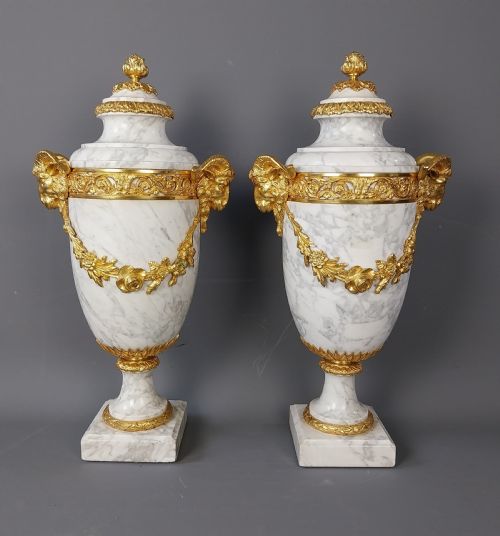

Antique Marble Cassolettes
Antique marble cassolettes are reversible decorative vessels crafted to display either a solid urn lid or a bobeche for burning candles.
Antique Marble Cassolettes
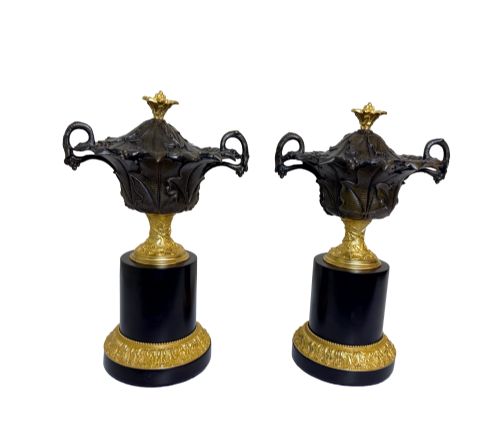
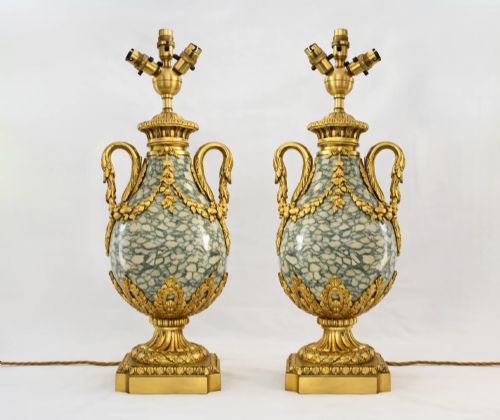
Antique marble cassolettes emerge primarily from the nineteenth century, spanning Victorian production and French Empire or Louis XVI revivals. A buyer searching this phrase encounters decorative vessels formed from turned stone bodies paired with metal mounts.
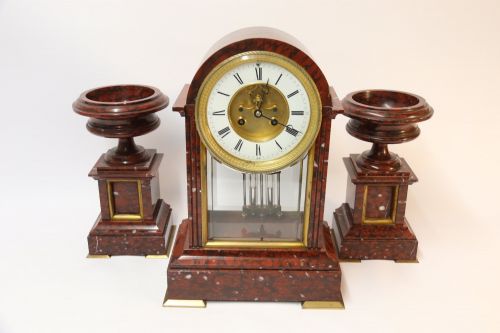
The most common form on this page is the matched pair, often adapted as table lamps or presented as garniture sets alongside mantel clocks. These pieces frequently incorporate reversible lids that transform the vessel from an ornamental urn into a candlestick.
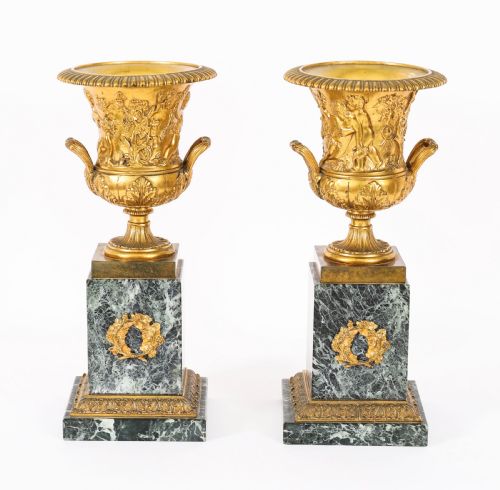
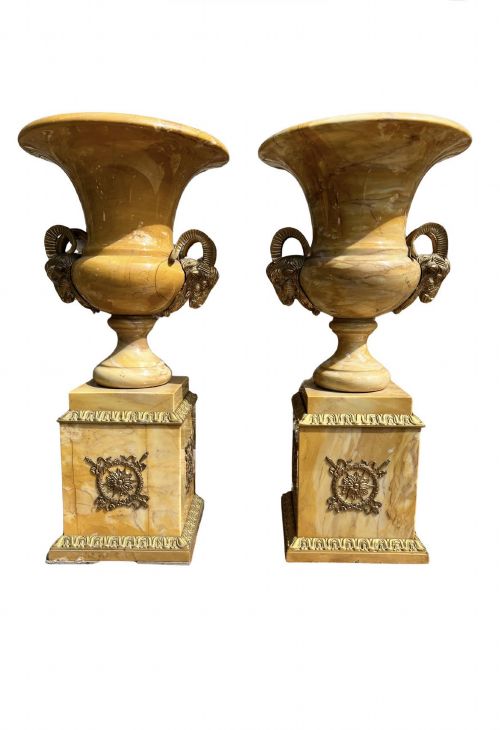
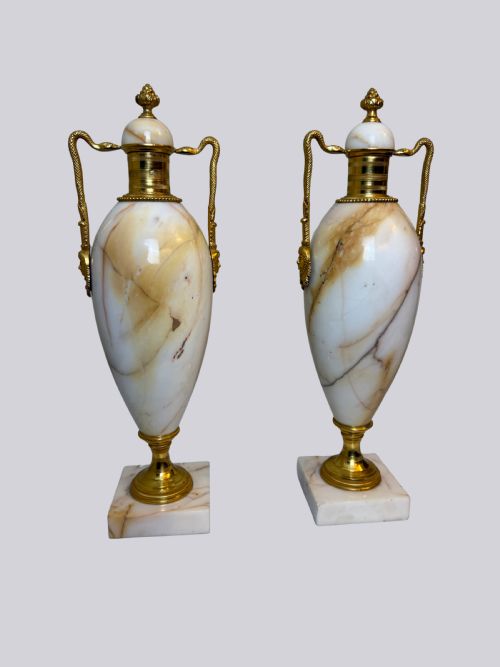
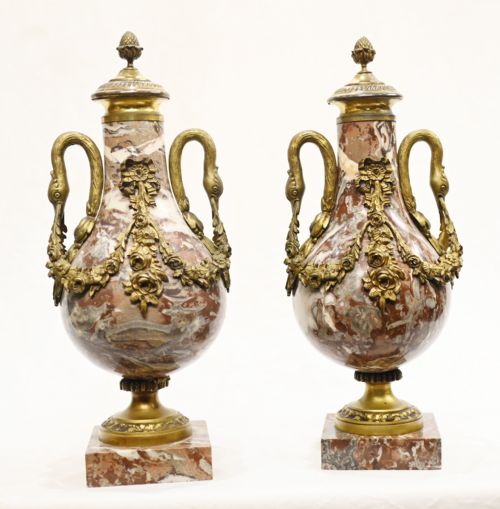
Origins cluster around French workshops and Italian Grand Tour production, drawing on Neoclassical design vocabulary. The bodies utilise diverse mineral varieties, including white onyx, green marble, sienna, and rouge marble.
How they were made
The construction relies on the union of turned stone and cast metal components. Marble and onyx bodies are shaped on lathes and polished, then secured with threaded rods running through the centre to anchor the base and neck.
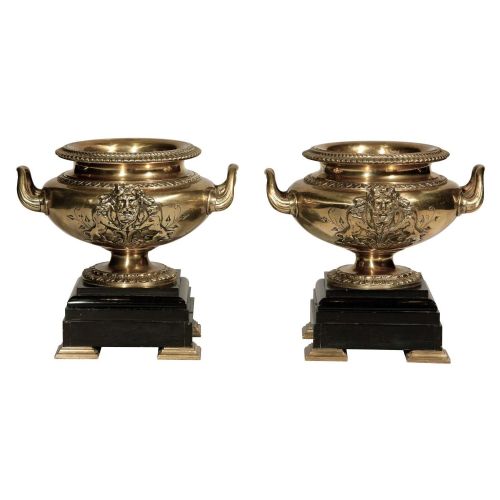
Mounts, handles, and feet consist of gilt bronze or ormolu, cast via the lost-wax method and subsequently chased by hand. Brass and silvered elements appear alongside bronze, fixed to the stone with pinned joints or threaded fasteners.
Listings feature nineteenth-century pieces spanning the Victorian era, French Empire style, and Louis XVI revival.
What varies in quality
Quality rests upon the crispness of the metal chasing and the grain of the stone. Superior examples display sharply defined acanthus leaves, bead reels, and cast mounts that fit the contours of the marble precisely without visible gaps.
The selection of the marble itself dictates the standing of the piece. Uniform veining, rich natural colouration in green, sienna, or rouge varieties, and heavy, solid turning separate finer decorative urns from simpler productions.
Samuel Marti
The Antique Marble Cassolettes Glossary
- Cassolette
- A reversible decorative vessel featuring a double-sided lid that functions as an urn top on one side and a candle nozzle on the other. This dual purpose defined domestic display and utility in formal rooms.
- Ormolu
- Finely ground high-carat gold amalgamated with mercury and applied to cast bronze through heat gilding. This historic technique produced a durable, rich golden surface sheen found on nineteenth-century mounts.
- Garniture
- A coordinated set of three or more ornamental objects designed for simultaneous display on a mantelpiece. Typically comprises a central clock flanked by matching cassolettes, urns, or candelabra.
- Grand Tour
- The nineteenth-century travel tradition where affluent travellers acquired classical antiquities and Neoclassical souvenir art across Italy and France. Items from this context emulate ancient architectural stone and metalwork.
- Bobeche
- A removable collar or drip pan seated inside the candle socket to catch wax. In reversible cassolettes, this element forms the reverse face of the lid.
Antique Marble Cassolettes: Frequently Asked Questions
What is an antique marble cassolette?
An antique marble cassolette is a decorative urn featuring a reversible lid. One side displays a solid stone or metal finial, while the reverse reveals a socket for holding a taper.
These objects originated as versatile mantel ornaments during the Neoclassical and French Empire periods. They allowed a room's decor to shift between floral urn display and candlelight.
How do you use a cassolette?
To use a cassolette, lift the central lid and invert it depending on the desired function. Placing the solid side up presents a decorative stone vase.
Flipping the lid exposes the candle nozzle, turning the piece into a candlestick or part of a garniture set. Collectors generally display them as ornamental pairs on sideboards or mantelpieces.
How do you date nineteenth century cassolettes?
Dating relies on stylistic markers, casting techniques, and the type of marble employed. Nineteenth-century pieces frequently draw on Louis XVI Revival and French Empire vocabularies.
Examining the internal fixings, bronze chasing quality, and the specific mineral varieties such as vert maurin or sienna helps narrow the production era.
Are all marble cassolettes French?
Not all cassolettes originate in France, though French workshops produced a high volume of gilt bronze mounted examples. Italian makers also created notable pieces, particularly within the Grand Tour tradition.
Italian pieces frequently utilise regional marbles like sienna and feature distinct casting styles associated with nineteenth-century workshops.