


Antique Mantle Clock Garniture
An antique mantle clock garniture brings together a central timepiece and matching side pieces to anchor a mantelpiece with symmetry and presence.
Antique Mantle Clock Garniture
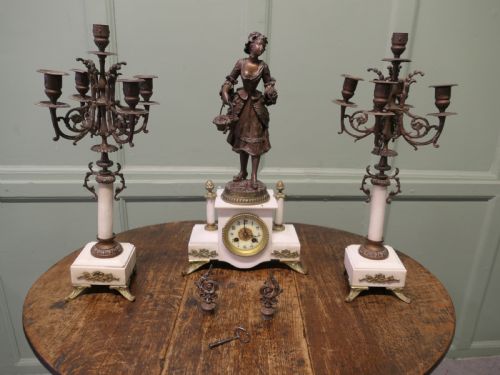
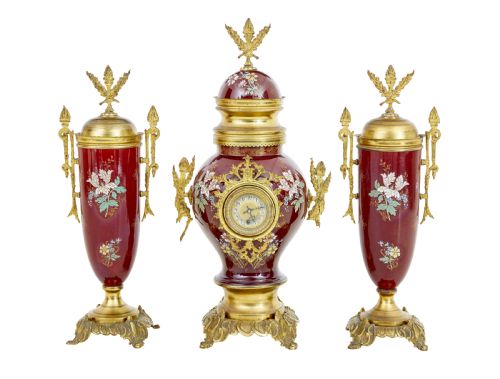
An antique mantle clock garniture presents a matched set consisting of a main clock flanked by matching side ornaments such as candelabras, urns, or vases. These multi-piece ensembles appear frequently in nineteenth-century Victorian formats, alongside later Art Deco iterations from the nineteen-twenties and nineteen-thirties.
The regional origin skews heavily toward French workshops, spanning Louis XV and Louis XVI revivals, Neo-Classical designs, and Empire styles. Alongside these formal continental suites, British interpretations emerge in marble and porcelain, often housing eight-day movements designed for domestic parlours.
Buyers seeking this phrase encounter three-piece configurations most commonly, where the central dial dictates the aesthetic of the matching vessels placed to either side. These sets function both as timekeepers and as decorative centerpieces intended to command a room.
Materials and construction
Maker workshops built these garnitures using heavy stones and metals, pairing marble, slate, and onyx with cast ormolu, gilt bronze, and gilded brass. Enamel dials and painted porcelain panels frequently provide the face and decorative inserts for the central clock.
Foundry casting and hand-finishing dominated the production of the metal mounts, whilst stone bases required precise cutting and polishing to support weighty mechanical movements. Enamel work demanded careful kiln firing to achieve crisp numerals and decorative motifs on the clock faces.
Listings feature 19th Century French pieces alongside Victorian marble and Art Deco designs in brass and glass.
Craftsmanship and detail
Quality rests in the crispness of the cast metal mounts and the depth of the hand-chasing on ormolu and bronze elements. Finer sets display harmonious proportions between the central clock and its matching side pieces, utilising superior grades of marble and unblemished enamel dials.
The complexity of the movement and the presence of specialised complications, such as moon phases or detailed statutory castings after known sculptors, separate standard production from superior examples. Integrated decorative schemes where porcelain, bronze, and stone elements are conceived as a single artistic vision command stronger visual authority.
Finnigan Manchester·Meissen·Ferdinand Barbedienne·Etienne Maurice Falconet
The Antique Mantle Clock Garniture Glossary
- Garniture
- A matched set of decorative objects designed to be displayed together on a mantelpiece or sideboard. It typically comprises a central clock accompanied by two matching side pieces such as candelabras or urns.
- Ormolu
- Gilt bronze produced by applying a finely ground high-carat gold-mercury amalgam to a bronze object, which is then fired to drive off the mercury. This technique creates a durable golden surface finish characteristic of fine French pieces.
- Cloisonne
- An ancient technique for decorating metalwork objects using vitreous enamel held within raised metal wire partitions. These colourful compartments form intricate patterns across the clock case or garniture bodies.
- Candelabra
- A branched candlestick holder designed to hold multiple candles simultaneously. In a clock garniture, a pair of these stands beside the main timepiece to create balanced symmetry.
Antique Mantle Clock Garniture: Frequently Asked Questions
How do these clocks work?
Most antique examples rely on a mechanical spring-driven movement that requires manual winding with a key. Many feature eight-day movements that run for over a week before needing attention.
The internal gear train drives the hands and often powers a strike mechanism that chimes on the hour or half-hour using bells or gongs.
Where should I place one?
These sets suit prominent mantelpieces, large sideboards, or console tables where the full width of the three-piece arrangement can be appreciated. The central clock acts as the anchor point with the side ornaments framing it.
Ensure the supporting surface is level and sturdy enough to bear the weight of heavy marble or bronze components. Keep the arrangement away from direct heat sources and strong sunlight.
How do I date these pieces?
Dating relies on stylistic clues, materials, and movement signatures found on the clock face or backplate. Nineteenth-century pieces often display distinct revival styles like Louis XV or Rococo, while later sets adopt Art Deco geometry.
Maker marks, retailer stamps, and serial numbers stamped onto the brass movements provide further chronological markers. Comparing the casting style and dial typography helps confirm the period.