
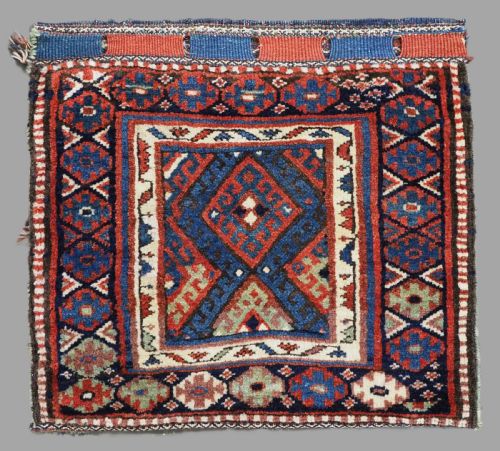


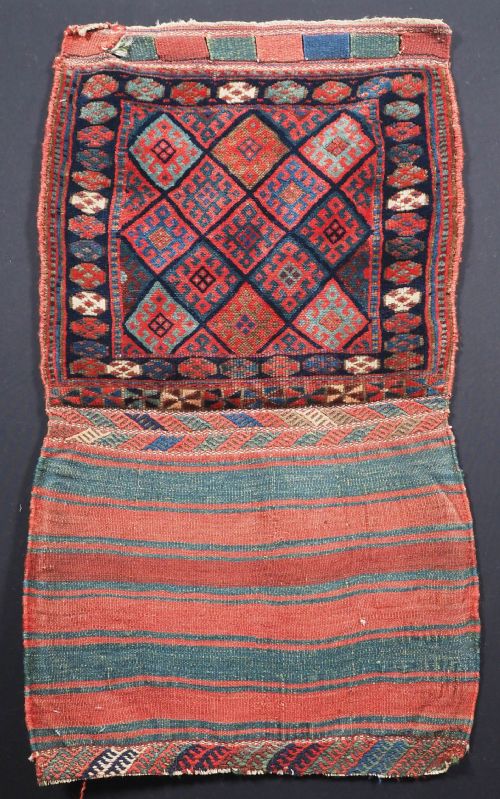
Antique Kurdish Bag Face
An antique kurdish bag face is a woven tribal fragment of nomadic artistry, prized for its dense wool geometry and enduring village utility.
Antique Kurdish Bag Face
When you search for an antique kurdish bag face, you encounter fragments of larger storage sacks, saddlebags, and vanity bags created by nomadic weavers in Persian and Anatolian Kurdistan. These textiles date primarily from the late nineteenth century into the early twentieth century, spanning the decades between eighteen eighty and nineteen twenty. The most common form you meet on this page is the Jaf Kurd bag face, often preserved from complete saddlebag pairs.
Makers utilised wool, hand-spun wool, and cotton foundations to construct durable textiles intended for daily tribal life. Alongside bag faces, you will find occasional complete bags with plain weave backs, small cushions, and chanteh vanity pieces. These objects reflect the tribal and nomadic traditions of their makers, carrying patterns developed across generations of village weavers.
What varies in quality
Quality rests in the handling of the hand-spun wool and the crispness of the tribal design work. Pieces with tightly packed knots and well-preserved borders demonstrate greater technical skill from the weaver.
The survival of the original structure also influences the character of the piece, distinguishing a robust saddlebag face from a heavily worn fragment. The depth of the wool pile and the clarity of the motifs separate the standard examples from the finest woven works.
Listings feature wool, hand-spun wool, and cotton across periods spanning eighteen eighty to nineteen twenty.
The Antique Kurdish Bag Face Glossary
- Bag face
- The decorative knotted-pile front of a nomadic storage sack or saddlebag. It represents the primary artistic effort of the textile.
- Chanteh
- A small traditional vanity bag or personal carrier woven by nomadic women. These small pieces often served as utilitarian containers for personal items.
- Juval
- A large storage bag used within nomadic tents for bedding and household goods. They form a distinct category alongside smaller saddlebags.
- Boteh
- A stylised floral or almond-shaped motif commonly found in Persian and Kurdish weaving. This pattern appears frequently across regional tribal textiles.
- Plain weave
- A simple unpiled flat-woven structure utilised for the backs of bags or structural bands. It contrasts with the dense pile of the decorative face.
Antique Kurdish Bag Face: Frequently Asked Questions
How were these bags used originally?
Nomadic families utilised these textiles as saddlebags on animals or as storage sacks inside tents for household goods and bedding.
Over time, many complete bags separated into individual bag faces as the utilitarian backs wore away from friction and age.
How do I date these tribal pieces?
Dating relies on material analysis, wool quality, and structural traits characteristic of late nineteenth and early twentieth-century weaving.
Most surviving examples date from around eighteen eighty to nineteen twenty, reflecting traditional tribal patterns passed down through generations.
How do I care for a textile bag face?
Protect the wool pile from direct sunlight and damp conditions to preserve the integrity of the natural materials.
Gentle vacuuming without a rotating brush helps remove dust while safeguarding the hand-spun wool structure.