
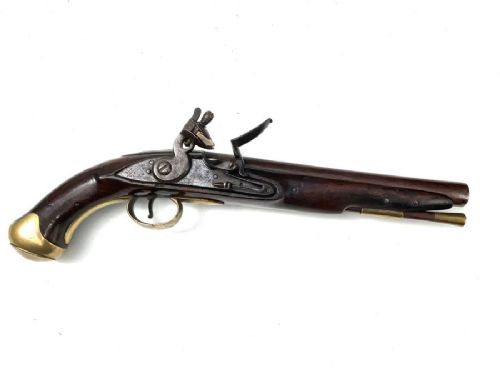


Antique Holster Pistol
An antique holster pistol is a heavy, single-shot firearm designed for carriage on horseback, prized by collectors for its mechanical ingenuity and martial history.
Antique Holster Pistol
An antique holster pistol represents a specialised class of historic firearm produced primarily for military, naval, and civilian self-defence use from the eighteenth through the nineteenth century. These sturdy weapons were meant to be carried in saddle holsters by cavalrymen and travellers who required substantial stopping power at close range. On this page, the pieces you encounter span diverse origins, ranging from British military and civilian workshops to Ottoman, Scottish, and continental European makers.
The material record on this page shows significant variety in geographic style and cultural ornamentation. You will find eighteenth-century British examples bearing formal brass furniture alongside Ottoman Balkan pieces enriched with silver inlay and embossed brass cladding. Forms range from heavy flintlock cavalry arms to later percussion conversion pistols and smoothbore military sidearms.
Dating across the selection centres heavily on the eighteenth and nineteenth centuries, capturing the evolution from early flintlock mechanisms to mid-nineteenth-century percussion systems. Master makers from London, Birmingham, and regional European centres signed their work, leaving behind tangible evidence of period gunmaking traditions.
Materials and construction methods
Makers built the foundational structure of an antique holster pistol using forged iron or steel for the barrel and lock mechanism, paired with dense hardwoods such as walnut for the stock. Stocks frequently received additional reinforcement and embellishment through cast brass furniture, silver wire inlay, or complete metal plating in regional Ottoman styles.
Lock mechanisms relied on precise metalworking to generate a spark via flint and steel or, in later nineteenth-century pieces, to detonate a percussion cap. Barrels were forged in steel or brass, sometimes featuring smoothbore construction designed to fire lead balls.
Antique Holster Pistol Retail Price Guide 2026
Typical asking prices for holster pistol among the pieces listed under this phrase on Sellingantiques today, from the lower quarter to the upper quarter. They describe what is for sale here now, not the wider market.
Listings feature walnut stocks, brass barrels, and silver mounts across eighteenth and nineteenth-century examples.
Distinctions in quality and execution
The distinction between standard military issue arms and high-end civilian pieces lies in the crispness of the lock action and the sophistication of the metal and wood ornamentation. Master gunmakers demonstrated their skill through finely filed lock plates, delicate silver wire inlays, and cast brass grotesque butt caps that required superior hand-chasing ability.
Preservation of original surface finishes, legible maker signatures, and the structural integrity of the wooden stock define the upper tier of surviving examples. Weapons retaining matching components and clear proof marks offer a more complete historical record than those altered or assembled from disparate parts over time.
Harrison of London·John Campbell of Doune·T. Potts·Timothy Hughes·Thomas Anelli·R. Willoughby·Meyer & Mortimer
The Antique Holster Pistol Glossary
- Flintlock
- An ignition mechanism that uses a piece of flint held in a cock to strike a steel frizzen, creating sparks to ignite the priming powder. This system dominated military and civilian firearms throughout the eighteenth century.
- Percussion cap
- A small metal cup containing a priming compound placed on a nipple, which explodes when struck by the hammer to ignite the main charge. This mid-nineteenth-century technology largely superseded the flintlock.
- Miquelet
- A form of flintlock mechanism common in Spain, Italy, and the Ottoman Empire, characterised by an external mainspring and a combined steel and frizzen. It provided robust ignition in diverse climates.
- Smoothbore
- A barrel lacking internal rifling, designed to fire spherical lead balls without spin. Most holster pistols of this era utilised smoothbore barrels for ease of loading on horseback.
- Bore
- The interior diameter of the barrel, often measured in gauge or bore size indicating the number of lead balls of that diameter that could be cast from a pound of lead.
Antique Holster Pistol: Frequently Asked Questions
How do I identify a flintlock holster pistol?
Look for the external lock mechanism on the side of the stock, featuring a cock holding a piece of flint that strikes a steel frizzen to create a spark.
Holster pistols are generally larger and heavier than pocket pistols, built with robust stocks intended for saddle carriage.
Were these pistols used exclusively by the military?
While many examples served British cavalry units and foreign armies, a significant portion were produced for affluent civilians, travellers, and officers who purchased private weapons.
Civilian pieces often feature finer decorative elements like silver wire inlay and ornate brass furniture compared to standard military issue.
What is the difference between flintlock and percussion pistols?
Flintlock pistols rely on a flint striking a steel plate to ignite loose gunpowder in a pan, technology prevalent in the eighteenth century.
Percussion pistols, emerging by the mid-nineteenth century, use a hammer to strike a cap placed over a hollow nipple, offering greater reliability in wet weather.
How do regional styles differ across the listings?
British and European pieces often emphasise restrained elegance with figured walnut stocks and engraved steel lock plates.
Ottoman and Balkan examples frequently incorporate Miquelet locks, extensive silver wire work, and embossed brass or metal cladding.