




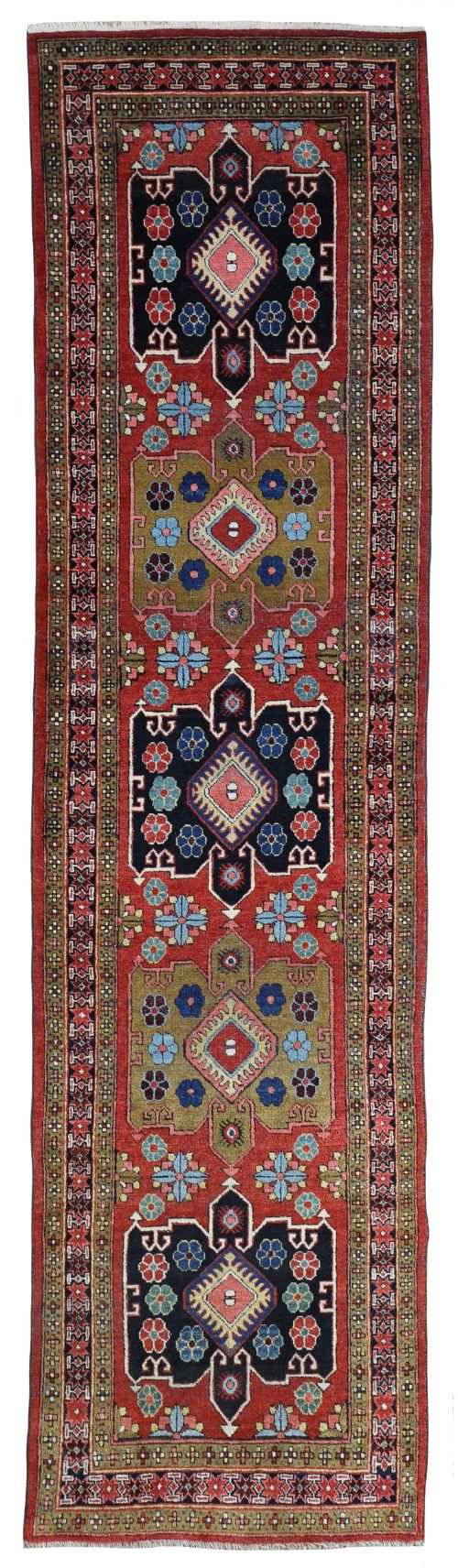
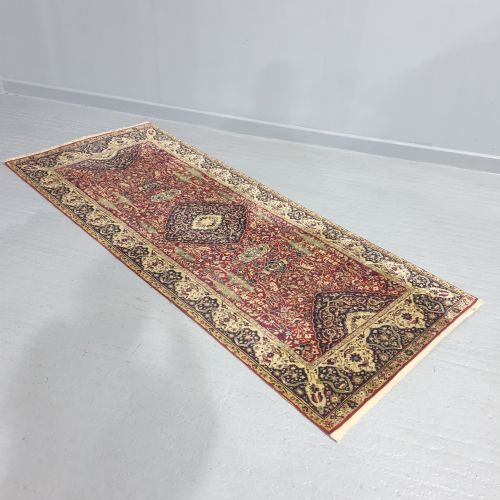


Antique Floral Hallway Runner
An antique floral hallway runner brings enduring colour and pattern to a narrow space through woven wool and cotton.
Antique Floral Hallway Runner
An antique floral hallway runner is a long, narrow floor covering designed specifically for passages, corridors, and entrance spaces. These pieces combine practical proportions with botanical motifs originating from Persian, Caucasian, and Ottoman traditions.
Buyers browsing this selection will frequently encounter narrow formats woven in wool and cotton, spanning periods from the nineteenth century into the early twentieth century. Examples range from village rugs of the Chahar Mahal region to room-sized carpets adapted into elongated runners.
Regional styles dictate the character of each runner, encompassing Persian Bakhtiari, Bidjar, Heriz, and Sarouk designs alongside Caucasian Karabagh and Gendje Kazak interpretations. Each piece reflects the specific weaving grammar of its origin while maintaining the narrow format demanded by hallway placement.
Factors Distinguishing Quality
Quality in an antique floral hallway runner rests upon the precision of the weave and the structural integrity of the wool foundation. Finer knots permit intricate detailing of stylized Mina Khana patterns and French-inspired rose designs.
Proportion and balance also define superior examples, particularly in pieces of exceptional length where maintaining a straight, uniform width requires high skill. The handled tension of the wool and cotton directly influences how flat the runner lies along a corridor floor.
Antique Floral Hallway Runner Retail Price Guide 2026
Typical asking prices for floral hallway runner among the pieces listed under this phrase on Sellingantiques today, from the lower quarter to the upper quarter. They describe what is for sale here now, not the wider market.
Listings feature wool and cotton runners spanning the nineteenth century through the 1930s, encompassing Persian, Caucasian, and Ottoman styles.
The Antique Floral Hallway Runner Glossary
- Runner
- A long, narrow carpet format intended for corridors, staircases, and hallways. These pieces typically display an extended length relative to their width.
- Pile
- The upright or knotted surface of a rug formed by the ends of threads woven through the foundation. This layer absorbs foot traffic and displays the floral design.
- Warp
- The stationary lengthwise threads stretched on a loom prior to weaving. Cotton is commonly utilised for this foundational element in Persian and Caucasian production.
- Weft
- The horizontal threads passed across the warp to bind the knots in place. Together with the warp, they form the structural grid of the textile.
- Lattice
- An open, intersecting framework of diagonal bands forming a repeating grid across the field. Floral motifs frequently populate the compartments of this geometric layout.
Antique Floral Hallway Runner: Frequently Asked Questions
Where should I place a hallway runner?
These narrow floor coverings fit naturally into corridors, entrance halls, and passages where length is required without overwhelming floor space. Their elongated proportions guide the eye through the interior architecture.
Positioning a runner away from heavy moisture keeps the wool and cotton foundations stable over time. A proper underlay prevents slipping on hard hallway flooring.
What materials make up these runners?
Wool forms the surface pile across these pieces, selected for its natural resilience and capacity to hold rich dye colours. Cotton provides the supportive foundation structure in the warp and weft.
This combination offers both structural stability for long narrow formats and soft underfoot comfort. The interaction of these two materials dictates how the textile behaves under tension.
How do I date an antique runner?
Dating relies on stylistic markers, dye characteristics, and structural analysis consistent with periods from the late nineteenth century into the early twentieth century. Shifts in design influences, such as European-inspired rose motifs, offer clues to the era of production.
Comparing knot style and wool preparation against documented regional examples refines the timeline. Pieces from this selection span several decades of traditional weaving output.