
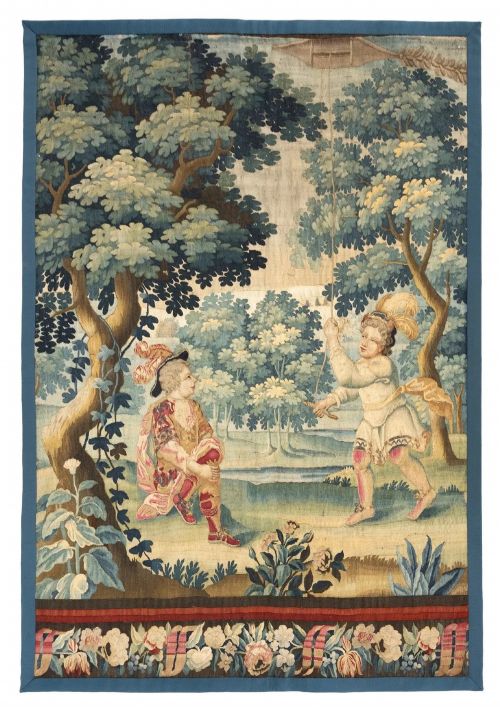
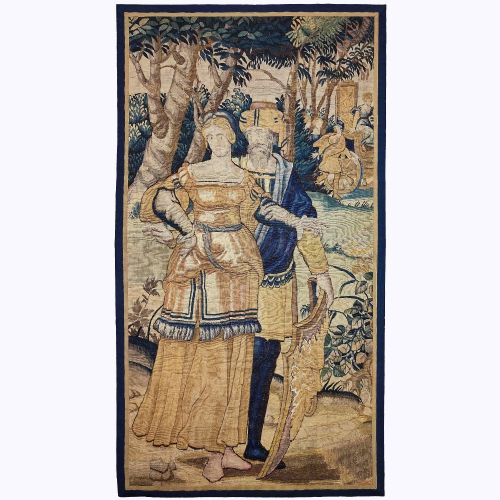
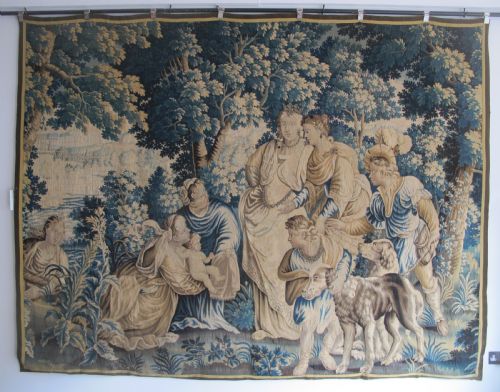


Antique Figural Tapestry
These antique figural tapestry pieces bring historic narrative and rich textile art into interiors, offering woven and embroidered scenes from centuries past.
Antique Figural Tapestry
When you search for antique figural tapestry, you encounter woven wall art, embroidered needlepoint panels, and textile fragments originating across several European centres. The most common forms on this page range from large wall hangings and framed portraits to decorative cushion covers and upholstered furniture panels.
The material timeline spans from sixteenth-century Flemish panels to nineteenth-century French armchairs and firescreens. Buyers regularly find seventeenth-century Aubusson and Audenaarde pieces alongside Victorian interpretations and Italian needlework depicting noble figures and biblical narratives.
Markers of quality
Quality in these textiles rests upon the intricacy of the figural detail, the subtlety of the wool and silk colour palette, and the preservation of the woven narrative. Earlier sixteenth and seventeenth-century works demonstrate complex compositional depth, whereas later nineteenth-century examples often employ bolder needlepoint execution.
The condition of the fibres and the structural integrity of the supporting timber frames or mountings significantly influence the piece. Original mountings, such as period gilt frames or carved oak surrounds, elevate the overall integrity of the textile.
The inventory includes walnut, oak, and rosewood frames housing wool and silk textiles from the sixteenth to the nineteenth century.
The Antique Figural Tapestry Glossary
- Aubusson
- A style of tapestry originating from the French town of Aubusson, known for pictorial wall hangings and room furnishings.
- Audenaarde
- A Flemish centre of tapestry production celebrated for verdure and figural woven panels dating to the eighteenth century and earlier.
- Gros-point
- A type of counted-thread embroidery using a heavy yarn on canvas, frequently utilised for durable cushion covers and upholstery.
- Needlepoint
- Embroidery stitched onto a canvas mesh to create dense pictorial surfaces, common in nineteenth-century decorative panels.
- Flemish Renaissance
- A sixteenth-century artistic movement influencing northern European tapestry design with elaborate narrative scenes.
Antique Figural Tapestry: Frequently Asked Questions
How do I hang a large tapestry?
Large textile panels require even weight distribution across a specialised rod or a concealed wooden batten to prevent fibre distortion.
Avoid hanging textiles in direct sunlight to protect the wool and silk dyes from fading over time.
Can I use tapestry cushions daily?
Seventeenth-century cushion covers and needlepoint panels were designed for functional home use, but fragile antique fibres benefit from gentle handling.
Rotate them periodically to minimise wear on specific areas of the embroidery.
What is the difference between weaving and needlepoint?
Weaving constructs the image simultaneously with the fabric structure on a loom using warp and weft threads.
Needlepoint embroiders a design onto an existing canvas mesh base after the textile foundation is produced.
How do I identify a seventeenth-century piece?
Examine the complexity of the narrative, the specific dye palettes typical of early Flemish or French workshops, and the weave density.
Documentation and framing styles often provide additional contextual clues regarding the century of origin.