




Antique Empire Semainier
An antique empire semainier is a towering seven-drawer chest offering commanding French presence and practical vertical storage.
Antique Empire Semainier
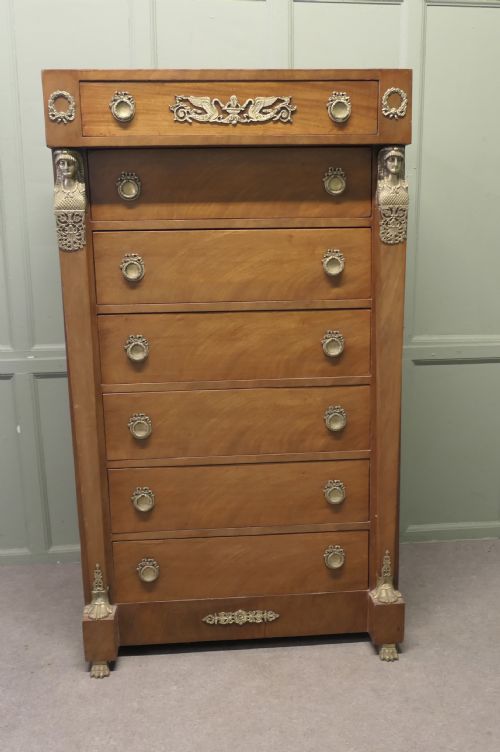
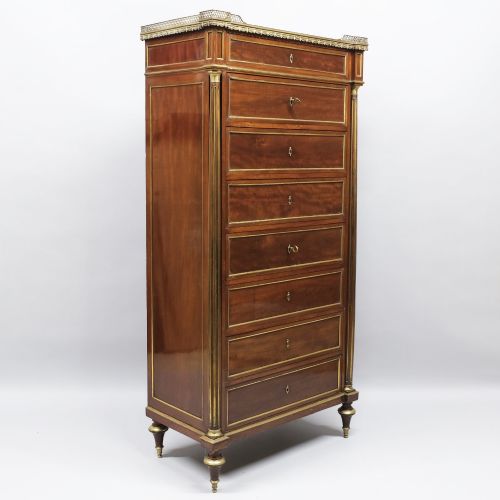
The antique empire semainier appears across this page primarily as tall French chests of drawers from the nineteenth century, including specific periods such as Regency, eighteen hundred, eighteen fifty, eighteen eighty, and nineteen twenty. These pieces take the form of tall chests of drawers, cabinets on chests, banks of drawers, and cartonnier chests.
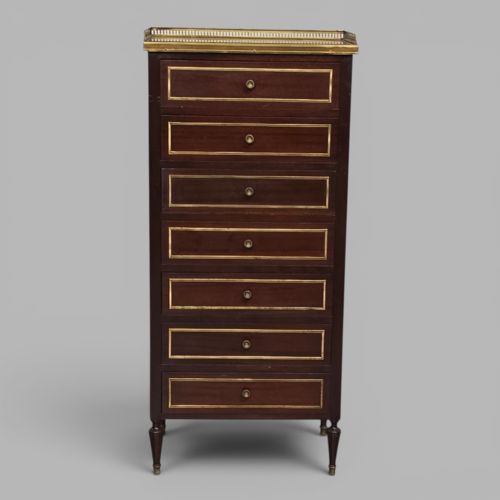
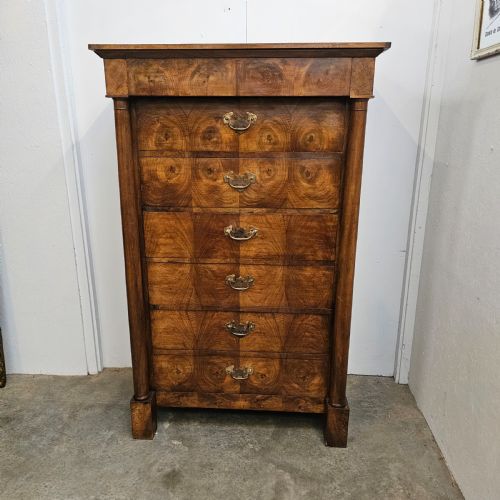
Most examples originate from French workshops, executed in the French Empire, nineteenth century French, Louis Philippe, and Neo Classical styles. A buyer encounters variations ranging from simple oak frames to bookmatched walnut and inlaid mahogany surfaces topped with marble.
How They Were Made
Cabinetmakers constructed these tall chests using solid woods and veneers like mahogany, walnut, burr walnut, oak, and cherry over robust structural frames. Surfaces often feature bookmatched veneers and intricate inlay work to create striking visual patterns across the drawer fronts.
Mounts in brass, gilt bronze, and ormolu decorate the facades, anchored securely to the primary timber bodies. Marble tops appear on specific regional and period variants, providing a contrasting, durable surface above the uppermost drawer.
Object forms on this page include standard chests of drawers, cabinets on chests, banks of drawers, and specialised cartonnier chests.
What Varies in Quality
Quality reveals itself in the precision of the timber selection, visible in the matching of walnut or mahogany grain across multiple drawers. Superior execution shows in the crispness of cast ormolu and gilt bronze mounts, which sit flush against the timber without awkward gaps.
The integrity of the internal drawer construction and the smoothness of the timber runners distinguish finer examples from standard workshop production. The integration of decorative elements like marble slabs and subtle inlay dictates the relative sophistication of each piece.
The Antique Empire Semainier Glossary
- Semainier
- A tall seven-drawer chest traditionally designed to hold one week of clothing or paperwork, originating in France. This form provides substantial vertical storage while occupying a minimal floor footprint.
- Ormolu
- Ground gold applied to bronze mounts and decorative hardware, commonly found on French Empire furniture. This technique imparts a rich, metallic lustre to the structural corners and drawer pulls.
- Bookmatched
- A veneer technique where two adjoining wood panels are mirrored to create a symmetrical pattern. Cabinetmakers utilised this method on drawer fronts to highlight the natural grain of walnut or mahogany.
- Cartonnier
- A specialised tall chest designed to hold papers, documents, or cartons, often associated with nineteenth-century French studies. These pieces share the vertical proportions typical of the semainier form.
- Neo Classical
- A style drawing inspiration from classical antiquity, featuring restrained ornamentation and symmetrical proportions. This aesthetic heavily influenced the design of French Empire furniture.
Antique Empire Semainier: Frequently Asked Questions
What is a semainier?
A semainier is a tall chest featuring seven distinct drawers, traditionally intended to hold a week of garments or documents.
This vertical form maximises storage capacity while requiring minimal floor space in a room.
How are these chests dated?
Dating relies on examining construction methods, timber choices, decorative mounts, and stylistic markers recorded in the evidence.
Nineteenth-century pieces often display specific French regional characteristics and period-appropriate hardware like ormolu or brass.
Where were they made?
The pieces listed originate predominantly from France, spanning various nineteenth-century periods and stylistic movements.
French workshops produced these tall chests using native and imported timbers like walnut, mahogany, and oak.
What woods were used?
Cabinetmakers utilised mahogany, walnut, burr walnut, oak, and cherry for the primary bodies and drawer structures.
Veneers and intricate inlay work frequently embellished the exterior surfaces of these tall chests.
Do they include marble tops?
Certain nineteenth-century French variants incorporate fitted marble slabs above the topmost drawer.
This stone surface provides a contrasting texture and a durable finish to the upper section of the chest.