


Neoclassical Tallboy Chest
A neoclassical tallboy chest commands a room with its upright scale and architectural dignity, offering stately storage through balanced classical proportions.
Neoclassical Tallboy Chest
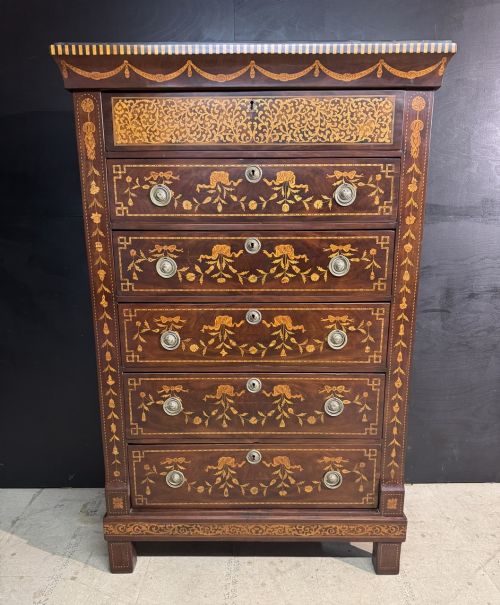
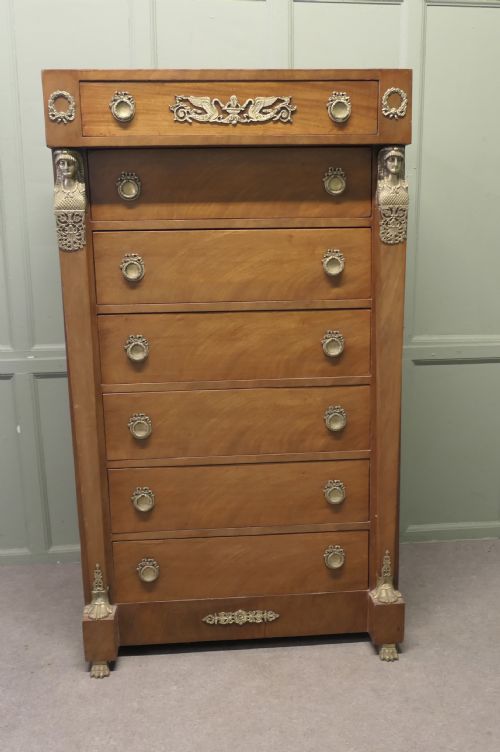
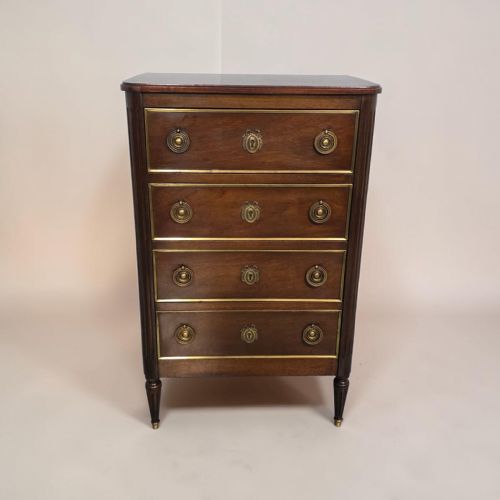
A neoclassical tallboy chest combines vertical storage with classical order, emerging in forms such as chests of drawers, chest on chest, and secretaire variants across the centuries. You will most frequently encounter nineteenth-century pieces alongside eighteenth-century examples, reflecting sustained stylistic revivals.
The aesthetic draws on periods including the Georgian, Regency, and Victorian eras, as well as continental expressions from Dutch, French, and Swedish workshops. These tall chests utilise the architectural discipline of the neoclassical movement to temper their imposing height.
Makers adapted the tallboy layout across various regional interpretations, balancing upright proportions with disciplined drawer arrangements. The resulting pieces serve as commanding focal points while providing practical domestic storage.
Materials and construction methods
Cabinetmakers constructed these tall chests using robust primary timbers such as mahogany, walnut, and birch, frequently supplemented by pine for internal framing. Selected hardwoods provided the structural integrity required to support stacked drawer tiers.
Surface enrichment relied on elaborate fruitwood inlay, marquetry, and polychrome decoration, alongside painted finishes that transformed the underlying timber. Gilt bronze and brass mounts further articulated the classical vocabulary of the designs.
Some tall chests hide a drop-front writing surface, proving that even formal furniture occasionally enjoys keeping secrets.
Distinctions in craftsmanship and design
Quality rests in the precision of the joinery and the restraint applied to decorative elements such as fruitwood inlay and brass mounts. Superior examples maintain crisp architectural lines that prevent the tall proportions from appearing heavy.
The treatment of secondary timbers and drawer linings indicates the standard of workshop execution. Refined pieces demonstrate careful timber selection that enhances the natural grain beneath polished or painted surfaces.
The Neoclassical Tallboy Chest Glossary
- Tallboy
- A tall chest of drawers, often constructed as one cabinet stacked upon another or as a single tall carcass. This form maximises vertical storage capacity while maintaining a compact floor footprint.
- Marquetry
- The art of applying decorative veneer pieces to a structure to form intricate designs. This technique frequently employs contrasting fruitwoods on eighteenth-century surfaces.
- Biedermeier
- A central European style spanning the nineteenth century characterised by utilitarian comfort and clean neoclassical lines. It prioritises honest timber grains over excessive ornamentation.
- Secretaire
- A cabinet incorporating a writing drawer with a drop-front desk surface. This hybrid form integrates a functional writing space within the upper tiers of a tall chest.
Neoclassical Tallboy Chest: Frequently Asked Questions
What is a neoclassical tallboy chest?
A tall chest of drawers designed with classical architectural proportions, featuring balanced drawer arrangements and restrained ornament derived from antiquity.
These pieces provide substantial vertical storage while maintaining an orderly and dignified silhouette suited to principal rooms.
How do I date a tall chest?
Dating relies on examining the timber species, construction techniques, hardware, and stylistic markers such as marquetry or painted decoration.
Eighteenth-century examples often display intricate fruitwood inlay, whereas nineteenth-century revival pieces may utilise birch or walnut with Empire motifs.
Where should I place a tall chest?
The upright scale makes these chests ideal for bedrooms, hallways, or dressing rooms where floor space is limited but vertical capacity is needed.
Ensure adequate clearance for upper drawers and allow the architectural lines to anchor the surrounding wall space.
What woods were commonly used?
Cabinetmakers employed durable primary timbers including mahogany, walnut, and birch, often paired with pine for internal carcase construction.
Surfaces were frequently enhanced with fruitwood veneers, paint, or contrasting inlay work to accentuate the neoclassical geometry.