




Empire Walnut Chest Drawers
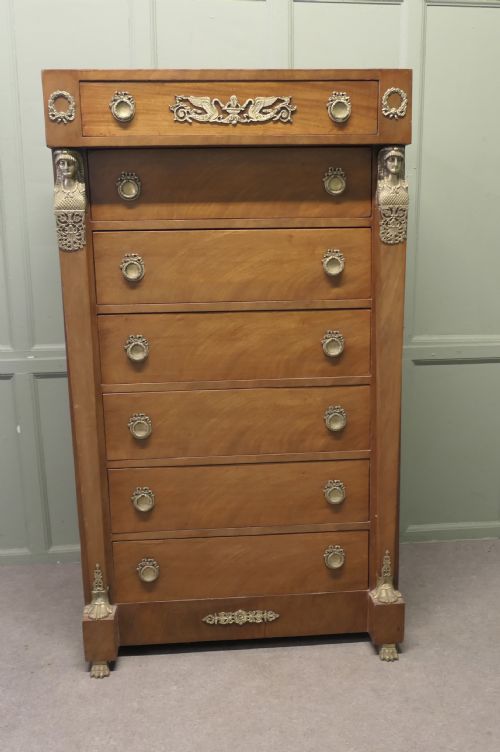
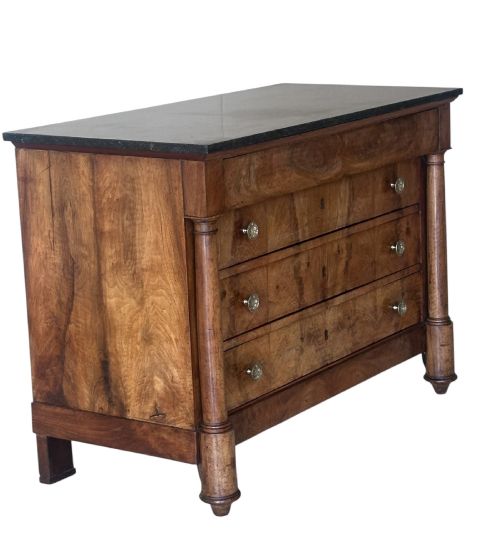
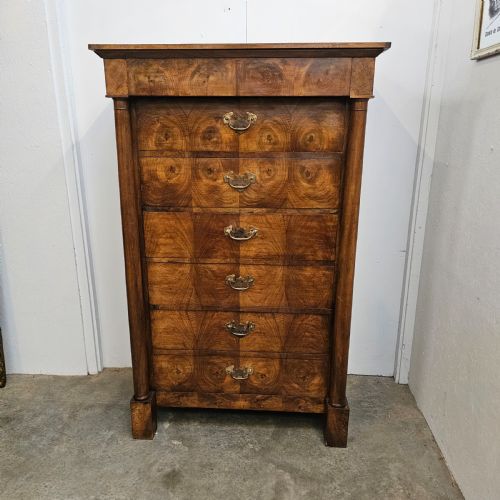
These empire walnut chest drawers bring serious continental presence to a room, offering grand proportions and deep, figured timber.
Empire Walnut Chest Drawers
An empire walnut chest drawers is a statement storage piece defined by classical continental forms and rich grain patterns. Buyers search for this phrase to find substantial commodes and tall chests that anchor a bedroom or reception room.
The pieces appearing here are predominantly nineteenth century French and Italian examples, alongside Dutch and Georgian works. You will most frequently encounter walnut, burr walnut, and walnut veneer fashioned into commodes, semainiers, and secretaire cabinets.
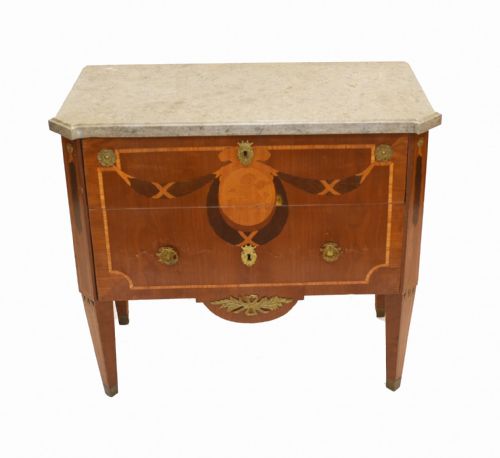
Regional variations span from French Empire and Charles X styles to Italian Neoclassical and Dutch marquetry. These designs often incorporate contrasting marble tops, brass hardware, and gilt bronze mounts to enhance the dark timber.
How they were made
Cabinetmakers utilised dense walnut and highly figured burr walnut veneers laid over solid secondary timbers to create striking geometric bookmatched patterns across the drawer fronts. This technique maximised the visual impact of the grain, particularly on large French commodes.
Structural embellishments relied on cast brass and ormolu mounts fixed to the corners, feet, and drawer pulls, introducing metallic highlights to the dark wood. Heavier pieces frequently incorporated fitted marble slabs as resilient working tops.
Inlaid stringing and marquetry details, seen in Italian and Dutch pieces, involved precise hand-cutting of contrasting fruitwood and lighter veneers. Joinery employed traditional hand-cut dovetails for drawer construction to ensure durability.
Semainier chests originally provided seven drawers, one for every day of the week, ensuring proper organisation for the meticulous nineteenth century wardrobe.
What varies in quality
The grade of the walnut veneer and the symmetry of its bookmatching establish the primary visual tier of a piece. Finer examples display continuous, richly figured grain patterns that wrap fluidly across multiple drawer fronts.
The crispness and weight of the ormolu mounts or brass hardware dictate another level of distinction. Finely chased bronze details indicate a workshop of higher standing than simple stamped brass plates.
The integrity of the structural carcase and the precision of the drawer fit reflect the original maker's skill. Superior execution ensures drawers glide smoothly despite seasonal timber movement.
The Empire Walnut Chest Drawers Glossary
- Commode
- A low chest of drawers, typically French, standing on relatively short legs. It serves as both a decorative console and practical bedroom storage.
- Semainier
- A tall, slender seven-drawer chest designed traditionally to hold a week's worth of linen. This form maximises vertical storage space.
- Ormolu
- Gilded bronze mounts applied to furniture for decorative contrast. The technique involves coating cast bronze with a mercury-gold amalgam.
- Bookmatching
- A veneer technique where adjacent slices of timber are opened like a book to mirror each other. This creates symmetrical, repeating grain patterns.
- Secretaire cabinet
- A piece featuring a pull-down writing flap concealing small drawers and pigeonholes. It combines desk functionality with cabinet storage.
Empire Walnut Chest Drawers: Frequently Asked Questions
How do I care for antique walnut?
Keep walnut furniture away from direct sunlight and radiators to prevent the timber and veneers from drying out and splitting. Apply a quality beeswax occasionally to nourish the grain and maintain a soft sheen.
Avoid using modern silicone polishes, which build up a residue over time and dull the finish. Clean surfaces simply with a dry, soft cloth.
Are marble tops original?
Many continental commodes and chests were designed specifically to house fitted marble tops, providing a durable and luxurious surface. These slabs are generally heavy and sit unattached within a rebated wooden frame.
Replacements do occur over time due to breakage, so check the underside of the stone for signs of age matching the carcase.
What is the difference between an empire and a charles x chest?
Empire pieces, rooted in the early nineteenth century, lean towards heavier, monumental forms with stark classical lines and prominent ormolu mounts. They project a sense of imperial power and architectural structure.
Charles X furniture, following shortly after, softens these rigid proportions with lighter woods, subtler grain arrangements, and more domestic, understated elegance.