
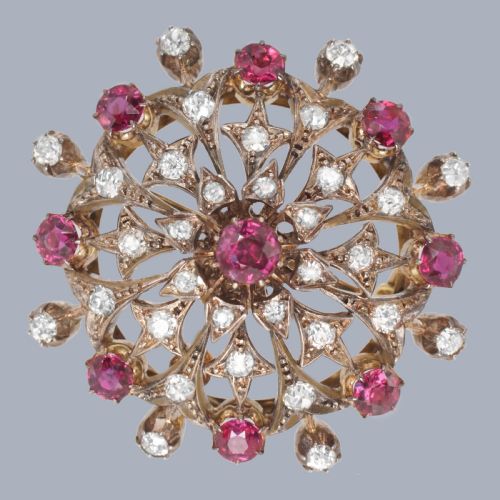


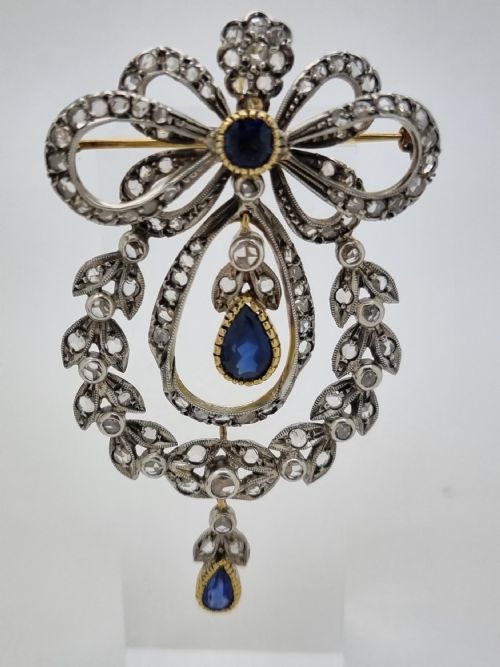
Antique Conversion Brooch
An antique conversion brooch brings together earlier jewels and versatile mountings, giving a dual-purpose piece that wears equally well as a pendant.
Antique Conversion Brooch
An antique conversion brooch is a hybrid jewel designed to transform between a lapel ornament and a neck pendant, offering two ways to display the same piece. The examples on this page span the Victorian, Edwardian, and Art Deco eras, reaching from the late nineteenth century into the 1930s.
Most pieces combine brooches and pendants into single convertible mounts, alongside occasional hybrid bracelet forms. The selection includes sunbursts, floral acanthus motifs, and Austro-Hungarian enamelwork alongside simpler English silver and china designs.
Many items incorporate gem reports or feature central stones such as diamonds, rubies, sapphires, peridots, and garnets. The common thread is the clever engineering that allows a single item of jewellery to serve multiple functions.
Materials and construction
Goldsmiths worked in yellow gold, 15ct and 18ct gold, silver gilt, and 9ct or 14ct gold, often backing silver with gold to show diamonds to best advantage. Enamelwork, particularly red guilloche enamel, added vibrant colour to the metal frames.
Gemstones including diamonds, pearls, sapphires, rubies, and peridots were secured in claw or bezel settings. Convertible mechanisms relied on folding loops, removable bails, or screw-fit pins that concealed the fastening when worn around the neck.
Listings span from the 1880s through the Edwardian era to 1930, featuring gold, silver, diamonds, pearls, and enamel.
What separates the finest pieces
Quality rests on the subtlety of the conversion mechanism and how securely the piece fastens in both configurations. A superior example hides its hinges and loops so that neither function looks like an afterthought.
The selection of stones and the crispness of chased motifs, such as floral acanthus or sunburst rays, determine the level of artistry. Heavier gold weights and undamaged enamel surfaces further elevate a piece above standard production.
The Antique Conversion Brooch Glossary
- Conversion brooch
- A jewel adapted from its original form, usually a brooch altered to also function as a pendant. This versatility was popular in various periods to suit changing fashions.
- Guilloche
- An engraved decorative pattern on metal covered with translucent enamel. It creates repetitive geometric waves that catch the light beneath the colour.
- Silver gilt
- Silver covered with a thin layer of gold. This technique provided the bright white setting favoured for diamonds while keeping the warm tone of gold against the skin.
- Acanthus
- A classical ornamental motif based on Mediterranean foliage leaves. Designers carved and chased these curved shapes into gold mounts during the Victorian era.
- Sunburst
- A radial design radiating outwards from a central stone. This popular motif mimics the rays of the sun in gemstones and precious metal.
Antique Conversion Brooch: Frequently Asked Questions
What is an antique conversion brooch?
An antique conversion brooch is a piece of jewellery originally made as one item, such as a brooch, and later adapted with loops or hinges to also be worn as a pendant.
These pieces reflect historic practices of updating older jewels to match the changing fashions of subsequent decades.
How do you wear a convertible brooch?
These jewels feature hidden bails, fold-down pin stems, or detachable fittings that allow the wearer to transition between pinning the piece to a lapel and suspending it from a chain.
The engineering ensures that the fastening mechanism for one mode remains discreet while using the other.
Which periods are common for these pieces?
The listings here feature items from the Victorian, Edwardian, and Art Deco periods, spanning the late nineteenth century through to about 1930.
Victorian and Edwardian examples frequently incorporate diamonds, pearls, and coloured gemstones in yellow gold or silver settings.
What materials appear in these jewels?
Metals include 9ct, 14ct, 15ct, and 18ct yellow gold, silver, and silver gilt, often paired with decorative red guilloche enamel.
Gemstones range from diamonds and pearls to rubies, sapphires, peridots, garnets, and painted china plaques.