
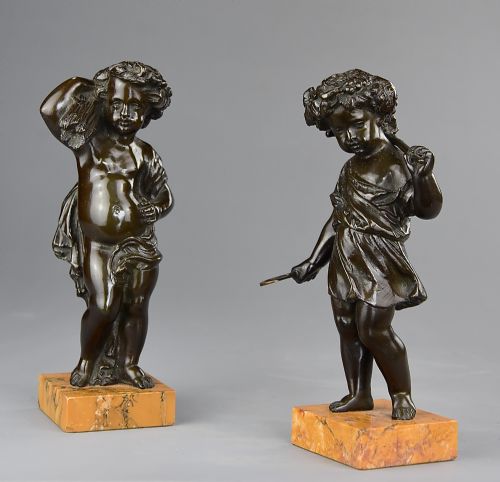
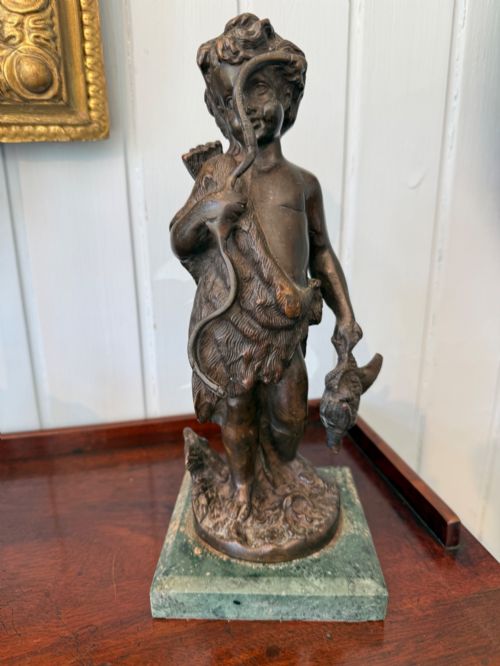


Antique Cherub Statuette
An antique cherub statuette brings classical mythology into a room through cast metal and painted ceramic figures.
Antique Cherub Statuette
Every antique cherub statuette represents mythological figures of youth, love, and harvest, appearing across the nineteenth and early twentieth centuries in both bronze and porcelain.
Buyers meet these pieces in various forms, from small desk statuettes and lamp conversions to balanced pairs mounted on marble or wood bases.
French and Italian workshops dominate the origin of these works, frequently drawing on classical motifs and neoclassical sculpture traditions.
Materials and methods
Foundries produced bronze examples using traditional casting methods, often finishing the metal with patination, ormolu gilding, or fine hand-chasing.
Ceramic and porcelain versions relied on moulded soft or hard paste, finished with hand-painted polychrome decoration and enamel detailing.
Some cherubs hold grapes for harvest, while others hunt with dogs or wear clever disguises.
Judging quality
In porcelain pieces, quality rests upon the delicacy of the moulding and the precision of the hand-painted enamels, avoiding muddy colours or flat glazes.
Edme Samson·Royal Worcester·Meissen·Karl Tutter·Johann Joachim Kandler
The Antique Cherub Statuette Glossary
- Putto
- A plump, winged male child figure frequently seen in Renaissance and later classical art. It serves as the primary subject for these statuettes.
- Ormolu
- Finely ground high-carat gold applied to bronze objects using a mercury amalgam technique. This creates a bright, durable golden surface.
- Patinated bronze
- Metal treated with chemical solutions to produce a controlled surface colour, ranging from deep brown to greenish tones.
- Hard paste porcelain
- A dense, vitrified ceramic composition fired at high temperatures. It allows for sharp detail and a bright white body.
Antique Cherub Statuette: Frequently Asked Questions
What is the difference between a cherub and a putto?
Art historians distinguish between biblical cherubim and secular putti, though nineteenth-century makers used the terms interchangeably for winged children.
Most statuettes on the market depict the playful, secular putto rather than the celestial guardian.
How do I care for bronze cherub statuettes?
Bronze requires only occasional dusting with a soft brush to keep the patination stable and intact.
Avoid commercial metal polishes, which strip away historical patination and damage the metal surface.
Where were these figures displayed originally?
Victorian and Edwardian interiors featured these statuettes on mantelpieces, occasional tables, and enclosed cabinet shelves.
Pairs often flanked clocks or candelabras on formal drawing-room mantelpieces.
How can I date a porcelain cherub figure?
Makers applied factory marks, impressed numbers, and painted symbols to the base of ceramic pieces during manufacture.
Comparing these marks to standard factory reference guides reveals the active production period.