


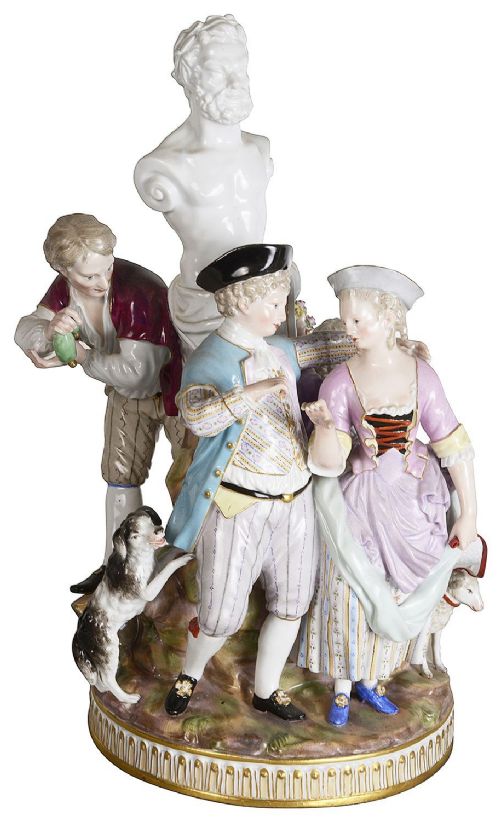


Antique Ceramic Courting Couple
An antique ceramic courting couple captures romantic pastoral fantasy in porcelain, offering charm and decorative presence for a traditional interior.
Antique Ceramic Courting Couple
An antique ceramic courting couple comprises figures and groups depicting romantic pairs, gallants, and ladies in pastoral or formal settings. These pieces primarily take the form of decorative porcelain figurines, lace groups, and table lamps originating from European factories during the eighteenth and nineteenth centuries.
The most common examples on this page belong to the nineteenth century, including Victorian pieces, Rococo Revival styles, and German or French productions. Buyers encounter everything from single biscuit figures to large paired groups adorned with enamel and gold leaf.
Factory origins span major European ceramic centres, notably France and Germany, encompassing makers like Meissen, Volkstedt, and Paris firms. The visual vocabulary draws heavily on French Rococo and Neo-Rococo aesthetics, presenting idealised couples often accompanied by musical instruments or classical elements.
How they were made
These figures rely on hard-paste porcelain, bisque porcelain, and faience, shaped through moulding and hand-modelling techniques. Makers applied detailed surface treatments including polychrome enamel paints, gilding, and applied gold leaf to accentuate garments and decorative motifs.
Specialised techniques distinguish particular styles, such as delicate ceramic lace incorporated into Paris porcelain groups or unglazed biscuit and Parian bodies utilised for matte textural contrast. Metal components appear occasionally, particularly when figures are adapted into table lamps or fitted with auxiliary mountings.
Listings feature 19th Century, Victorian, 1880, 1930, and 18th Century periods.
What varies in quality
Quality in these figures rests on the crispness of the modelling, the delicacy of facial expressions, and the intricacy of painted or applied details. Superior pieces display finely rendered hand-painted enamel work and precise gilding that remains crisp across complex drapery and floral elements.
The sophistication of the factory origin and the complexity of the form dictate the upper tier of the range, seen in intricate Meissen groups or elaborate Paris lace figures. Simpler moulded pieces or later twentieth-century German productions represent a more straightforward standard of execution.
Bourdois & Bloch·Letu & Mauger·Volkstedt·Meissen·Triebner Ens & Co·Ludwigsburg
The Antique Ceramic Courting Couple Glossary
- Bisque Porcelain
- Unbleached, unglazed porcelain fired to a matte, tactile finish. It reveals fine sculptural detail without the glossy shine of standard ceramic glazes.
- Hard-paste Porcelain
- A durable ceramic composition fired at very high temperatures, originating in China and later mastered in Europe at factories like Meissen. It provides a robust and resonant body for intricate figurines.
- Faience
- Tin-glazed earthenware produced widely in continental Europe. It offers an opaque white background suitable for colourful hand-painted decoration.
- Parian
- A fine-grained, white, unglazed biscuit porcelain resembling marble, developed in the nineteenth century. It takes its name from Parian marble found in Greece.
- Rococo Revival
- A nineteenth-century design movement resurrecting the asymmetry, scrollwork, and playful romance of the eighteenth-century French style. It dominates the aesthetic of many Victorian ceramic groups.
- Enamel
- Vitrified glass powder fused to the ceramic surface through firing, providing permanent colour. It allows for vibrant hues on garments and decorative accessories.
Antique Ceramic Courting Couple: Frequently Asked Questions
What periods do these courting couples come from?
The pieces span from the eighteenth century through the nineteenth century and into the early twentieth century. Eighteenth-century examples represent early European factory production, while nineteenth-century pieces frequently embrace Rococo Revival and Victorian aesthetics.
German and French workshops dominate the production timeline across these eras. Stylistic cues and factory marks help narrow down the manufacturing decade.
How were ceramic courting figures displayed?
Historically, these decorative figures sat upon mantelpieces, drawing-room tables, and within display cabinets as conversation pieces. They reflected fashionable taste for romantic and pastoral motifs in domestic interiors.
Some later examples were adapted into table lamps, combining ornamental sculptural presence with functional lighting. Pairs were often placed symmetrically to anchor a room scheme.
How do I identify French versus German figures?
French pieces often exhibit the ornate stylings of Paris porcelain workshops and Faience traditions, featuring delicate lace work or vibrant enamel palettes. German output is frequently anchored by historic factories like Meissen and Volkstedt, known for classical sculptural grouping and distinct pastoral themes.
Factory marks, when present on the base, provide the definitive attribution for origin and period.