



Antique Brass Calendar
An antique brass calendar brings mechanical precision and nineteenth-century desk organisation into a modern room.
Antique Brass Calendar
When you search for an antique brass calendar, you find desk accessories and timepieces designed to track dates through shifting mechanical systems. These objects range from simple travel mounts holding miniature almanacs to elaborate perpetual calendars integrated into carriage clocks and stationery cabinets.
Makers such as William Tonks and Best & Lloyd produced sturdy cast brass pieces, while firms like Drocourt and L'Epee integrated date work into sophisticated carriage clocks. The selection spans utilitarian desk clips to heavy architectural desk stands with Egyptian decoration.
What varies in quality
Quality in these pieces depends on the crispness of the brass casting and the complexity of the mechanism. Heavy cast brass with sharp, clean detailing and signed maker's marks represents the upper tier of production.
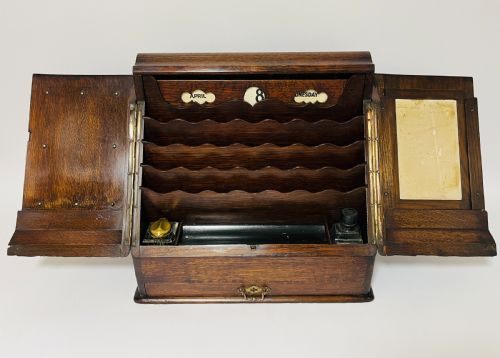
The integration of multiple functions, such as combined inkwells, thermometers, or clock movements with moon phases, elevates a piece beyond a standard desk calendar. Well-preserved original paper inserts, glass panels, and fully operational mechanical date rollers further distinguish finer examples.
William Tonks of Birmingham·Best and Lloyd·Drocourt·L Epee·Asprey London·J F Bautte Et Cie
The Antique Brass Calendar Glossary
- Perpetual calendar
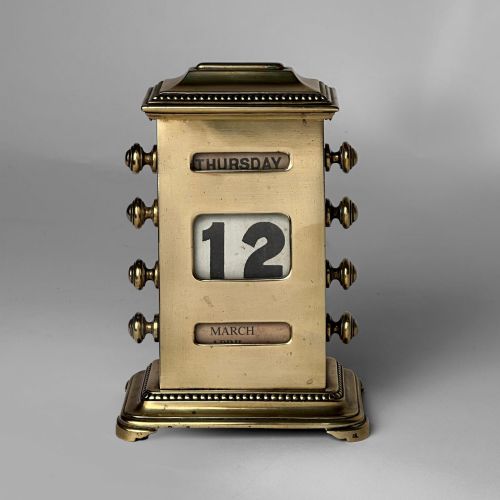
- A mechanism designed to correctly display the date through changing months and leap years without manual monthly adjustment. These systems rely on intricate internal gear wheels and rotating cylinders.
- Carriage clock
- A small, spring-driven timekeeper originally designed for travelling during the nineteenth century. Many fine examples incorporate alarm functions, strike trains, and calendar date work.
- Grande sonnerie
- A striking clock mechanism that sounds both the hours and the quarters automatically on every quarter hour. This complex complication is typically found on high-grade nineteenth-century French clocks.
- Almanac
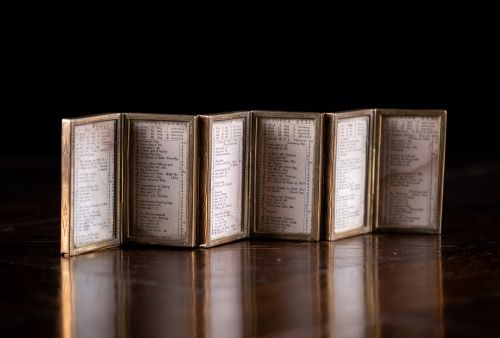
- An annual publication containing tabular information such as calendars and anniversaries. Miniature versions were often housed in glazed brass travelling mounts for daily reference.
- Desk clip
- A sprung metal arm mounted to a wooden or brass base for holding papers and notes. Some Edwardian variants integrated a perpetual calendar directly onto the hardware.
Antique Brass Calendar: Frequently Asked Questions
How do perpetual calendars work?
Perpetual calendars use internal gear trains and rotating drums to account for the varying lengths of months automatically. They require manual adjustment only during leap years, depending on the specific mechanical design.
Simpler desk models relied on manually turned thumbscrews or sliding indicator cards to change the day, date, and month daily or monthly.
Where were these calendars used?
These pieces sat upon writing desks, partners' desks, and library tables in late nineteenth and early twentieth-century homes and offices. They served as essential daily reference tools before digital timekeeping.
Portable versions with folding stands or fitted cases travelled with owners in luggage or were placed on hotel dressing tables.
How do I care for brass desk accessories?
Maintain brass by dusting it gently with a dry, soft cloth to prevent the accumulation of grit in engraved crevices and mechanical joints. Avoid harsh chemical polishes that strip away the aged patina accumulated over decades.
Keep mechanical date rollers and clock movements lubricated professionally if the piece contains active clockwork components.
How can I tell the period?
Dating relies on stylistic clues, such as heavy Victorian casting, Edwardian mahogany combinations, or geometric Art Deco lines from the nineteen-thirties. Maker's marks and retailer signatures stamped into the brass also help establish an accurate date of origin.
Original paper inserts and accompanying leather travel cases often provide specific clues, such as printed years on nineteenth-century almanacs.