
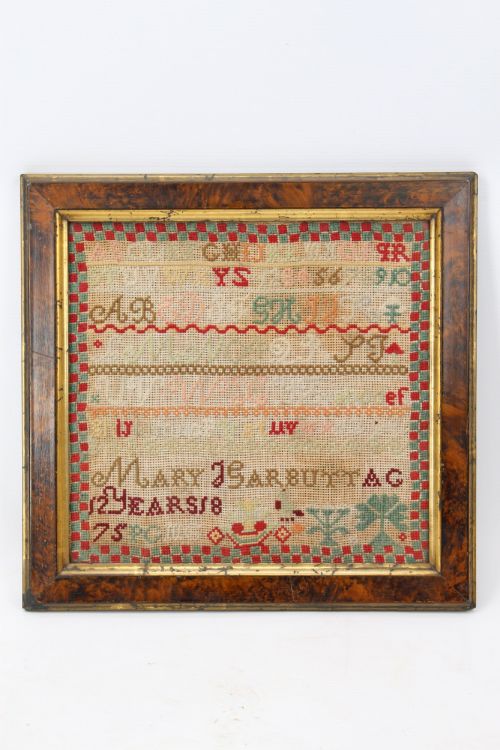
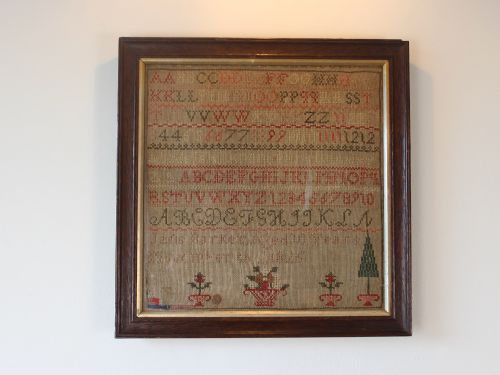
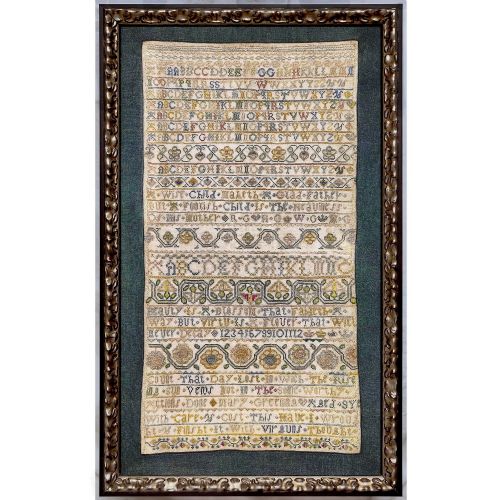


Antique Alphabet Sampler
An antique alphabet sampler holds the patient stitch work of children and young women, preserving letters, numerals and verses in fine thread.
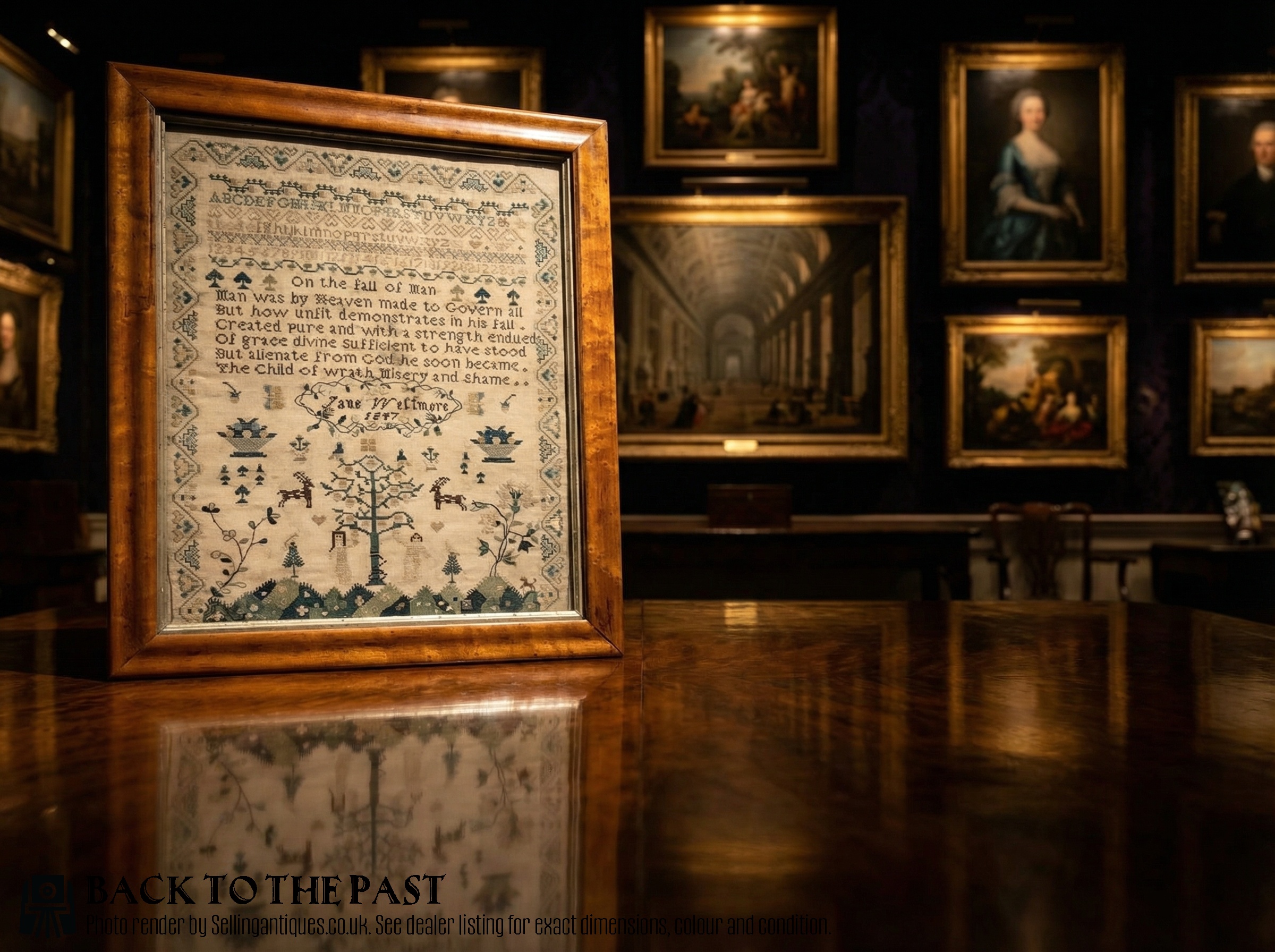
Antique Alphabet Sampler
An antique alphabet sampler is a textile piece worked in thread to demonstrate needlework proficiency, most frequently encountered from the Georgian and Victorian periods. These pieces often record the maker's name, age and date alongside rows of alphabets and numbers.
The format ranges from simple practice panels to complex framed wall art containing pious verses, moral texts and decorative motifs. Surviving examples span from the late seventeenth century through to the end of the nineteenth century, reflecting changing educational practices.
Makers on this page include young girls such as Mary J Garbutt, Annabella Samon and Margaret Ann Blackow, whose stitched records survive in linen grounds. Collectors encounter both modest domestic efforts and elaborate schoolroom pieces.
Materials and construction
Needlework samplers rely on linen foundation fabric worked with wool, silk thread and standard thread. The natural fibres support counted thread embroidery techniques, primarily cross stitch and varied running stitches.
Many surviving examples retain period wooden frames and glass protection that preserve the fragile textile ground. Silk threads often show distinct fading while wool and linen maintain structural integrity over centuries.
Antique Alphabet Sampler Retail Price Guide 2026
Typical asking prices for alphabet sampler among the pieces listed under this phrase on Sellingantiques today, from the lower quarter to the upper quarter. They describe what is for sale here now, not the wider market.
Current listings feature needlework samplers spanning the 18th century, Georgian period, and Victorian era, worked in linen with silk and wool thread.
Assessing quality and execution
Quality in an antique alphabet sampler rests upon the regularity of the stitching, the complexity of the alphabets and the inclusion of pictorial motifs or verse. Finer examples display precise tension, balanced layouts and clear lettering across the linen ground.
The historical documentation adds distinct merit, particularly when makers record their age, location, or specific institutions such as the Oswestry National School or Crystal Palace. Condition plays a role, with clean linen and secure framing separating superior survivals from damaged textiles.
Mary J Garbutt·Annabella Samon·Jane Wettmore·Ann Hodson·Margaret Ann Blackow·Maggie Muir·Sarah Baker·Ann B Gilies·Martha Hall·Sarah Reading·Jane Pattinson·Eleanor Grady·Jane Brand
The Antique Alphabet Sampler Glossary
- Band sampler
- A long, narrow textile featuring horizontal bands of diverse embroidery patterns and alphabets. These early forms allowed workers to practice distinct stitches in sequence.
- Cross stitch
- An embroidery technique formed by two crossing diagonal stitches. This method creates the foundational lettering and motifs seen across most nineteenth-century examples.
- Linen
- A strong textile woven from flax fibres, used as the primary foundation ground for needlework. Its uniform weave facilitated the counting required for precise lettering.
- Tapestry sampler
- A needlework panel executed on a canvas or open-weave ground using heavier wool or silk threads. These pieces often cover larger pictorial compositions alongside alphabets.
- Schoolroom sampler
- A needlework piece produced under formal instruction, frequently bearing the name of an academy or teacher. Such pieces often exhibit disciplined letterforms and uniform borders.
Antique Alphabet Sampler: Frequently Asked Questions
What is an antique alphabet sampler?
An antique alphabet sampler is a historical piece of textile art where a young worker stitched letters, numbers and sometimes decorative motifs onto a linen background. These panels served as educational exercises and testaments to domestic skill.
Most surviving examples date from the Georgian and Victorian eras, often recording the maker's age and specific dates. They provide direct insight into nineteenth-century education and needlework traditions.
How were alphabet samplers used?
Young girls and students created these textiles to master basic literacy and advanced embroidery stitches. Schools and homes utilised them as practical training tools for domestic life.
Once completed, families framed and displayed the panels as wall art in domestic interiors. They served as commemorative keepsakes marking a child's progress or milestones.
How do I date an antique alphabet sampler?
Many samplers include embroidered dates, maker names and ages that establish a clear point of origin. Stylistic clues such as framing materials, linen texture and typography also indicate the period.
Georgian examples tend to feature distinct muted palettes and simpler borders, while Victorian pieces often incorporate elaborate wool work and formal typography. Comparing the lettering style to known historical benchmarks refines the chronology.
How should I care for a framed sampler?
Keep textile samplers away from direct sunlight to prevent the fading of silk and wool threads. Stable indoor humidity levels protect the fragile linen ground and wooden frames from deterioration.
Avoid hanging pieces in damp areas such as kitchens or unheated spaces. Professional framing using conservation glass ensures the textile remains secure and protected from airborne pollutants.