




Amboyna Centre Table
An amboyna centre table brings warmth and rich grain to a room, offering a striking focal point with its distinctive figured wood.
Amboyna Centre Table
When you search for an amboyna centre table, you are looking at nineteenth-century occasional furniture designed to stand free in a room. Most examples on this page date from the Victorian era, spanning the middle and latter decades of the nineteenth century.
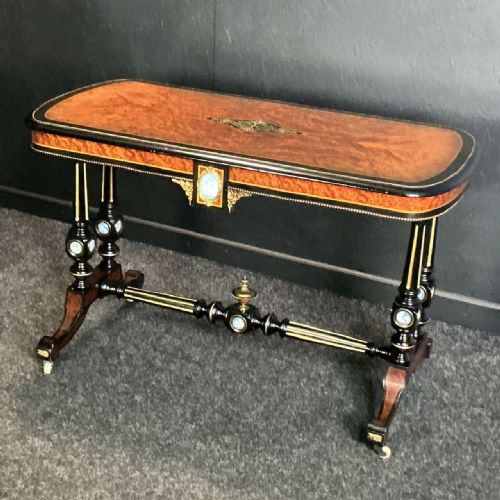
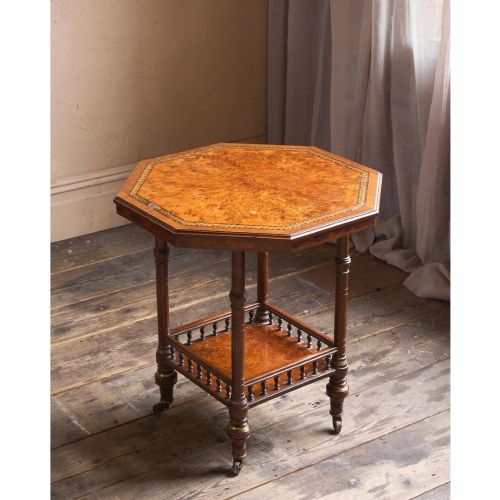
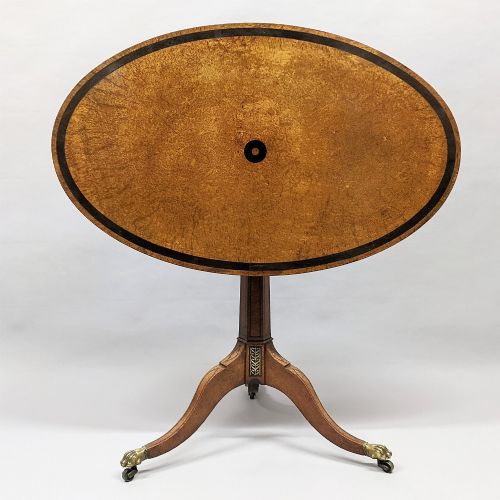
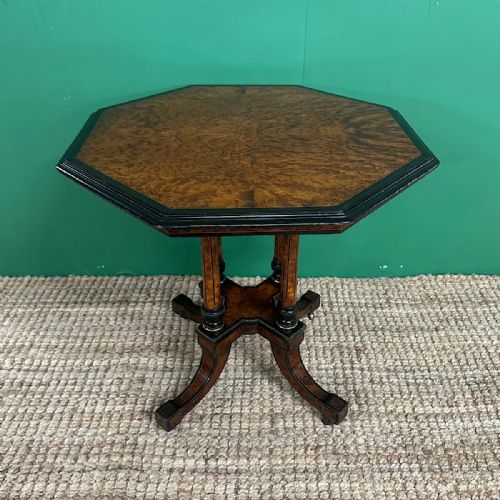
The forms vary from round tilt-top pieces to oval side tables and occasional tables. Makers often combined amboyna veneer with ebonised wood, brass, or ormolu mounts to create these decorative centre tables.
How they were made
Cabinet makers applied fine amboyna veneer over a secondary wood base to showcase the intricate, swirling grain of the timber. They frequently incorporated ebonised wood borders, brass stringing, and marquetry inlay to enhance the visual depth.
Metal mounts in ormolu and parcel gilt details were added to accentuate the architectural lines of the tables. These techniques required skilled craftsmanship to manage dense tropical hardwoods and delicate veneers.
Some nineteenth-century tables include a tilt mechanism designed so the heavy amboyna top could hide modestly against the wall.
What varies in quality
The fineness of the amboyna veneer and the complexity of the marquetry inlay determine the tier of a piece. Stronger examples display rich, unblemished figuring across the entire top surface rather than patchy or faded grain.
Attribution to documented workshops elevates certain tables, particularly those showing refined carving, precise brass mounts, and well-executed ebonisation. The integrity of the timber ground and the crispness of secondary woods also separate standard production from superior cabinet work.
Gillows·Edwards And Roberts·George Blake and Co·Edward Holmes Baldock·Holland and Son
The Amboyna Centre Table Glossary
- Ebonised
- Wood treated with a dark stain or finish to imitate ebony. It provides a sharp, dark contrast against the golden tones of amboyna.
- Ormolu
- Gilded bronze applied as decorative mounts and feet on Victorian furniture. It adds metallic highlights to the dark wood structures.
- Marquetry
- Inlaid patterns of wood veneers assembled to form decorative pictures or geometric designs. It is commonly found on the top surfaces of nineteenth-century centre tables.
- Tilt-top
- A table mechanism allowing the surface to pivot and lock vertically when not in use. This clever design saved space in grand Victorian drawing rooms.
Amboyna Centre Table: Frequently Asked Questions
Where should I place a centre table?
A centre table belongs in the middle of a room where it can be viewed from all sides. It functions well in a large hallway or drawing room as a display surface.
Ensure there is enough walking space around the perimeter so the table sits comfortably within the room's proportions.
How do I care for amboyna veneer?
Keep amboyna furniture away from direct sunlight and strong heat sources to prevent the veneer from drying out and lifting. Dust gently with a dry microfibre cloth.
Avoid silicone polishes and moisture, which can damage the historic polish and delicate wood grain over time.
What is the difference between a centre table and a side table?
A centre table is finished on all sides because it is intended to stand freestanding in an open space. Side tables are generally built to sit flush against a wall.
Victorian makers applied the same decorative amboyna veneers to both forms, though true centre tables often feature more elaborate marquetry across the entire top.
How can I identify a Victorian amboyna table?
Look for characteristic nineteenth-century construction methods, such as mahogany or oak secondary timbers beneath the amboyna veneer. Stylistic cues like ebonised borders and brass ormolu mounts point directly to the Victorian period.
Many examples also incorporate marquetry inlay or French revival influences popular during the middle decades of the nineteenth century.