


19th Century Pocket Watch
These 19th century pocket watch pieces are precise timekeepers and associated holders that bring Victorian mechanical craft directly to your pocket or desk.
What 19th century pocket watch pieces are
When you search for a 19th century pocket watch, you are looking at portable mechanical timepieces driven by spring power, alongside the stands, cases, and boxes designed to display or store them. The pieces you meet here span the Victorian era, including specific years like 1883 alongside broader 19th century designations.
Origin points vary between English makers in London and continental pieces, notably French hallmarked solid silver and enamel examples. Whether you require a working watch with its winding key or a mahogany stand with dentil decoration, each item reflects the domestic and personal timekeeping habits of the period.
What varies in quality
Quality separates mass-produced items from pieces bearing signature details, such as named London makers or French hallmarks on solid silver and enamel. The precision of the internal movement, particularly complex fusee mechanisms, dictates the mechanical standard of the watch.
In the associated stands and boxes, craftsmanship shows in the execution of parquetry inlay, dentil decoration, and the choice of timbers like mahogany. Preserved components, including original winding keys and undamaged enamel dials, elevate the integrity of the piece.
Retail Price Guide 2026
Typical UK retail prices for 19th century pocket watch, calculated from the Sellingantiques database of over a million retail prices indexed since 2003. This retail price guide relies exclusively on Sellingantiques data; no external sources or auction records are used, so the figures do not describe the wider market.
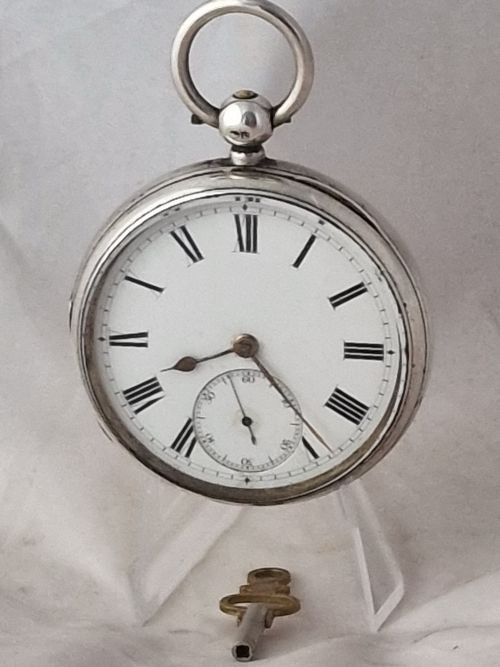
Several 19th century pocket watch owners clearly misplaced their winding keys, as surviving examples frequently retain their original keys tethered safely nearby.
Bickley London·Longines·Sir John Bennett·Waltham
The 19th Century Pocket Watch Glossary
- Fusee
- A conical pulley used in older watch movements to equalise the torque of the mainspring as it unwinds. This mechanism helps maintain consistent timekeeping accuracy throughout the power reserve.
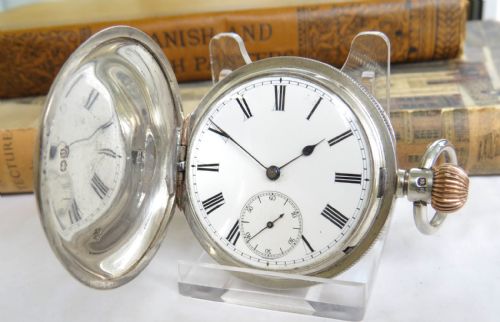
- Full hunter
- A pocket watch style featuring a spring-loaded metal cover that protects the glass dial. The cover opens via a push-piece on the crown.
- Parquetry
- A geometric mosaic of wood pieces used for decorative effect on boxes and stands. It involves precise fitting of contrasting timber veneers.
- Dentil
- A series of small, rectangular blocks spaced evenly along a moulding. This architectural detail frequently appears on mahogany watch stands.
Frequently Asked Questions
How do I wind a Victorian pocket watch?
Many 19th century watches utilise a separate key rather than a stem-winder. You insert the key into the designated square arbor on the back plate or dial to tension the mainspring.
Take care not to over-wind the mechanism, stopping gently as soon as resistance increases to avoid snapping the internal spring.
What is a fusee pocket watch?
A fusee movement incorporates a conical drum connected to the mainspring by a fine chain. This ingenious design compensates for the diminishing force of the spring as it runs down.
This method ensures steady power delivery to the escapement, resulting in more reliable timekeeping across the winding cycle.
How were pocket watches displayed in the 19th century?
Owners placed their watches on dedicated mahogany stands, holders, or parquetry boxes when not being carried in a waistcoat pocket. These accessories kept the timepiece visible on a desk or bedside table.
Some holders included small hooks or glass domes to protect the watch while allowing the dial to remain clearly in view.