
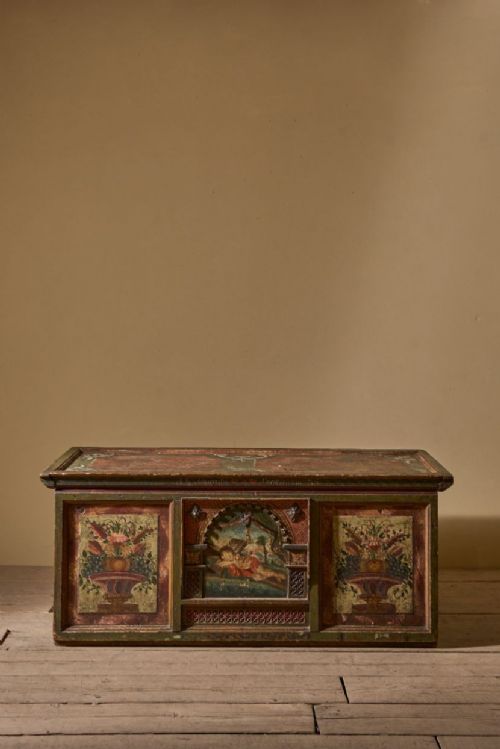


19th Century Marriage Chest
These heavy wooden trunks carried dowries across Europe and beyond, bringing hand-painted folk tradition straight into a modern hallway.
19th Century Marriage Chest
A 19th century marriage chest serves as a robust storage container built to hold household linens and personal property for a new household. These sturdy trunks appear frequently in Scandinavian, Alpine, Spanish Colonial, and traditional Indian forms.
Buyers encounter pine and oak box structures most often, frequently shaped with dome tops or flat lids. Many examples originate from Swedish workshops, displaying regional folk art painting traditions.
Continental workshops also produced intricately inlaid walnut coffer chests and carved beech cassone pieces. Each trunk reflects the distinct aesthetic of its local village or regional style.
How they were made
Carpenters constructed these storage pieces primarily from solid pine, oak, walnut, or beech timber. Iron and wrought iron hardware, including strap hinges and handles, reinforced the heavy timber joints.
Painters applied pigment, mineral pigment, and protective paint finishes directly to the wood surfaces. Artisans incorporated intricate folk decoration, hand-painted motifs, and occasionally elaborate surface inlay.
Swedish folk art dominates the painted box category, accompanied by examples from Spanish Colonial and traditional Indian origins.
What varies in quality
The sophistication of the hand-painted decoration separates standard utility trunks from superior folk art examples. Bold, well-preserved pigment layers and detailed regional brushwork indicate higher artistic effort during creation.
Construction choices dictate overall robustness, distinguishing simple boarded pine boxes from heavily framed oak or walnut coffers with complex joinery. Original wrought iron mounts and undisturbed surface patinas elevate the integrity of a piece.
The 19th Century Marriage Chest Glossary
- Cofer
- A large strongbox or chest used for storing valuables and household goods. These heavy containers typically feature reinforced lids and sturdy timber walls.
- Cassone
- An expensive richly decorated chest used in Italy for holding bridal trousseau items. These carved wooden boxes often display Renaissance motifs.
- Dome top
- A rounded lid construction that sheds dust and provides extra internal capacity. This curved shape appears frequently on Scandinavian storage chests.
- Mineral pigment
- Natural earth and mineral colorants used by folk artists to paint wooden surfaces. These traditional mixtures produced durable matte finishes.
19th Century Marriage Chest: Frequently Asked Questions
How were marriage chests used?
Families used these large wooden trunks to transport and store the bride's dowry, including linens, clothing, and household valuables.
They doubled as sturdy seating or tables within modest rural homes before finding permanent placement against a wall.
Where do most painted chests originate?
A significant portion of these painted examples originate from rural Swedish and Alpine regions where folk art traditions thrived throughout the eighteen hundreds.
Other variations stem from Spanish Colonial territories, traditional Indian workshops, and various continental European areas.
How do I care for a painted pine chest?
Keep the piece away from direct sunlight and dramatic humidity shifts to protect fragile historic paintwork and mineral pigments.
Dust gently with a dry cloth and avoid chemical polishes that might damage the original surface patina.