
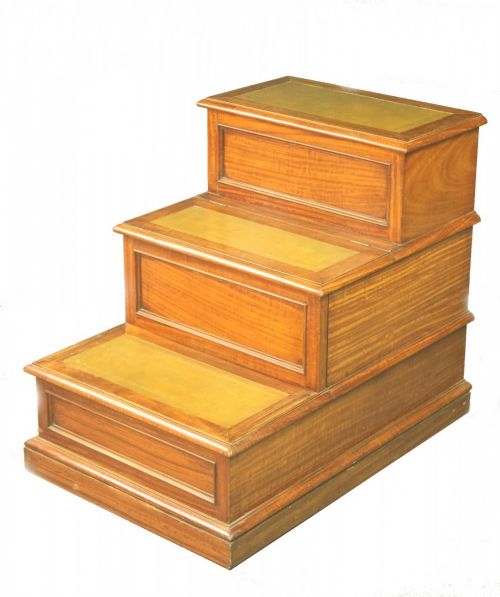


19th Century Library Steps
These 19th century library steps bring period architectural presence to a room while solving the perennial problem of high shelves.
19th Century Library Steps
When you search for 19th century library steps, you encounter pieces designed to reach high bookcases in period homes. Mahogany and oak dominate the selection, often appearing in traditional three-tread forms or ingenious metamorphic designs that convert into chairs, stools, or tables.
The material palette extends beyond standard hardwoods to include pine, satinwood, walnut, and fruitwood. Alongside standard sets, the evidence includes specialised bed steps and step ladders suited to different domestic tasks.
Stylistic variations range from restrained Regency examples to elaborate Victorian pieces, including Gothic Revival interpretations that reflect the architectural tastes of the period.
Materials and construction
Cabinetmakers utilised dense timbers like mahogany, oak, and walnut to ensure stability under load. These woods were turned, joined, and polished to withstand daily domestic use.
Many treads feature inset leather surfaces, often detailed with blind tooling, to provide grip. Brass hinges, brackets, and fittings allow folding and metamorphic designs to transition smoothly between configurations.
Listings feature woods including mahogany, oak, walnut, pine, satinwood, and fruitwood, alongside leather and brass elements.
Judging quality in library steps
Quality rests upon the ingenuity of the mechanism and the integrity of the timber. Metamorphic pieces that shift between a chair and steps demand precise joinery to remain sturdy in both forms.
The refinement of the secondary details, such as the quality of the brass hardware and the application of leather treads, distinguishes standard utility pieces from finer library furnishings.
Phillips Brothers·J. Jarvis
The 19th Century Library Steps Glossary
- Metamorphic
- Furniture designed to transform into another functional form, such as a chair converting into library steps. This clever engineering allowed space-saving versatility in period interiors.
- Tread
- The horizontal surface of a step upon which one places the foot. In library steps, these are frequently surfaced with leather.
- Gothic Revival
- A nineteenth-century style drawing inspiration from medieval architecture. Pieces in this manner often incorporate pointed arches and heavy oak construction.
- Fusee
- A conical pulley used in clock movements to equalize the power of the mainspring as it unwinds. This mechanism appears in specialised timepiece variants associated with libraries.
- Regency
- A stylistic period spanning the early nineteenth century characterised by classical restraint and elegance. Furniture from this era displays clean lines and fine timber selection.
19th Century Library Steps: Frequently Asked Questions
How do metamorphic library steps work?
Metamorphic steps utilise hidden hinges and pivoting joints that allow the upper section to unfold securely over a lower base. This mechanical ingenuity transforms a standard chair, stool, or table into a functional flight of stairs.
Once locked into position, the frame provides stable support before folding back into its compact primary shape when not in use.
What is the difference between library steps and bed steps?
Library steps were built taller to reach upper bookshelves in domestic studies and grand libraries. They prioritize stability at height and frequently incorporate larger tread configurations.
Bed steps were constructed with lower profiles to assist occupants in climbing into high period bedframes. Their smaller scale distinguishes them from full library ladders.
Where were library steps placed?
These pieces sat beside tall bookcases within home studies, libraries, and parlours. Their portable nature allowed them to be moved wherever high shelving required access.
When not in active use, folding or metamorphic variants occupied minimal floor space against the wall or functioned as seating.
How do I identify a Regency set?
Regency examples display classical proportions, restrained ornamentation, and often feature rich mahogany with minimal fuss. The joinery emphasises clean architectural lines typical of the early nineteenth century.
Later Victorian pieces often introduce heavier proportions, contrasting oak, or elaborate Gothic Revival detailing.