
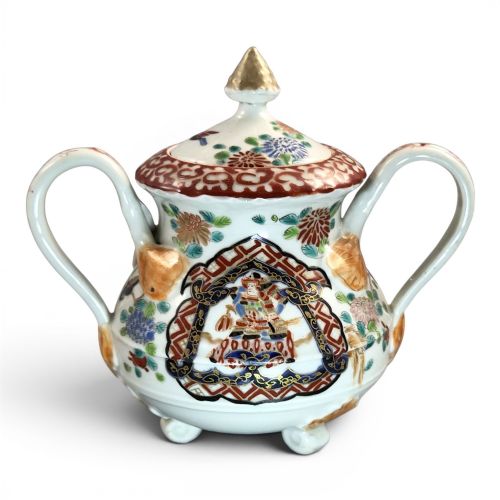


19th Century Imari Jar
A 19th century imari jar brings together striking iron-red and cobalt blue palettes to anchor a room with traditional ceramic weight.
19th Century Imari Jar
A 19th century imari jar typically presents as a covered ginger jar, lidded vase, or koro originating from Japan during the Meiji period. These ceramic vessels combine distinct forms with dense coloration to function as decorative centrepieces.
The selection ranges from individual covered ginger jars from Arita to large pairs of lidded vases and sugar bowls with figural scenes. Many examples originate in the decades between eighteen-fifty and eighteen-ninety, reflecting traditional Japanese porcelain production.
Makers such as Fukagawa contributed marked pieces featuring samurai motifs, while others display standard floral and geometric panelling. Buyers encounter both single jars and balanced pairs suited for mantelpieces or side tables.
Materials and construction
These pieces utilise porcelain, ironstone, and ceramic bodies shaped into vases, jars, and bowls. The foundational clay is fired before receiving complex hand-painted decoration.
Enamel glaze, gold leaf, and gilt details are applied over or under the glaze to create the characteristic Imari sheen. Cobalt blue underglaze works alongside iron-red enamel and gold highlights to define the surface patterns.
Listings feature items from eighteen-fifty through eighteen-ninety, spanning the Meiji period and featuring porcelain, ironstone, and enamel glaze.
Factors distinguishing quality
Quality rests upon the precision of the brushwork and the complexity of the palette, particularly the integration of gold leaf and enamel glaze. Superior pieces exhibit crisp cobalt blue underglaze contrasted with finely detailed iron-red motifs.
The presence of specific kiln marks, such as those from Fukagawa, or documented origins like Arita elevate an item's standing. Scale and proportion also matter, with exceptionally large lidded vases or balanced pairs demonstrating greater ambition in design.
Fukagawa·Mason·Arita
The 19th Century Imari Jar Glossary
- Imari
- A style of Japanese porcelain featuring a palette dominated by cobalt blue, iron-red, and gold. This decorative approach originated in Arita and gained popularity across Europe in the nineteenth century.
- Meiji Period
- The era in Japanese history spanning from eighteen-sixty-eight to nineteen-twelve, associated with opening trade and distinct ceramic exports. Pieces from this time often display refined enamel work and varied forms.
- Ginger Jar
- A high-shouldered ceramic vessel with a domed lid, originally designed for storing spices. Nineteenth century examples frequently serve decorative roles on mantels and tables.
- Ironstone
- A type of heavy ceramic developed in Britain as a durable alternative to porcelain. Mason's ironstone pieces represent this category within nineteenth century collections.
- Koro
- A traditional Japanese incense burner typically supported on three legs and fitted with a pierced lid. These lidded vessels appear in nineteenth century inventories alongside standard vases.
19th Century Imari Jar: Frequently Asked Questions
How do I identify a Meiji period piece?
Meiji period items align with the late nineteenth century reign and typically display technical refinement in their enamel glazes and gilding. Look for distinct export styling intended for Western markets during this era.
Pottery marks on the base, such as those from Fukagawa or Arita, often confirm the Japanese origin and help narrow the production date within the eighteen-eighties or nineties.
What is the difference between a jar and a vase?
Jars generally feature a wide shoulder and a fitted lid, echoing their original utility for storage, whereas vases are open-topped vessels designed purely to display foliage or stand alone.
In nineteenth century Imari ceramics, covered ginger jars and lidded vases often overlap in form, functioning primarily as decorative objects rather than utility containers.
Where should I display a large lidded jar?
Large lidded jars require a stable surface with sufficient weight capacity, such as a sturdy console table, sideboard, or deep mantelpiece. Pairs look striking when balanced symmetrically on either side of a fireplace or architectural feature.
Keep them away from high-traffic walkways to protect the protruding lids and delicate gilt surfaces from accidental knocks.
Are Mason's ironstone pieces considered Imari?
Mason's ironstone represents a British interpretation of Eastern ceramic styles rather than traditional Japanese porcelain. These nineteenth century pieces adopt similar Imari-inspired red, blue, and gilt palettes on a dense ceramic body.
They offer a distinct alternative to authentic Japanese imports while sharing the same decorative visual impact in a traditional interior.