


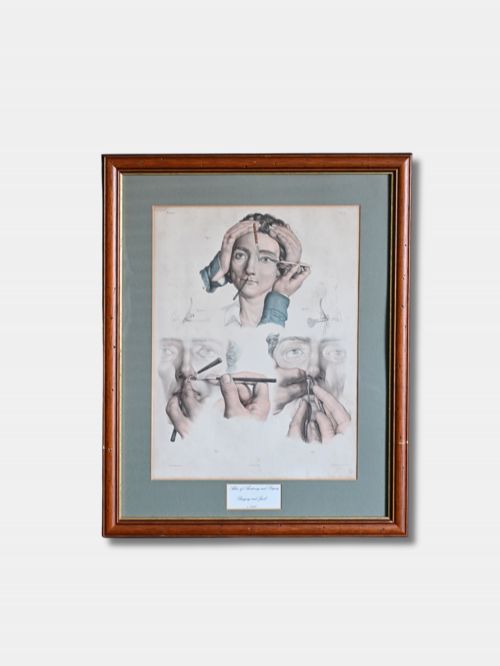


19th Century French Lithograph
A 19th century french lithograph brings the rich visual culture of the nineteenth century straight to your walls.
19th Century French Lithograph
A 19th century french lithograph is a printed work on paper capturing subjects ranging from natural history and architecture to portraiture and sporting scenes. You encounter these pieces framed behind glass in wood or giltwood surrounds, ready to hang.
The selections on this page span the 19th Century and Victorian eras, including specific dates such as 1800 and 1850 alongside broader nineteenth-century periods. Common formats include single framed prints, pairs, and sets depicting subjects like parrots, medical procedures, architectural plans, and Napoleon.
The styles represented include 19th Century French, Victorian, 19th Century Natural History, and the Barbizon School. These works function as wall art and framed prints, offering a direct window into historical French visual arts.
Materials and Techniques
The foundational medium for these works is ink applied to paper through the lithographic process, frequently enhanced with hand-colouring. Many examples incorporate charcoal elements alongside the primary printed lines.
Framing materials play a significant role in the presentation of these prints, utilising wood, gilt, and gold leaf to construct protective surrounds. Glazing with glass preserves the delicate paper and ink surfaces from environmental degradation.
19th Century French Lithograph Retail Price Guide 2026
Typical asking prices for 19th century french lithograph among the pieces listed under this phrase on Sellingantiques today, from the lower quarter to the upper quarter. They describe what is for sale here now, not the wider market.
A blue-faced parrot peers out from an 1800 sheet, reminding us that nineteenth-century printmakers loved exotic birds just as much as we do.
Assessing Quality and Execution
Quality in a 19th century french lithograph rests upon the clarity of the printed impression and the precision of any applied hand-colouring. Stronger impressions exhibit sharp lines and well-preserved ink density across the paper surface.
The quality of the framing materials also distinguishes the pieces, with substantial wood and giltwood frames providing superior context compared to simpler mountings. Completeness, particularly in multi-part sets, elevates the standing of the work.
Victor Adam·Henri Joseph Harpignies·House of Wentzel
The 19th Century French Lithograph Glossary
- Lithograph
- A print produced by drawing on a limestone or metal plate with a greasy substance so that ink adheres only to the drawn areas. This technique dominated nineteenth-century visual reproduction.
- Hand-Coloured
- A print finished with watercolour or pigment applied by hand after the initial printing process. This adds individual character and vibrant hues to the paper.
- Giltwood
- Wood that has been treated and coated with a thin layer of gold leaf or metallic gilt paint. It provides a reflective, ornate border for framed works.
- Barbizon School
- A nineteenth-century French art movement focused on naturalistic landscape painting and related printmaking. Works from this circle emphasise atmospheric effects and rural scenes.
19th Century French Lithograph: Frequently Asked Questions
What subjects do these prints cover?
The available subjects span natural history, architectural plans, medical procedures, and theatrical scenes from popular melodrama. You will also find equestrian sporting prints, portraits of historical figures such as Napoleon and Agnes Sorel, and topographical views.
These diverse topics reflect the broad visual interests of nineteenth-century French publishers and collectors. Each sheet offers a distinct record of contemporary knowledge, entertainment, or portraiture.
How are these prints typically framed?
Most pieces are housed beneath glass within wooden frames, frequently finished with gilt or gold leaf. These traditional surrounds protect the fragile paper from dust and atmospheric moisture.
The inclusion of glass and giltwood enhances the decorative presence of the wall art. Frames range from simple timber mouldings to more ornate gilded designs suited to domestic display.
How do I identify the period of a piece?
Dating relies on stylistic markers, paper characteristics, and contextual clues within the imagery such as costume or printing technique. References to specific eras like the Victorian period or the nineteenth century help establish a timeframe.
Some works carry specific dates or maker attributions within their titles. Comparing the print style to known nineteenth-century French production methods confirms the age.
Can I buy complete sets?
The inventory occasionally includes matching sets and pairs, such as architectural plans or multi-part lithograph series. These groupings provide a cohesive visual narrative for interior decoration.
Multi-print offerings allow collectors to acquire related imagery intended to be displayed together. Each set preserves the original association between the individual sheets.