
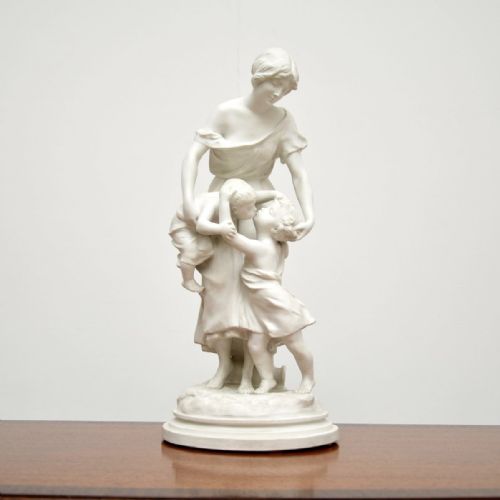


19th Century Bisque Figure
A 19th century bisque figure brings tactile unglazed ceramic modelling and classical form straight into a room.
19th Century Bisque Figure
When you search for a 19th century bisque figure, you encounter unglazed ceramic sculptures shaped as classical figures, mythological studies, fisher folk, and children. These objects stem from periods such as the Victorian era and the late nineteenth century, spanning decades like 1870, 1880, 1890, and 1900.
The versions most commonly met on this page are French and English works, produced by factories or individual makers, taking the form of figurines, statuettes, vases, and larger scale groups. They draw on styles including Neoclassical, French Rococo Revival, and Victorian Orientalism.
Makers represented in the evidence include Minton, Copeland, Vion et Baury, P. Ipsens Enke, Royal Dux, and Chantilly, alongside individual sculptors like Luca Madrassi and John Durham. Their outputs range from intimate single studies to imposing pairs of water carriers and shepherds.
How they were made
These pieces rely on biscuit porcelain, parian porcelain, and standard ceramic bodies left unglazed to produce a matte surface resembling carved marble. Parian ware utilises a specific porcelain recipe with a high feldspar content, fired to vitrify the material into a dense, translucent finish.
Moulding and slip-casting allow complex forms like classical drapery, hair strands, and flora to emerge with high definition. Certain items incorporate additions of enamel, gilt, or gold leaf to accent specific details on the unglazed bodies.
Listings feature parian porcelain, bisque porcelain, and gilt ceramic forms produced across the 19th century, including the 1870, 1880, 1890, and 1900 decades.
What varies in quality
The distinction between tiers rests upon the crispness of the modelling and the depth of the porcelain body, where factory output from firms like Copeland or Minton displays sharper relief than unmarked regional pieces. Sculptural ambition also dictates rank, separating straightforward domestic figures from large scale mythological studies modelled after known artists.
The presence of factory marks, moulded signatures, and documented studio provenance elevates certain groups above standard decorative wares. Material choice further establishes standing, with fine parian porcelain providing a denser, more marble-like tactile quality than ordinary ceramic bisque.
Luca Madrassi·Minton·P Ipsens Enke·Chantilly·Copeland·Royal Dux·Vion et Baury·John Durham
The 19th Century Bisque Figure Glossary
- Bisque
- Unglazed ceramic porcelain fired once or twice to create a matte, porous finish resembling marble. It absorbs oils easily and requires careful handling.
- Parian
- A type of fine biscuit porcelain developed in the nineteenth century to imitate carved white marble. It contains high proportions of feldspar, giving it a characteristic creamy texture.
- Biscuit
- An alternative term for unglazed ceramic or porcelain ware taken from the French term biscuit. It provides the matte surface standard to nineteenth-century sculptural figures.
- Neoclassical
- A style drawing inspiration from the classical art and culture of ancient Greece and Rome. It dominates many nineteenth-century subjects involving deities and classical literature.
- Rococo Revival
- A nineteenth-century design movement reviving the ornate, asymmetrical curves and natural motifs of the French Rococo period. Figures in this style often feature elaborate scrollwork and dynamic poses.
19th Century Bisque Figure: Frequently Asked Questions
What is a 19th century bisque figure?
A 19th century bisque figure is an unglazed ceramic or parian porcelain sculpture produced during the Victorian era, depicting mythological, allegorical, or everyday subjects.
These pieces were cast in moulds by European factories and independent studios to serve as ornamental works for domestic interiors.
How do I clean a bisque figure?
Because bisque and parian porcelain are unglazed and porous, they absorb dust and moisture readily into the ceramic body.
Gentle dusting with a soft dry brush is recommended, avoiding water or chemical cleaners that can stain the matte surface permanently.
How do I tell parian porcelain from bisque?
Parian porcelain contains a high feldspar content designed to vitrify slightly during firing, yielding a heavier weight and a subtle translucency akin to marble.
Standard bisque porcelain remains completely opaque and has a drier, chalkier texture to the touch.
Where were these figures displayed?
During the Victorian period, these sculptures occupied prominent spaces in drawing rooms, displayed on mantelpieces, pedestals, or occasional tables.
Pairs of figures often balanced each other on either side of a fireplace or at the ends of a sideboard.
Who made these porcelain figures?
Major European factories such as Minton, Copeland, Royal Dux, and Vion et Baury produced these figures alongside smaller workshops like P. Ipsens Enke.
Many pieces also reproduce specific sculptures by noted artists of the nineteenth century, including works after Thorvaldsen and Dannecker.