



1930s French Mantel Clock
A 1930s French mantel clock brings geometric lines and striking modernist materials straight to the fireplace.
1930s French Mantel Clock
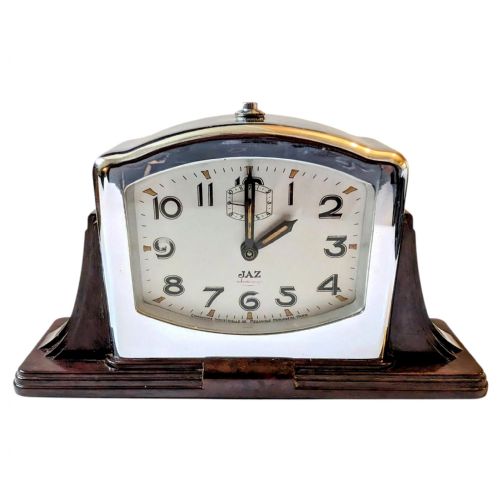
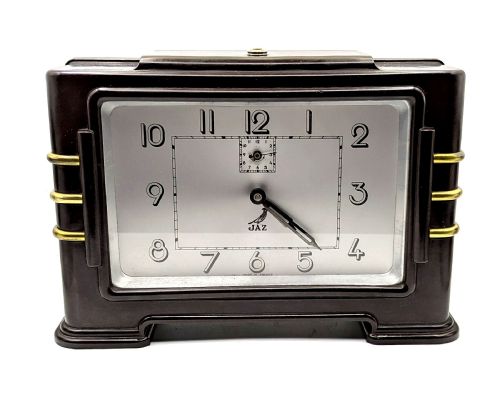
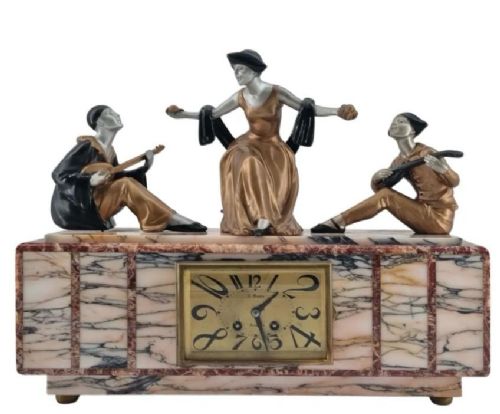
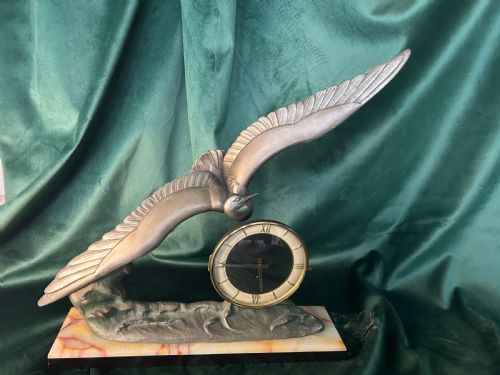
A 1930s French mantel clock embodies the bold geometric language of the Art Deco period, taking forms from simple architectural blocks to elaborate figural groupings. You will frequently encounter these timepieces executed in contrasting materials, sometimes accompanied by matching side garnitures or sculptural elements.
The objects on this page span several decades around the early twentieth century, with the majority centred firmly on the 1930 aesthetic. They range from compact desk clocks housed in colourful plastics to large marble garniture sets designed to command a room.
Makers and designers of the period experimented freely with symmetry and asymmetrical modernist motifs. Whether you seek a streamlined clock in rich walnut and chrome or a glass timepiece signed by an artisan, these pieces reflect the distinctive tastes of French interwar design.
Materials and construction
Makers utilised a diverse palette of natural and synthetic materials, pairing heavy stones like marble and onyx with industrial metals such as chrome, brass, and spelter. Bakelite appears frequently as a vibrant, moulded housing for the dial, while glass is employed for transparent modernist clock faces.
Cabinetmakers and metalworkers combined walnut woodwork with gleaming metallic trim to achieve the characteristic streamline aesthetic. Bronzed finishes and sculpted figures, such as dogs or harlequins, were cast and patinated to complement the central clock body.
The selection includes figural designs incorporating sculpted dogs, elephants, and harlequins alongside streamlined desk clocks.
Distinctions in quality
Quality rests upon the harmony of the materials and the sophistication of the design, distinguishing mass-produced items from signed works by notable makers. The integration of sculptural figures, such as those by known sculptors or clockmakers, elevates a piece well above standard production.
The crispness of the casting in metal elements and the careful selection of variegated marble or rich Bakelite indicate superior craftsmanship. Pieces that retain their original matching garnitures display a greater level of completeness and visual balance.
Jaz·Sega·Jaeger·P.M.Favre·DEP·Blangy·Michel Decoux·Jaeger-LeCoultre
The 1930s French Mantel Clock Glossary
- Garniture set
- A clock accompanied by a matching pair of side ornaments, such as vases or sculptural figures, designed to sit together on a mantelpiece.
- Bakelite
- An early form of synthetic plastic used extensively in the period for brightly coloured or deep red clock cases.
- Spelter
- A zinc alloy commonly cast and patinated to imitate bronze in figural clock sculptures.
- Mystery clock
- A timepiece where the mechanism driving the hands is concealed or rendered visually perplexing, often featuring transparent glass dials.
- Streamline
- An architectural and design style of the era emphasising long horizontal lines, curved corners, and aerodynamic sleekness.
1930s French Mantel Clock: Frequently Asked Questions
What is a clock garniture?
A clock garniture is a coordinated set consisting of a central mantel clock flanked by two matching decorative objects, such as side vases or sculptural figures.
These sets were designed to create a balanced, symmetrical display across a fireplace mantel or sideboard during the early twentieth century.
How do I identify a 1930s French clock?
Look for characteristic Art Deco design motifs, including stepped geometric shapes, streamline curves, and materials like chrome, onyx, and Bakelite.
Many examples feature French inscriptions on the dial or carry signatures from period clockmakers and sculptors active in France.
Where should I place a mantel clock?
These clocks are traditionally proportioned to sit centrally on a fireplace mantelpiece, where their weight and architectural presence can be fully appreciated.
They also function effectively on deep sideboards, desks, or console tables where the materials and decorative details remain visible from multiple angles.
What materials are common in these clocks?
The listings frequently feature natural stones like marble and onyx combined with polished chrome, brass, and cast spelter.
Synthetic materials such as Bakelite and clear glass also appear prominently, reflecting the modernist taste for industrial innovation.