


1920s Impressionist Landscape
A 1920s impressionist landscape brings light, atmosphere, and brushwork directly into a room.
1920s Impressionist Landscape
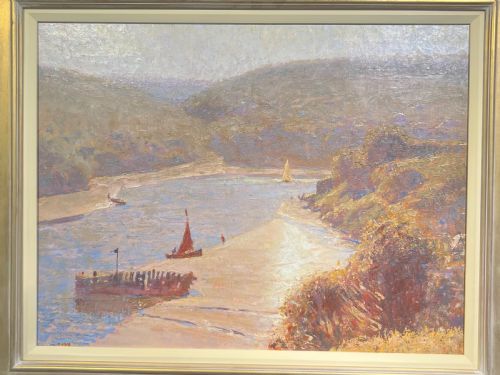
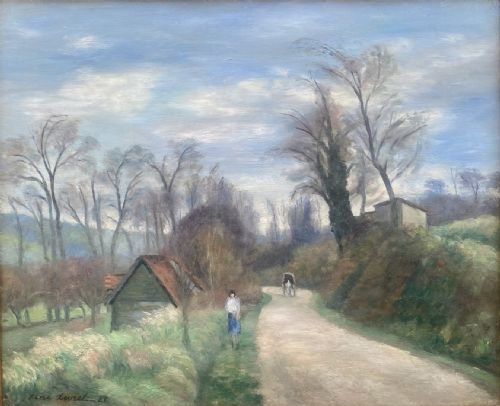
A 1920s impressionist landscape captures natural light and outdoor scenes through loose brushwork and vibrant pigments. These works record rural vistas, coastal scenes, and quiet village views from the early twentieth century.
Most examples found here originate from French and British creators working in oil or watercolour. Common subjects include the Mediterranean coast, French rivers, pastoral fields, and maritime settings.
The pieces range from intimate watercolours on paper to larger oil paintings on canvas, board, and panel. They reflect regional movements such as British Impressionism, Scottish Impressionism, and French Impressionism.
Materials and technique
Artists painted primarily with oil paint or watercolour applied to canvas, wood panels, paper, or board. Many landscape works were created plein air, directly outdoors to capture changing natural light.
The application involves visible, textured brushstrokes rather than smooth, blended surfaces. Gilt frames often accompany the finished paintings to complete the presentation.
Several artists preferred painting French laundry scenes and quiet bridges over grand historic monuments.
Distinctions in quality
Quality depends on the surety of the brushwork and the artist's handling of light and atmospheric depth. Stronger compositions balance colour harmony with a convincing sense of place.
The integrity of the original support, whether canvas, wood panel, or paper, influences the piece. Well-preserved painted surfaces retain their texture and pigment vibrancy without heavy restoration.
Cecil Allan Mould·Rene Levrel·Raymond Moritz·Louis Suire·Owen Bowen·Edmond Defonte·Maurice Asselin·George Graham·Pierre Peltier·Walter J. Hall
The 1920s Impressionist Landscape Glossary
- Plein air
- Painting outdoors to capture direct natural light and immediate visual impressions of a landscape. This method was central to impressionist practice.
- Post-Impressionism
- An art movement following impressionism that explored expressive colours and distinct forms. It builds upon impressionist techniques while introducing individual stylistic approaches.
- Oil paint
- Pigment suspended in a drying oil, commonly used on canvas, board, or panel. It allows for thick impasto application and rich colour depth.
- Watercolour
- Pigment suspended in a water-based solution applied to paper. It produces translucent washes and delicate tonal effects.
- Camden Group
- A circle of British artists influenced by post-impressionism. Their work often focused on domestic and landscape subjects with bold handling.
1920s Impressionist Landscape: Frequently Asked Questions
How do I identify a 1920s impressionist landscape?
Look for visible, expressive brushstrokes that capture light and atmosphere rather than fine detail. The subjects typically feature outdoor views such as coastlines, fields, or rivers.
Materials often include oil paint on canvas or panel, or watercolour on paper. Dates and signatures on the work or frame further help confirm the period.
Where were these paintings created?
These works come from various regions, with a strong representation of French and British locations. Coastal scenes from Brittany and Provence appear alongside British maritime and pastoral views.
Artists frequently travelled to paint specific landscapes on location, recording local architecture and countryside.
How should I frame and display them?
Many pieces come in period frames, often gilt, which complement the tonal quality of the painting. Display them away from direct sunlight to protect pigments from fading.
Stable room humidity helps preserve organic supports like canvas, paper, and wood panels over time.
What is the difference between oil and watercolour versions?
Oil paintings use thick pigments on canvas, wood, or board, offering textured surfaces and deep colour saturation. Watercolours use translucent washes on paper, resulting in lighter, more delicate effects.
Both mediums were used concurrently during the period to capture impressionist atmospheric effects.