


18th Century Pocket Pistol
An 18th century pocket pistol is a compact firearm built for personal defence, prized by collectors for its fine mechanical ingenuity and pocket-sized portability.
18th Century Pocket Pistol
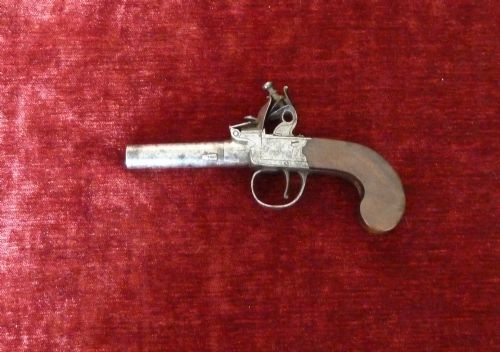
An 18th century pocket pistol is a small, concealable firearm designed for personal security by travellers and gentlemen during the Georgian era. These pieces frequently appear in forms such as the Queen Anne type, turn-off pistol, boxlock, and cannon barrel variant.
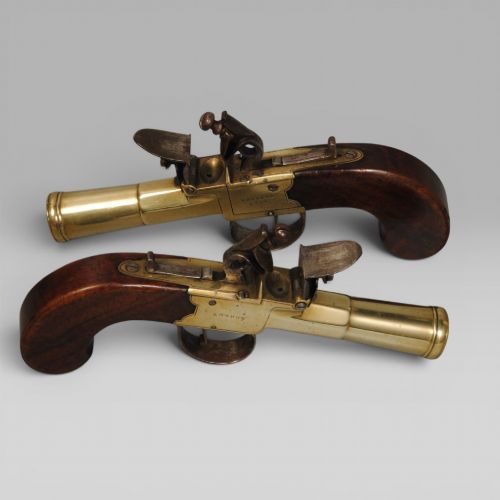
The objects seen here span periods from the early 18th century into the Napoleonic era, reflecting English and French origins. Makers such as Twigg, James Barber, Thomas Henshaw, John Rimes, and J. Robinson represent the skilled gunsmiths of London, Liverpool, and beyond.
Collectors encounter various designated formats including greatcoat, overcoat, travelling, and muff pistols. These firearms served everyday defence needs while showcasing the decorative arts of their time.
How these firearms were constructed
Makers constructed these pocket arms using steel for the barrels and mechanisms, paired with stocks of walnut or hardwood. Flintlock firing systems required precise metalwork to generate sparks from flint against steel.
Brass also appears in barrel and frame construction, offering an alternative to steel. Silver wire inlay frequently decorates the wooden grips, adding intricate detail to the handle.
Listings feature walnut, hardwood, brass, and steel materials across Georgian and Napoleonic periods.
What separates examples in quality
Quality rests upon the crispness of the flintlock mechanism and the legibility of maker signatures and proof marks on the metal. Master gunsmiths signed their work cleanly on the action or barrel.
The refinement of the woodwork, particularly the execution of silver wire inlay and the shaping of the walnut grip, distinguishes standard utility pieces from finer commissions.
Twigg London·James Barber London·Thomas Henshaw London·John Rimes London·J Robinson Liverpool
The 18th Century Pocket Pistol Glossary
- Flintlock
- A firearm ignition mechanism that uses a piece of flint struck against a steel frizzen to create sparks. This system dominated firearms technology through the 17th and 18th centuries.
- Turn-off pistol
- A firearm featuring a barrel that unscrews from the breech for loading from the front. This design allowed a tight fit between ball and powder without a ramrod.
- Boxlock
- A pistol design where the lock mechanism is forged as an integral part of the breech frame rather than mounted to the side. It provides a clean, compact appearance.
- Cannon barrel
- A barrel shaped with a flared muzzle resembling a small cannon. This style is frequently found on Queen Anne type pocket pistols.
- Bore
- The interior diameter of the barrel. Pocket pistols are often categorised by this measurement, such as the forty-bore size seen in period travelling pieces.
18th Century Pocket Pistol: Frequently Asked Questions
What is an 18th century pocket pistol?
An 18th century pocket pistol is a small, concealable firearm used for personal protection by travellers and citizens during the Georgian period. These weapons were designed to fit inside a coat pocket, muff, or bag for discreet carriage.
They utilise flintlock firing mechanisms and often feature short barrels designed for close-range defence. Makers signed many of these pieces on the metal action plates or barrels.
How were they used?
Owners carried these pistols for self-defence against highwaymen and footpads while travelling along poorly lit roads or city streets. They were loaded with powder and lead balls prior to departure.
Because they lacked modern sights and long barrels, they were intended for use at very close quarters. The turn-off barrel design allowed the user to screw the ball directly into the breech.
How do I live with one?
Living with an 18th century pocket pistol involves displaying it securely in a glass cabinet or specialised shadow box away from damp conditions. Metal components benefit from light, regular applications of gun oil to preserve the steel and brass.
Display stands that hold the pistol safely without straining the wood stock are ideal for tabletop or cabinet placement. Keeping them out of direct sunlight protects the walnut and hardwood grips.
How do I tell periods apart?
Distinguishing periods relies on observing stylistic shifts in the shape of the butt, the engraving style, and the transition from rounded to more squared grips. Early 18th century pieces often feature bulbous, rounded wooden butts with simple mounts.
Later Napoleonic era pieces show more refined, straight grips and different engraved scrollwork on the boxlock actions. Maker signatures and Birmingham or London proof marks further anchor pieces to specific decades.