



Walnut Grip Pocket Pistol
A walnut grip pocket pistol is a compact personal firearm designed for concealment, offering a tangible link to historical self-defence.
Walnut Grip Pocket Pistol
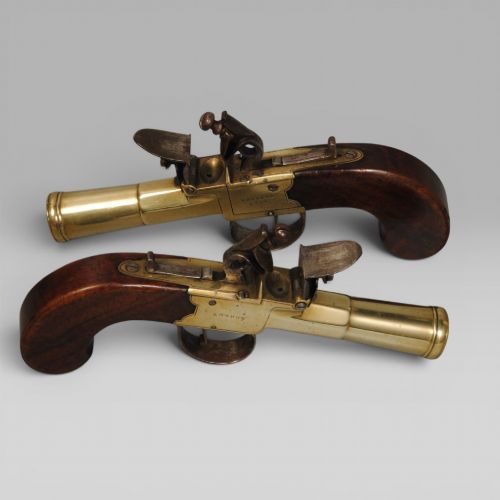
A walnut grip pocket pistol encompasses historical personal firearms designed for concealment during the eighteenth and nineteenth centuries. These pieces appear across Georgian, Regency, and Victorian periods, reflecting the shifting demands for personal protection over time.
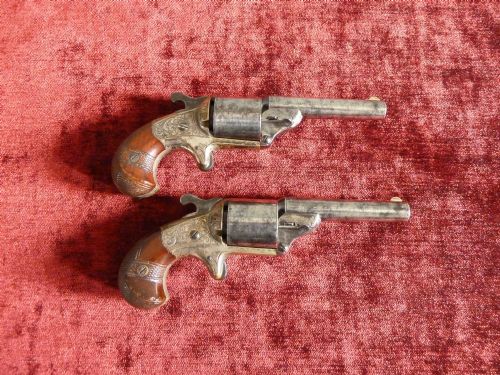
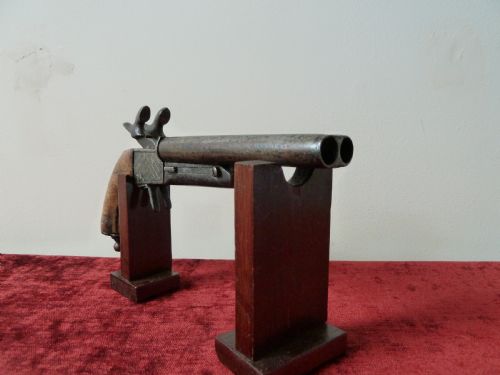
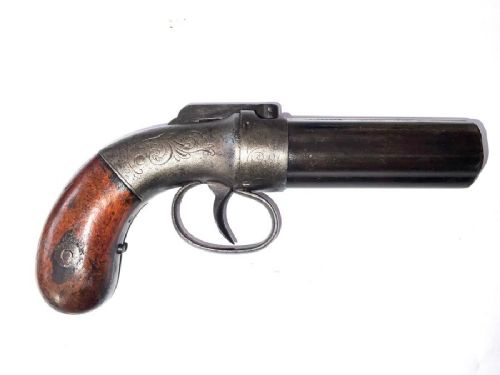
The selection on this page ranges from early flintlock box-lock pocket pistols to mid-nineteenth-century percussion revolvers and rimfire variants. Buyers encounter both British provincial work and American designs, showing how makers adapted these arms for the pocket.
Forms include muff pistols, box-lock blunderbuss pistols, and pepperbox revolvers fitted with wooden stocks. Each example demonstrates the distinct mechanical ingenuity applied to scaling down firepower for everyday carry.
Materials and Construction
Construction relies primarily on forged steel and iron for the barrels, actions, and internal mechanisms, paired with turned walnut for the grip. Brass frequently appears in frames, trigger guards, and butt caps, particularly on eighteenth-century box-lock designs.
Makers shaped the walnut stocks to fit the hand within a limited compass, often incorporating chequering to improve purchase. Barrels and actions received proof marks at established centres such as Birmingham, London, or Liège, verifying their structural integrity.
Listings feature walnut grip pocket pistols spanning the eighteenth and nineteenth centuries, incorporating steel, iron, and brass.
Factors of Quality
Quality rests in the crispness of the metal engraving, the precision of the lock mechanism, and the finish of the walnut stock. Finer pieces display integrated or folding triggers, sliding safeties, and neatly fitted wood without gaps around the metal tangs.
Makers known for superior output produced actions with smooth, positive movement and clearly struck maker signatures and proof marks. The balance between barrel length and grip proportion also dictates the sophistication of the build.
Allen And Thurber·J R Cooper·Auguste Francotte·J Robinson
The Walnut Grip Pocket Pistol Glossary
- Flintlock
- An ignition mechanism that uses a piece of flint struck against a steel frizzen to create sparks for gunpowder ignition.
- Percussion cap
- A small metal cup containing priming compound placed on a nipple, struck by the hammer to fire the charge.
- Box-lock
- A firearm action where the breech and the frame are forged as a single piece, concealing the mechanism internally.
- Pepperbox revolver
- A multi-barrelled firearm where the entire cluster of barrels rotates with each pull of the trigger or cocking of the hammer.
- Proof marks
- Official stamps struck onto the metal parts to verify that the firearm has undergone testing with standard powder loads.
Walnut Grip Pocket Pistol: Frequently Asked Questions
How do I date a walnut grip pocket pistol?
Dating relies on identifying the ignition system, such as flintlock, percussion, or cartridge, alongside proof marks and maker details.
Stylistic cues in the walnut grip shape and engraving styles further narrow down the decade of production.
Were these pistols used for duelling?
Pocket pistols were designed for personal defence and concealment rather than formal duelling.
Their short barrels and compact frames made them suitable for carrying in pockets or muffs.
What is a turn-off barrel?
A turn-off barrel unscrews from the breech to allow ball loading from the front without a ramrod.
This design appears frequently on eighteenth-century pocket pistols to speed up reloading.
How should I display my pistol?
Displaying these pieces involves secure placement in controlled indoor environments away from excessive humidity.
Many collectors use custom wooden display cases lined with baize or velvet.