
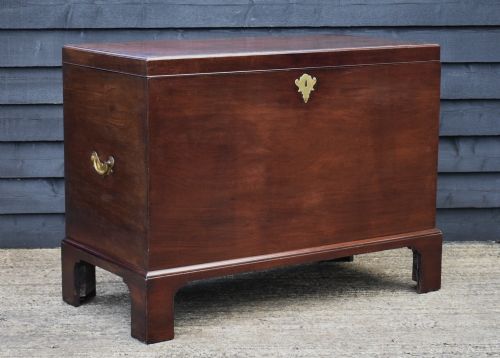


18th Century Mahogany Trunk
An 18th century mahogany trunk brings heavy timber and brass hardware into a room, offering deep storage with the weight of Georgian history.
18th Century Mahogany Trunk
The 18th century mahogany trunk category encompasses large storage forms made primarily during the Georgian, George II, and George III periods, originating from English and Dutch East Indies workshops around 1750 to 1780. Buyers searching this phrase will most frequently encounter substantial mule chests, blanket boxes, and housekeepers trunks that combine deep compartment storage with lower drawer arrangements.
Beyond standard blanket boxes, the pieces appearing on this page include specialist forms such as silver trunks, hall trunks, dowry chests on stands, and military travelling chest boxes. These variations reflect domestic utility and travel requirements of the Georgian era, often incorporating fruitwood inlay alongside primary mahogany timbers.
How they were made
Makers constructed these trunks using dense mahogany planks, frequently complemented by contrasting fruitwood inlay for decorative banding and panel detail. The structural integrity relied on heavy joinery suited to domestic storage and military transport.
Functional metalwork defined the fabrication process, with durable brass carrying handles, strap hinges, and key escutcheons fitted to secure the heavy lids and drawers of mule chests and travelling boxes.
Listings feature Georgian periods, including George II and George III eras around 1750 to 1780, constructed from mahogany, brass, and fruitwood inlay.
What varies in quality
Quality in an 18th century mahogany trunk rests on the selection of timber figures and the integration of secondary elements like fruitwood inlay or brass mounts. Pieces featuring elevated stands, such as chest on stand formats from the George II era, demand greater joinery skill than simple floor-standing blanket boxes.
The distinction between utilitarian travelling boxes and formal housekeepers trunks lies in the refinement of proportion and secondary drawer configuration. Better examples maintain crisp edges on mouldings and original brass hardware that befits a Georgian interior.
The 18th Century Mahogany Trunk Glossary
- Mule chest
- A storage chest featuring one or more drawers built into the base beneath the main compartment. This form bridges the traditional blanket box and the chest of drawers common in Georgian homes.
- George III
- The design period spanning from 1760 to 1820, characterised by refined proportions and classical restraint. Furniture from this era often utilises mahogany with subtle inlay work.
- Escutcheon
- A protective plate surrounding a keyhole, usually fashioned from brass on these trunks. It prevents the timber from splitting around the lock mechanism during frequent use.
- Fruitwood inlay
- Decorative contrasting light wood inserted into the darker mahogany surface. This technique added geometric or botanical patterns to the front panels of chests and coffers.
18th Century Mahogany Trunk: Frequently Asked Questions
What is a mule chest?
A mule chest combines a deep top compartment for blankets with one or more drawers fitted into the base. It served as a transitional piece before dedicated chest of drawers designs dominated bedrooms.
In the Georgian period, these items sat in bedchambers or hallways to hold household textiles and personal belongings securely.
How do I date a Georgian trunk?
Dating relies on architectural styles, timber choice, and hardware construction methods typical of the 18th century. Pieces linked to George II or George III reigns often show specific bracket feet and cornice details.
Examine the secondary woods inside the drawers and the style of the brass handles to confirm the period of manufacture around 1750 to 1780.
Where were silver trunks used?
Silver trunks were built to store valuable tableware, flatware, and ceremonial items safely within large country houses or during travel. Their robust construction protected valuable possessions from damp and theft.
These reinforced containers often feature heavy brass carrying handles and secure internal partitions designed specifically for metal services.
How do I live with a heavy trunk?
Position the piece against a sturdy wall in a hallway, living room, or bedroom where its substantial timber presence grounds the room. The flat top surface functions well for displaying lamps or decorative objects.
Ensure the trunk stays away from direct heat sources to prevent the mahogany from drying out or the fruitwood inlay from lifting over time.