



18th Century Italian Pottery
These pieces of 18th century italian pottery bring tin-glazed earthenware and painted pigment straight from historic Italian workshops into a modern room.
18th Century Italian Pottery
When you search for 18th century italian pottery, you encounter a specialised selection of vessels, jars, and wall art produced across Italy during the 1700s. These items range from apothecary jars and pharmacy wet drug jars to devotional plaques and pilgrim flasks.
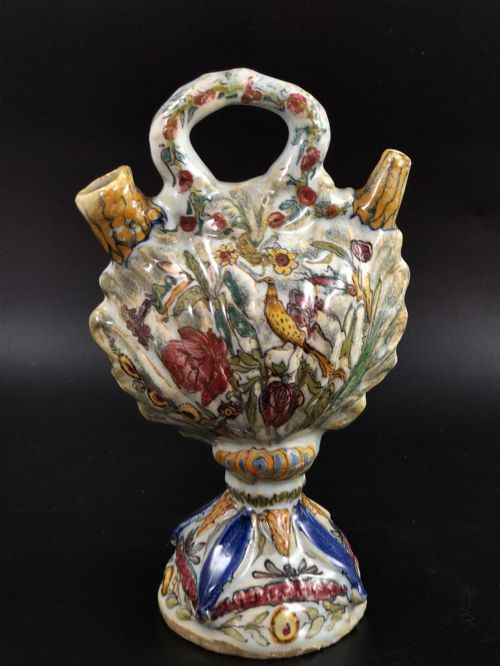
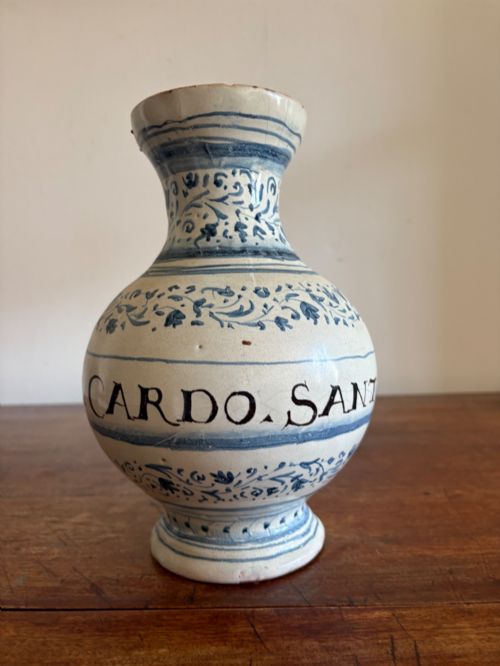
The most common forms on this page are blue and white or polychrome albarelli and pilgrim flasks, reflecting the functional and decorative output of Italian kilns. Baroque and Renaissance stylistic influences appear frequently across the surviving pieces.
How They Were Made
Potters shaped these ceramics from earthenware clay before coating the body in an opaque tin glaze that provided a smooth white ground for painting. Artisans then applied coloured pigment directly onto the unfired or fired glaze surface.
Vessels such as pharmacy jars and lidded vases required precise throwing on the wheel, while devotional plaques and flat pilgrim flasks demanded skilful moulding and hand-modelling of scallop-shell forms.
Several pharmacy jars on this page spent centuries holding dubious medicinal remedies before finding their way onto display shelves.
What Varies in Quality
Quality rests primarily in the fluidity and precision of the painted decoration, where confident brushwork separates standard production pieces from finer examples. The vibrancy and control of the polychrome or blue and white pigments dictate visual depth.
The crispness of the moulded details, especially on apothecary jars and pilgrim flasks, reveals the condition of the original moulds and the care taken during finishing before the final firing.
The 18th Century Italian Pottery Glossary
- Albarello
- A cylindrical earthenware jar used by apothecaries for storing drugs and ointments. These vessels typically feature a waisted centre for ease of handling.
- Majolica
- Italian tin-glazed earthenware painted with colourful pigments on a white glaze ground. The technique developed during the Renaissance and continued through the Baroque period.
- Faience
- European tin-glazed pottery produced outside of France, often used interchangeably with majolica in descriptions of Italian wares. It shares the same opaque white glaze base.
- Pilgrim Flask
- A flattened flask with loops for suspension, historically carried by travellers or pilgrims. Italian examples often incorporate scallop-shell motifs.
- Tin Glaze
- A lead glaze made opaque by the addition of tin oxide. This surface creates a bright white background suitable for hand-painted decoration.
18th Century Italian Pottery: Frequently Asked Questions
What were apothecary jars used for?
Apothecaries used these cylindrical jars to store dried herbs, syrups, ointments, and medicinal drugs in pharmacies. The labels painted on the front identified the contents for the apothecary.
Over time, these utilitarian vessels became decorative items displayed in domestic interiors and collection cabinets.
How do I identify a pilgrim flask?
Pilgrim flasks feature a flattened body designed for travel, often accompanied by side loops for suspension cords. 18th-century Italian versions frequently adopt scallop-shell forms.
They stand apart from standard vases through their distinct shape and dual-sided decorative panels.
What is the difference between blue and white and polychrome?
Blue and white pieces rely exclusively on cobalt pigment applied to the white tin glaze, creating a sharp monochromatic finish. This style echoes earlier majolica traditions.
Polychrome pieces introduce a broader palette of colours, using multiple pigments to create more complex pictorial scenes or floral motifs.
How do I care for 18th-century ceramics?
These earthenware pieces require stable indoor humidity and protection from sudden temperature changes to preserve the historic glaze. Dust them gently with a soft, dry cloth.
Avoid using water or cleaning agents on the porous ceramic body and historic surfaces.