
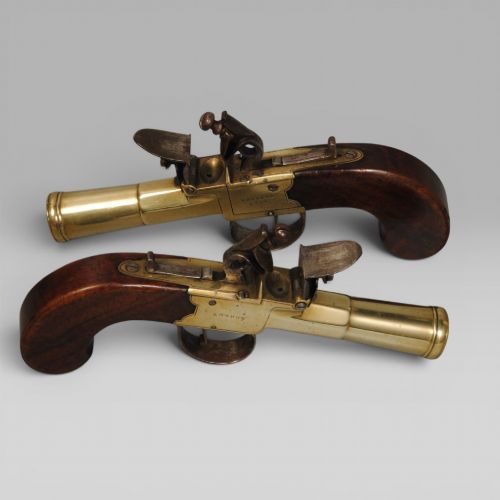

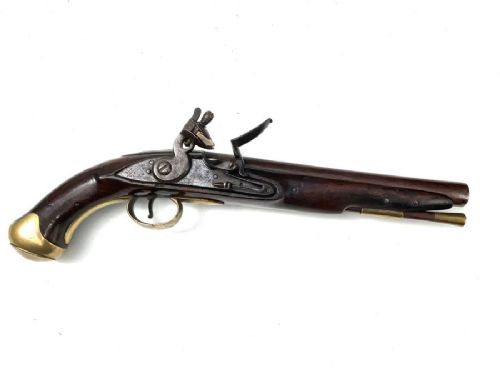


18th Century Flintlock Pistol
When evaluating an 18th century flintlock pistol, one looks closely at the integration of steel mechanism and hardwood stock.
18th Century Flintlock Pistol
An 18th century flintlock pistol encompasses military service arms, civilian pocket pieces, and heavily decorated Ottoman or Balkan holster variants. Buyers searching this phrase encounter English boxlock pocket pistols, Scottish scroll-butt pieces, and heavy dragoon arms dating from the 1700s through the early 1800s.
The regional styles vary widely, ranging from London maker-signed duelling pieces to brass-mounted Italian Brescia types and Bosnian Sarajevo region firearms.
Forms span from small travelling muff pistols to long-barrelled cavalry blunderbusses, utilising steel, iron, walnut, and brass.
How They Were Made
Makers shaped stocks from walnut and other hardwoods, often embedding silver wire inlay or mounting them with brass and mother-of-pearl.
Barrels and lock plates combined forged steel and iron, occasionally featuring cast decorations, gilt inlay, or brass cannon configurations.
Mechanisms relied on functional flintlock actions, snaphaunce variants, and turn-off barrel designs assembled by provincial and metropolitan gunsmiths.
18th Century Flintlock Pistol Retail Price Guide 2026
Typical asking prices for 18th century flintlock pistol among the pieces listed under this phrase on Sellingantiques today, from the lower quarter to the upper quarter. They describe what is for sale here now, not the wider market.
Some pocket pistols screw apart from the front like jars.
What Varies in Quality
Quality rests in the crispness of the lock mechanism engraving and the precision with which silver wire or metal mounts fit into the wooden stock.
Signed works by known London or continental makers display superior finishing compared to standard military contract issues from the Tower armoury.
The harmony between cast brass furniture, carved butt caps, and overall stock proportions dictates the distinction between standard field pieces and high-grade civilian commissions.
Harrison of London·T. Potts·John Campbell of Doune·La Motte·James Barber·Thomas Henshaw·Timothy Hughes·Thomas Anelli·R. Willoughby·I Parr·John Rimes·J. Robinson·Barber of Newark·Dutton·Wilson·Knubley·Ketland and Co·Richards·Ezekiel Baker
The 18th Century Flintlock Pistol Glossary
- Flintlock
- A firearm ignition mechanism that uses a flint struck against a steel frizzen to create sparks. This system dominated military and civilian arms throughout the eighteenth century.
- Boxlock
- A pistol design where the breech and the lock frame are forged as a single unit. This layout typically places the main components inside a clean, enclosed metal housing.
- Snaphaunce
- An early precursor to the flintlock utilising a sliding steel cover over the pan. It remains distinct for its external mainspring and specialised dog-head design.
- Turn-off barrel
- A barrel designed to unscrew from the breech for easy loading without a ramrod. This configuration appears frequently on pocket and Queen Anne type pistols.
- Holster pistol
- A large firearm carried in a saddle holster rather than a belt. These service and civilian arms typically feature robust stocks and longer barrels for mounted use.
18th Century Flintlock Pistol: Frequently Asked Questions
How were these pistols carried?
Civilians tucked smaller pocket and muff variants into coats or waistbands for personal defence during travel. Larger holster pistols rode in leather saddle holsters on horseback.
Military personnel secured service dragoon arms in specialised belt hooks or horse furniture, ensuring rapid access during cavalry operations.
What is a Queen Anne type pistol?
This designation describes firearms featuring a breech and lock forged in one solid piece with a screw-off barrel. They lack a traditional sideplate.
Such pieces often incorporate distinctive swell-butt wooden grips decorated with grotesque silver butt caps and intricate wire inlays.
How do I identify Ottoman variants?
Ottoman and Balkan pieces display distinct rat-tail mechanisms, ball triggers, and heavy application of silver inlay or coral and mother-of-pearl mounts. Their stocks often feature characteristic extended, flared butts.
Signatures are sparse compared to British workshop pieces, relying instead on regional decorative metalwork and specialised lock plate configurations.
Were these used in military service?
Many examples on the market served regiments across Europe, bearing Tower armoury stamps, crown proof marks, or military contractor signatures. Light dragoons and cavalry units relied on these standardised steel and brass pieces.
Officers also purchased private-purchase sidearms from prominent London gunsmiths for personal campaigns.