

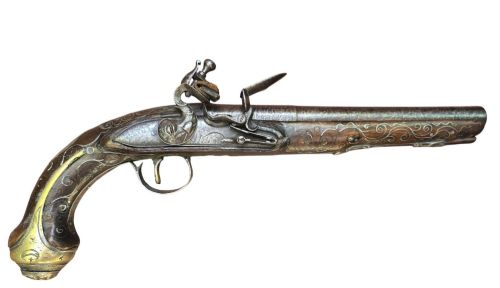


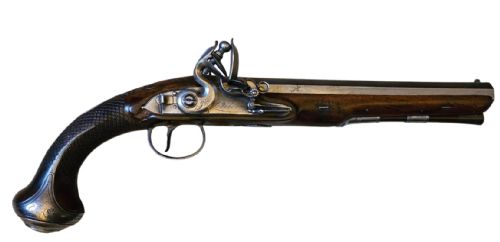


Dark Walnut Flintlock Pistol
These dark walnut flintlock pistol pieces combine period steel and rich wood stock work, offering collectors authentic martial history.
Dark Walnut Flintlock Pistol
A dark walnut flintlock pistol is a muzzle-loading firearm relying on a flint-strike ignition mechanism, housed in timber stocks that range from deep-grained walnut to general wood. When you search for a dark walnut flintlock pistol, you encounter examples spanning the seventeenth, eighteenth, and nineteenth centuries, including military, naval, and civilian overcoat formats.
The pieces on this page heavily feature Georgian military specimens, British cavalry and sea service arms, and continental European works like the Italian Brescia-type holster pistol or Ottoman variants with French locks. Makers such as T. Potts and Barber of Newark appear alongside unbranded service pieces and early seventeenth-century builds.
How they were made
Gunsmiths shaped the stocks from dense timbers such as walnut and walnut wood, pairing them with heavy steel and iron barrels. Many pieces incorporate cast brass furniture, brass sideplates, and occasionally silver parc or gilt inlay decoration upon the metal components.
Lock mechanisms utilised drop-forged steel for the frizzen and cock, designed to generate a spark against the flint upon pulling the trigger. Barrels were forged and bored by hand, then stamped with proof marks to certify their structural integrity.
Dark Walnut Flintlock Pistol Retail Price Guide 2026
Typical asking prices for dark walnut flintlock pistol among the pieces listed under this phrase on Sellingantiques today, from the lower quarter to the upper quarter. They describe what is for sale here now, not the wider market.
Listings feature walnut, steel, brass, and silver across 17th-, 18th-, and 19th-century military and civilian forms.
What varies in quality
Quality rests in the crispness of the lock mechanism and the finesse of the metal ornamentation, distinguishing standard military issue from bespoke officer commissions. Engraving on the brass furniture and the intricacy of gilt inlay work separate ordinary utility pieces from high-status workshop production.
The preservation of the dark walnut stock significantly influences the character of an arm, particularly where carving, silver wire inlay, or brass mounts remain intact. Maker attribution, such as signed locks by known London or provincial gunsmiths, elevates the standing of a piece within historical firearms collecting.
T. Potts·Dumarest·Barber of Newark
The Dark Walnut Flintlock Pistol Glossary
- Flintlock
- A firearm ignition mechanism that uses a piece of flint held in a cock to strike a steel frizzen, creating sparks to ignite the gunpowder charge. This system dominated military and civilian arms from the seventeenth through the early nineteenth century.
- Holster pistol
- A large handgun designed to be carried in a saddle holster on horseback rather than worn on a belt. These pieces were standard equipment for cavalry troopers and travelling officers.
- Proof mark
- An official stamp struck onto the barrel of a firearm to certify that it has undergone pressure testing with a proof charge. British pieces commonly display London proof marks from official inspection houses.
- Sea service pistol
- A robust, corrosion-resistant firearm issued to naval forces, typically featuring brass furniture to withstand marine environments. These arms were essential for close-quarters combat on board ships.
- Frizzen
- The vertical steel plate hinged above the flash pan that the flint strikes to produce sparks and open the pan cover. Its hardness and geometry are critical for reliable ignition.
Dark Walnut Flintlock Pistol: Frequently Asked Questions
What is a dark walnut flintlock pistol?
A dark walnut flintlock pistol is an antique muzzle-loading handgun utilising a flint ignition system set into a wooden stock. These pieces served military troopers, naval personnel, and civilians travelling across the seventeenth to nineteenth centuries.
They survive today as historical artefacts reflecting the arms technology and metalworking standards of the Georgian era and earlier periods.
Were these pistols used in combat?
Many examples on this page served active military or naval roles, including cavalry holster pistols and sea service arms designed for combat duty. Others functioned as civilian protection pieces, such as overcoat pistols carried by mail coach inspectors.
Their robust construction and standardised calibres reflect their intended purpose as working defensive weapons.
How should I display a flintlock pistol?
Displaying a flintlock pistol safely involves mounting it securely in a stable environment away from direct sunlight and excessive humidity. Many collectors use custom shadow boxes or wall brackets that support the weight without stressing the walnut stock.
Keeping the metal lightly oiled and the timber clean preserves the historical surface condition for future generations.