

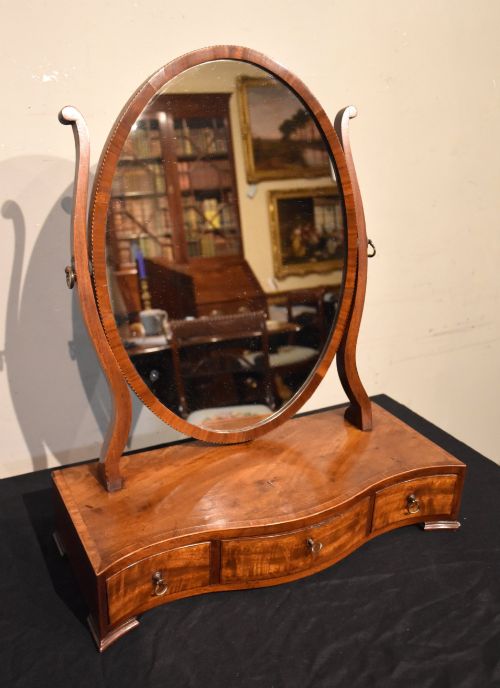
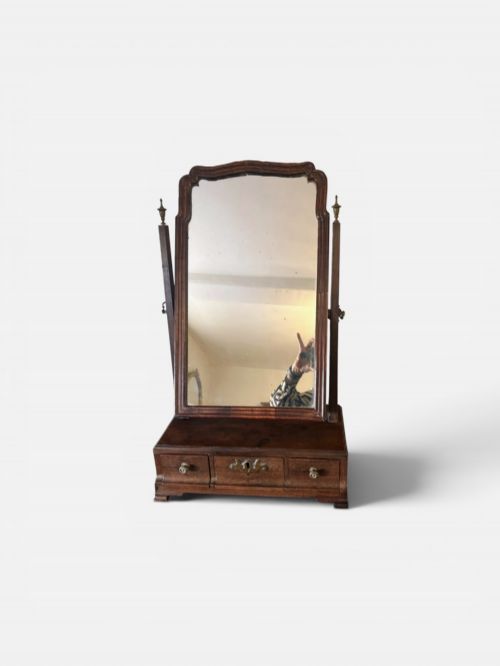


18th Century Cheval Glass
An 18th century cheval glass is a freestanding full-length mirror designed to pivot in a frame, offering a complete view of attire.
18th Century Cheval Glass
An 18th century cheval glass provides a tall, adjustable reflecting surface mounted on vertical uprights and stable floor-standing feet. These pieces belong to the Georgian and George III periods, originating from around 1750 to 1800.
While smaller toilet mirrors dominate the wider category, the true cheval glass stands tall enough for full-length viewing. The listings here balance these large floor-standing dressing mirrors alongside compact table variants.
Makers of the era constructed these standing frames primarily in rich mahogany, sometimes enhanced by brass fittings, giltwood, or delicate boxwood inlay. The form serves both a practical dressing function and a decorative architectural purpose in a room.
Materials and construction
Cabinet makers relied heavily on solid and veneered mahogany to build the uprights, bases, and frames for these mirrors. The dense grain allowed for slender, elegant structural members that could still support the weight of the pivoting glass.
Makers integrated cast brass pivot knobs, candle sconces, and delicate boxwood stringing to add functional detail and subtle contrast. Frames range from straightforward George III mahogany mouldings to ornate Chippendale and Sheraton interpretations.
18th Century Cheval Glass Retail Price Guide 2026
Typical asking prices for 18th century cheval glass among the pieces listed under this phrase on Sellingantiques today, from the lower quarter to the upper quarter. They describe what is for sale here now, not the wider market.
Some eighteenth-century dressing mirrors included concealed secret compartments behind the tiny base drawers for hiding letters.
Judging quality and craftsmanship
Quality rests in the proportional harmony of the frame and the integrity of the pivoting mechanism. Superior examples display refined timber selection, such as carefully figured mahogany veneers and crisp boxwood inlay.
The sophistication of the carved details on the legs and uprights distinguishes standard utilitarian pieces from finer workshop productions. Original brass hardware and undamaged mercury glass further elevate the standing of an individual mirror.
The 18th Century Cheval Glass Glossary
- Cheval glass
- A large, freestanding mirror mounted on a frame that allows it to swing vertically. This tall format became popular in the eighteenth century for full-length dressing.
- Toilet mirror
- A smaller mirror designed to sit on top of a dressing table or chest of drawers. These often feature small drawers built into the base plinth.
- Serpentine front
- A furniture front shaped with a convex centre flanked by concave curves. This undulating outline appears frequently on the drawer bases of Georgian dressing mirrors.
- George III
- The stylistic period spanning from 1760 to 1820, encompassing various phases of neoclassical and late rococo design. Pieces from this era often show accomplished joinery and classical restraint.
18th Century Cheval Glass: Frequently Asked Questions
Where should I place a cheval glass?
Position the mirror in a bedroom or dressing room where you need full-length reflection. Ensure it sits on a level floor so the pivoting frame operates smoothly without strain.
Keep the piece away from direct sunlight to protect the mahogany polish and the silvering on the old glass plate.
How do I operate the pivoting frame?
Most frames use brass thumbscrews or pins on the side uprights to hold the glass at the desired angle. Turn these gently to adjust the tilt without forcing the wood.
Over-tightening can damage the threaded brass inserts or split the surrounding mahogany housing.
How do I clean the historic glass?
Wipe the glass surface gently with a soft microfibre cloth and a mild, ammonia-free glass cleaner. Avoid spraying liquid directly onto the edges where moisture might seep behind the silvering.
Treat the wooden frame separately using a dry dusting cloth, avoiding modern silicone polishes.