22,891  PAGES BROWSED TODAY PAGES TODAY • 42 ANTIQUES UPLOADED TODAYNEW ARRIVALS
GIFTS
42 ITEMS ADDED TODAY
Sort Order
Items Per Page
Browse Categories
Sort order
Relevant Links
Items per page
ID #SA962431
SOLD
Email Phone
Save
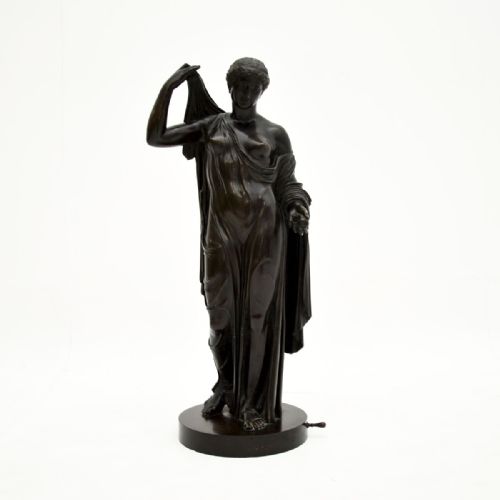
Art Nouveau Patinated Bronze Figure of Psyche by Gustave Eberlein
Sold by Solo Antiques
sold SA962431
Sorry, but this item has been sold.
Solo Antiques

Solo Antiques

Sellingantiques Verified Since Jan 2023
Browse dealers 48 items
  • About Us
    Solo antiques are specialist antiques dealers in art nouveau, art deco sculpture, glass and arts and crafts pieces from 1880 to 1935
  • Trade Associations
    Solo Antiques is a registered member of LAPADA  BADA  CINOA
Id #SA962431
PDF SHARE
SAVE

Art Nouveau Patinated Bronze Figure of Psyche by Gustave Eberlein

19th century
Sold 18 September 2025 · Solo Antiques
This “Art Nouveau Patinated Bronze Figure of Psyche by Gustave Eberlein” found a buyer.

It was listed by Solo Antiques. Sold pieces stay on Sellingantiques as a record of what has passed through, and the next one is rarely far away.

Description

Art Nouveau patinated bronze figure of Psyche by Gustave Eberlein. Very finely cast and modelled and sculpted by Gustav Heinrich Eberlein with a signature in the bronze. The figure has a foundry mark for the Gladenback foundry in Berlin and stands atop a rouge griotte marble base. A beautiful, finely detailed figure depicting Psyche who was believed in Greek Mythology to be the most beautiful woman in the world.

German c 1890

Gustav Heinrich Eberlein (14 July 1847, Spiekershausen (near Staufenberg) - 5 February 1926, Berlin) was a German sculptor, painter and writer. He was the son of a border guard. At the age of eight, his family moved to Hannoversch Münden, which would be his home for the remainder of his life, despite many years spent elsewhere. His parents lacked the money to provide him with formal artistic training, so he obtained instruction wherever possible, especially from the local goldsmith In 1866, thanks to the patronage of a pastor who had recognized his talents, he was able to attend the Academy of Fine Arts in Nuremberg. In 1869, he went to Berlin on a scholarship. Three years later, another scholarship enabled him to study in Rome.

Upon his return to Berlin, he received significant support from Martin Gropius. Despite growing success, the next decade was difficult. His three-year-old son died in 1882, then his mother in 1888. This was followed by a divorce in 1891. A year later, he married the Countess Maria von Hertzberg, an aspiring young artist, and was appointed a Professor at the Prussian Academy of Arts the year after that.

In 1900, he came out in strong opposition to the "Lex Heinze" (which, among other things, banned the display of "immoral" art works). That same year, all but a few of his figures were removed from display at the Great Berlin Exhibition, not only because of the law but also, probably, because of his support for French and Belgian sculptors (such as Rodin and Meunier). In fact, as tensions between Germany and its western neighbors grew, Eberlein's outspoken advocacy of peace and disarmament caused him to lose his public commissions.

He was able to find work elsewhere, notably in South America, but his finances never recovered and he was divorced for a second time in 1912. The following year, he auctioned off most of his possessions in anticipation of emigrating, but those plans were put off because of World War I. He received some orders during the war and created a small museum at his studios in Berlin but, after the war, criticism was renewed; especially for his creating a statue of Karl Marx at the same time he was doing one of the former Kaiser. He was especially well known for his small figures and portrait sculpture and produced over 900 works. The majority of his larger bronze monuments were melted down during World War II. Most of his 300 original plaster models were disposed of by the city of Münden after his death. In 1962, work related to a construction project revealed approximately 80 figures and 11 paintings that were preserved and restored between 1983 and 1989. Many are now in the collection of the Deutsches Historisches Museum, Berlin.

He was able to avert destitution only by adopting his housemaid as his daughter, ensuring that he would be cared for by her family. By the time of his death, he was nearly forgotten. He was buried at the Alter St.-Matthäus-Kirchhof in Berlin.

Excellent original condition. Wear commensurate with age.

Physical Dimensions
Height
35cm (13.78")
Declaration

Solo Antiques has dated this Bronze Figure of Psyche to the 1890s.

Reference Numbers
Sellingantiques Reference
SA962431
Dealers Internal Reference
2473
Dealers Notes

Please do not hesitate to contact me if you require any further information or details on this or any of my items.

All my item prices include UK Shipping

Description
Art Nouveau patinated bronze figure of Psyche by Gustave Eberlein.
“
Very finely cast and modelled and sculpted by Gustav Heinrich Eberlein with a signature in the bronze.
Solo Antiques

The figure has a foundry mark for the Gladenback foundry in Berlin and stands atop a rouge griotte marble base. A beautiful, finely detailed figure depicting Psyche who was believed in Greek Mythology to be the most beautiful woman in the world.

fig 1. A patinated dark brown bronze figure of a standing female standing on a circular plinth and square base.
fig 1. Art Nouveau Patinated Bronze Figure of Psyche by Gustave Eberlein

German c 1890

Gustav Heinrich Eberlein (14 July 1847, Spiekershausen (near Staufenberg) - 5 February 1926, Berlin) was a German sculptor, painter and writer. He was the son of a border guard. At the age of eight, his family moved to Hannoversch Münden, which would be his home for the remainder of his life, despite many years spent elsewhere. His parents lacked the money to provide him with formal artistic training, so he obtained instruction wherever possible, especially from the local goldsmith In 1866, thanks to the patronage of a pastor who had recognized his talents, he was able to attend the Academy of Fine Arts in Nuremberg. In 1869, he went to Berlin on a scholarship. Three years later, another scholarship enabled him to study in Rome.

fig 2. A patinated dark brown bronze figure of a standing female standing on a circular plinth and square base.
fig 2. Art Nouveau Patinated Bronze Figure of Psyche by Gustave Eberlein

Upon his return to Berlin, he received significant support from Martin Gropius. Despite growing success, the next decade was difficult. His three-year-old son died in 1882, then his mother in 1888. This was followed by a divorce in 1891. A year later, he married the Countess Maria von Hertzberg, an aspiring young artist, and was appointed a Professor at the Prussian Academy of Arts the year after that.

fig 3. A patinated dark brown bronze figure of a standing female standing on a circular plinth and square base.
fig 3. Art Nouveau Patinated Bronze Figure of Psyche by Gustave Eberlein

In 1900, he came out in strong opposition to the "Lex Heinze" (which, among other things, banned the display of "immoral" art works). That same year, all but a few of his figures were removed from display at the Great Berlin Exhibition, not only because of the law but also, probably, because of his support for French and Belgian sculptors (such as Rodin and Meunier). In fact, as tensions between Germany and its western neighbors grew, Eberlein's outspoken advocacy of peace and disarmament caused him to lose his public commissions.

fig 4. A patinated dark brown bronze figure of a standing female standing on a circular plinth and square base.
fig 4. Art Nouveau Patinated Bronze Figure of Psyche by Gustave Eberlein

He was able to find work elsewhere, notably in South America, but his finances never recovered and he was divorced for a second time in 1912. The following year, he auctioned off most of his possessions in anticipation of emigrating, but those plans were put off because of World War I. He received some orders during the war and created a small museum at his studios in Berlin but, after the war, criticism was renewed; especially for his creating a statue of Karl Marx at the same time he was doing one of the former Kaiser. He was especially well known for his small figures and portrait sculpture and produced over 900 works. The majority of his larger bronze monuments were melted down during World War II. Most of his 300 original plaster models were disposed of by the city of Münden after his death. In 1962, work related to a construction project revealed approximately 80 figures and 11 paintings that were preserved and restored between 1983 and 1989. Many are now in the collection of the Deutsches Historisches Museum, Berlin.

fig 5. A patinated dark brown bronze figure of a standing female standing on a circular plinth and square base.
fig 5. Art Nouveau Patinated Bronze Figure of Psyche by Gustave Eberlein

He was able to avert destitution only by adopting his housemaid as his daughter, ensuring that he would be cared for by her family. By the time of his death, he was nearly forgotten. He was buried at the Alter St.-Matthäus-Kirchhof in Berlin.

Excellent original condition. Wear commensurate with age.

Height
35cm (13.78")
Date of Manufacture

Solo Antiques has dated this Bronze Figure of Psyche to the 1890s.

Reference Numbers
Sellingantiques Ref
SA962431
Dealers Internal Ref
2473
Solo Antiques
Solo Antiques
Sellingantiques verified Since Jan 2023

Solo antiques are specialist antiques dealers in art nouveau, art deco sculpture, glass and arts and crafts pieces from 1880 to 1935

Dealer Profile

You can view the stock and full dealer information on the Solo Antiques Profile Page

Trade Associations

Solo Antiques is a registered member of LAPADA  BADA  CINOA

PDF SHARE
SAVE
A patinated dark brown bronze figure of a standing female standing on a circular plinth and square base. SOLD6+ MONTHS AGO
1 / 12
Archive I A patinated dark brown bronze figure of a standing female standing on a circular plinth and square base. SOLD6+ MONTHS AGO

Art Nouveau Patinated Bronze Figure of Psyche by Gustave Eberlein

Archive II A patinated dark brown bronze figure of a standing female standing on a circular plinth and square base. View II
Archive III A patinated dark brown bronze figure of a standing female standing on a circular plinth and square base. View III
Archive IV A patinated dark brown bronze figure of a standing female standing on a circular plinth and square base. View IV
Archive V A patinated dark brown bronze figure of a standing female standing on a circular plinth and square base. View V
Archive VI A patinated dark brown bronze figure of a standing female standing on a circular plinth and square base. View VI
Archive VII A patinated dark brown bronze figure of a standing female standing on a circular plinth and square base. View VII
Archive VIII A patinated dark brown bronze figure of a standing female standing on a circular plinth and square base. View VIII
Archive IX A patinated dark brown bronze figure of a standing female standing on a circular plinth and square base. View IX
Archive X A patinated dark brown bronze figure of a standing female standing on a circular plinth and square base. View X
Archive XI A patinated dark brown bronze figure of a standing female standing on a circular plinth and square base. View XI
Archive XII A patinated dark brown bronze figure of a standing female standing on a circular plinth and square base. View XII
FURTHER BROWSING

Visitors also looked at these ⇣

Enlarged Archival View
Telephone 07973 119739
Location
Lancashire
United Kingdom
Verified Since Jan 2023
Items For Sale 48
Items Sold 138
Solo Antiques
Solo Antiques
Verified Since Jan 2023
View Dealer Info
Location: Lancashire, United Kingdom
Verified
Jan 2023
For Sale
48
Sold
138
A patinated dark brown bronze figure of a standing female standing on a circular plinth and square base.
Art Nouveau patinated bronze figure of Psyche by Gustave Eberlein
Ref: SA962431
A patinated dark brown bronze figure of a standing female standing on a circular plinth and square base.
Detail View 1
Detail View 2
Detail View 3
Detail View 4
Detail View 5
Detail View 6
Detail View 7
Detail View 8
Detail View 9
Detail View 10
Detail View 11
Archival Detail
Every single antique dealer on our platform is individually approved by our internal team. We verify their professional trade history, ethical standards, and photographic quality to ensure a secure, high-standard buying environment. Upon joining, every dealer agrees to a strict 9-point code of conduct. While issues can occasionally arise, our dealers typically resolve them swiftly and directly with the buyer. In fact, since our founding in 2002, Sellingantiques has only had to step in to help resolve an issue on roughly five occasions—a true testament to the quality of our dealers and their dedication to your happiness.
Our dealers are highly experienced in packing and shipping fragile, high-value antiques. Because you are in direct contact with the dealer, you will be able to easily go through all available shipping and insurance options together to ensure your item arrives safely.
Antiques are the ultimate green purchase. By choosing historical pieces over newly manufactured goods, you completely eliminate the carbon footprint of modern mass production while preserving exceptional, timeless craftsmanship.
Written by Sellingantiques from the dealer’s photographs and listing
  • ObjectSculptures & Statues
  • Period19th century
  • StyleArt Nouveau
  • MaterialBronze
  • ColourDark Brown
  • MotifsNaturalistic human figure, Circular plinth base, Smooth patinated surface
  • SizeH 35 cm (14 in)

Art Nouveau bronze sculptures emerged in the late nineteenth and early twentieth centuries, characterised by fluid organic lines and themes inspired by mythology and nature.

These pieces were typically crafted using the lost-wax casting method, employing high-grade copper alloys finished with chemical patination to achieve deep brown tones.

Authentic pieces often feature foundry marks, artist signatures, crisp cast detailing, and natural age-related wear to the surface patination.

Position the piece on a mantelpiece or bookshelf as a focal point, allowing neutral lighting to highlight the rich contours and metallic finish.

Maintain the surface by dusting gently with a soft, dry cloth and avoid chemical cleaners or abrasives to preserve the original patina.
items
Add keywords to the filter
Price
£100
£250000
Era
Period
Style
Material
Origin
Stock Location
Recently Added
Online Payments
Categories