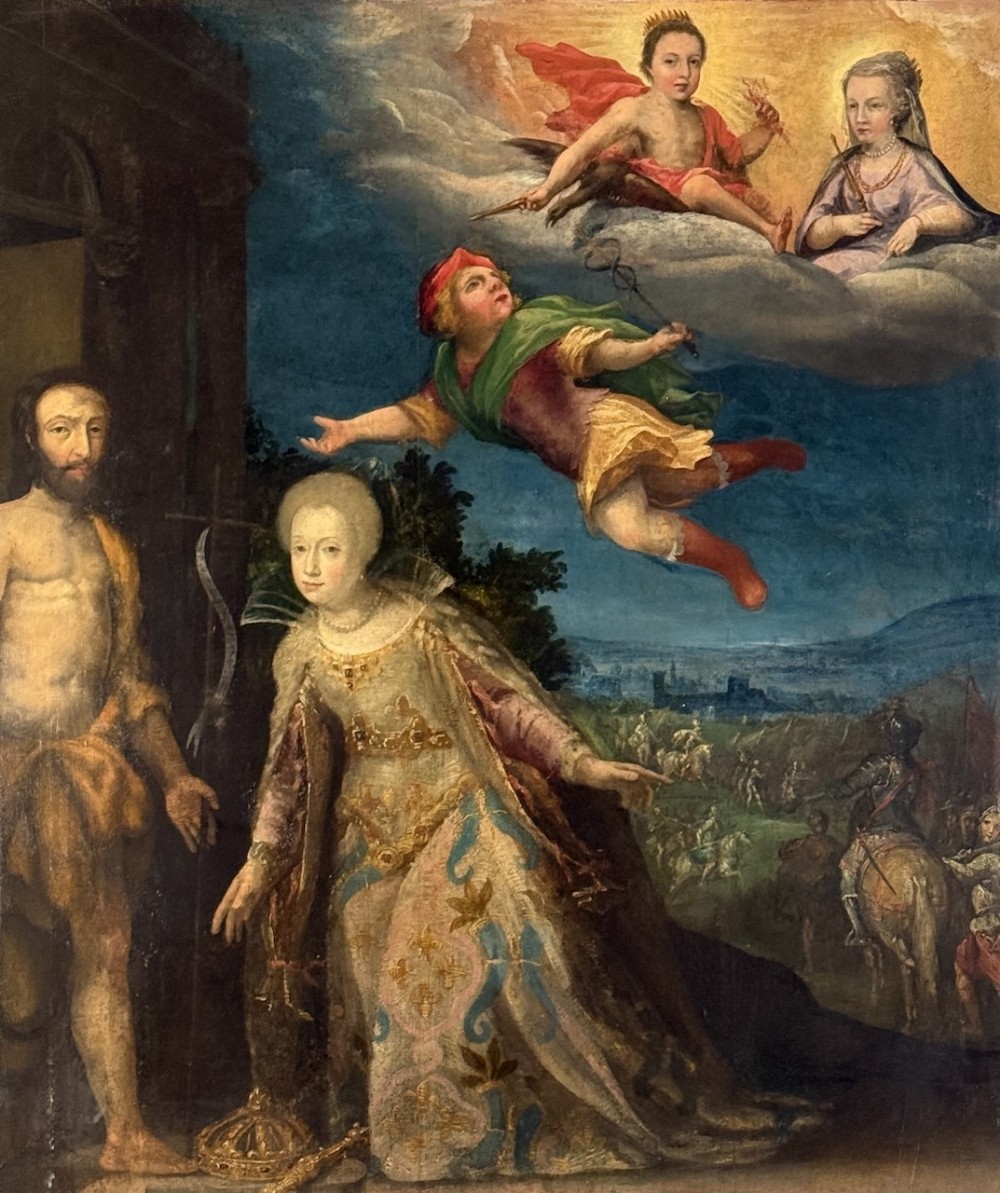
Period Portraits has dated this Mannerist Allegorical Oil Painting to the 16th Century.
Price: £14000
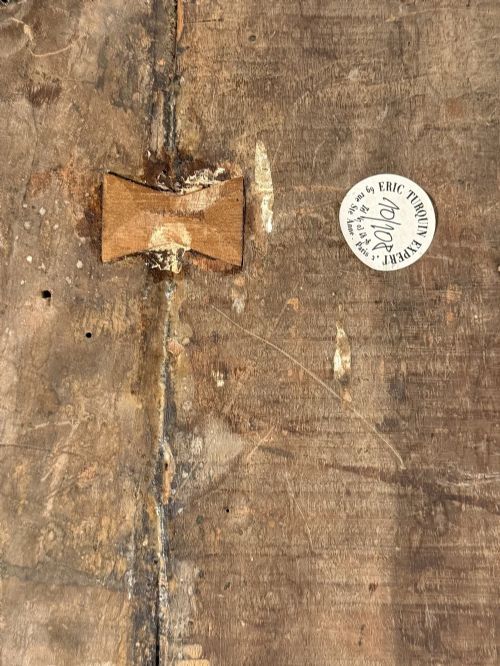
PROVENANCE: Cabinet Turquin (according to labels verso) Private collection USA Where acquired by Period Portraits
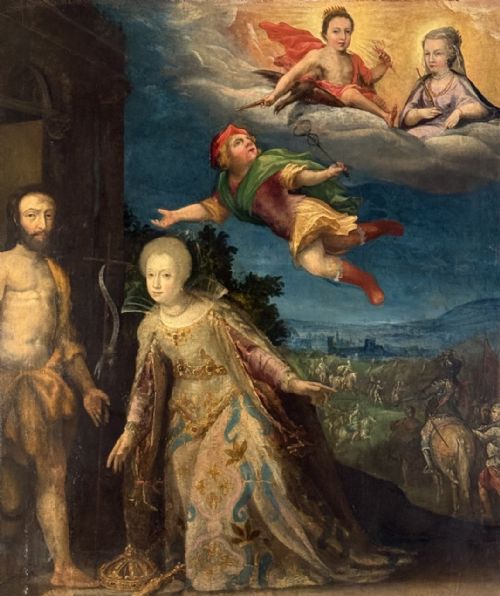
This compelling late Mannerist oil on panel represents a sophisticated synthesis of high-status court portraiture, sacred narrative, and Northern European vanitas imagery. Executed at the turn of the seventeenth century, the composition depicts an elaborate allegorical scene centered upon the transient nature of worldly power and royal splendor.
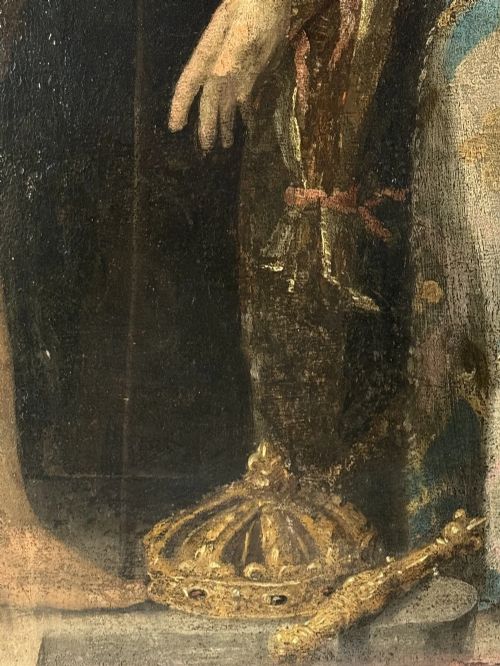
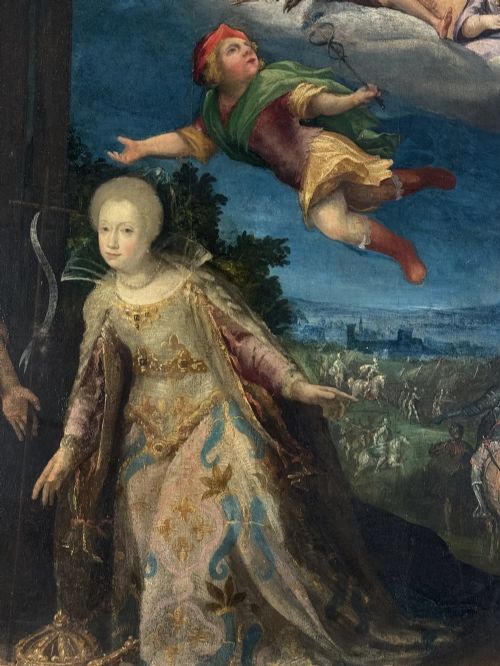
At the foreground of the pictorial space stands a queen or noblewoman attired in the opulent court fashion popular across Western and Northern Europe between 1585 and 1615. Her attire—featuring a stiff, elevated lace collar (medici ruff),intricate gold-embroidered brocade, pearls, and an ornate, winged coiffure—places her within the rarefied atmosphere of elite late Renaissance courtly life. In a gesture of profound humility and lay piety, she gazes toward the viewer while lowering herself to lay down her primary emblems of temporal authority—a royal crown and scepter—at the feet of Saint John the Baptist.
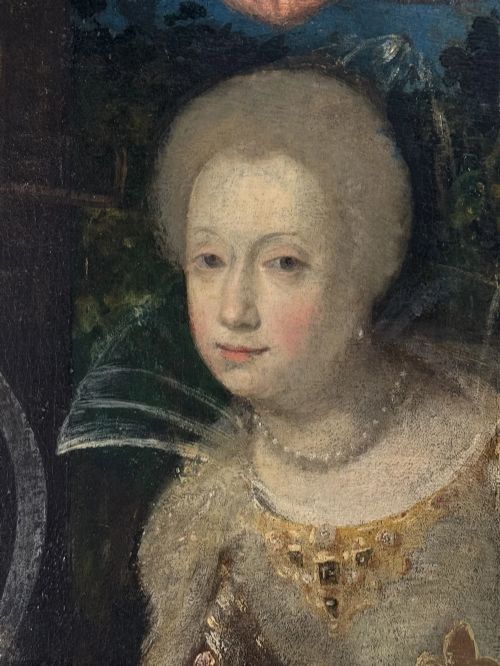
Saint John, depicted on the far left in his characteristic camel-skin garment and holding a slender cross, acts as an ascetic intercessor. His presence highlights the contrast between earthly vanity and spiritual redemption. The middle ground features a dynamic, mid-air figure—a classic Mannerist floating messenger bearing a wand or caduceus—who bridges the terrestrial scene below with the celestial vision above. In the upper right register, a golden heavenly cloud opens to reveal a crowned child and a veiled holy woman, symbolizing the divine grace and heavenly crown promised to those who renounce worldly riches.
Stylistically, the work exhibits strong hallmarks of the Northern Mannerist tradition, drawing clear parallels to workshops active in the Netherlands (Antwerp and Brussels) and the Habsburg court circles in Prague and the Rhineland:
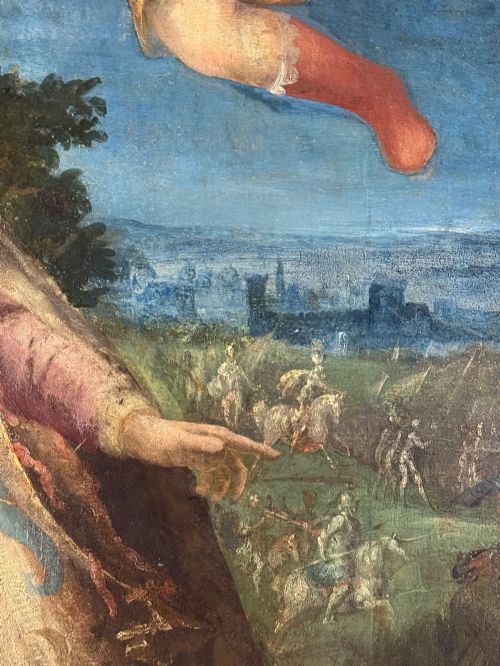
The deliberate verticality, dense spatial arrangement, and dramatic, elongated pose of the airborne figure recall the influence of artists such as Frans Floris, Maerten de Vos, and the circle of Rudolfine court painters like Hans von Aachen and Bartholomäus Spranger.
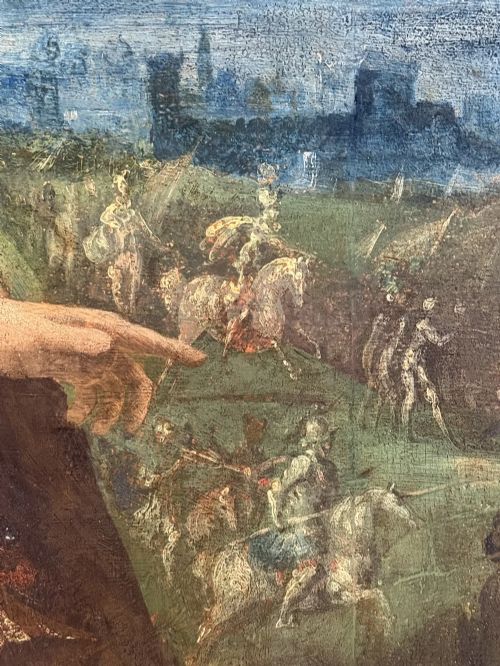
The background scene—featuring a distant rolling landscape beneath a moody,atmospheric sky with a skirmish of cavalry forces—reflects the Flemish tradition of placing devotional allegories against expansive, detailed topographies.
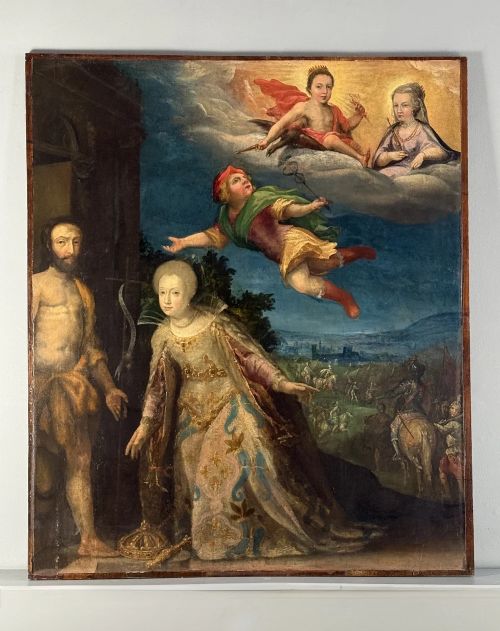
This work is finely executed upon an exceptionally large wooden support which has allowed for the meticulous rendering of luminous details, such as the delicate costume, metallic gleam of the crown and the soft glazes of the celestial clouds.
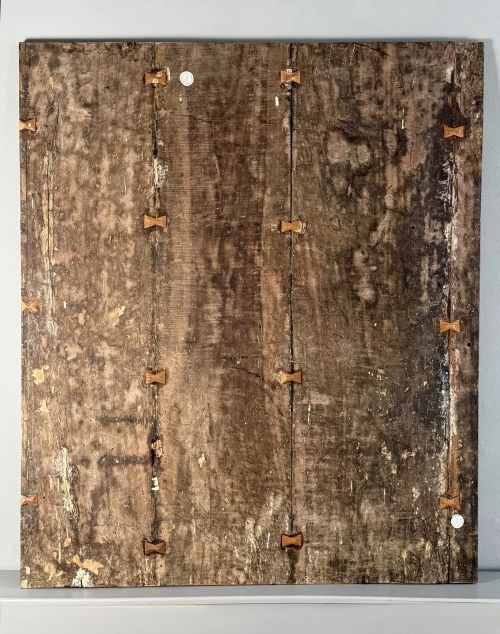
Whether created as a private devotional panel for a noble patron or as an allegorical commentary on virtuous governance and religious renunciation, this painting remains a captivating testament to the visual complexity and spiritual gravity of late 16th-c
Period Portraits has dated this Mannerist Allegorical Oil Painting to the 16th Century.
Specialist dealer in portraits from the 17th century to the 20th century. Our stock includes quality oil paintings, drawings, and mezzotints
You can view the stock and full dealer information on the Period Portraits Profile Page
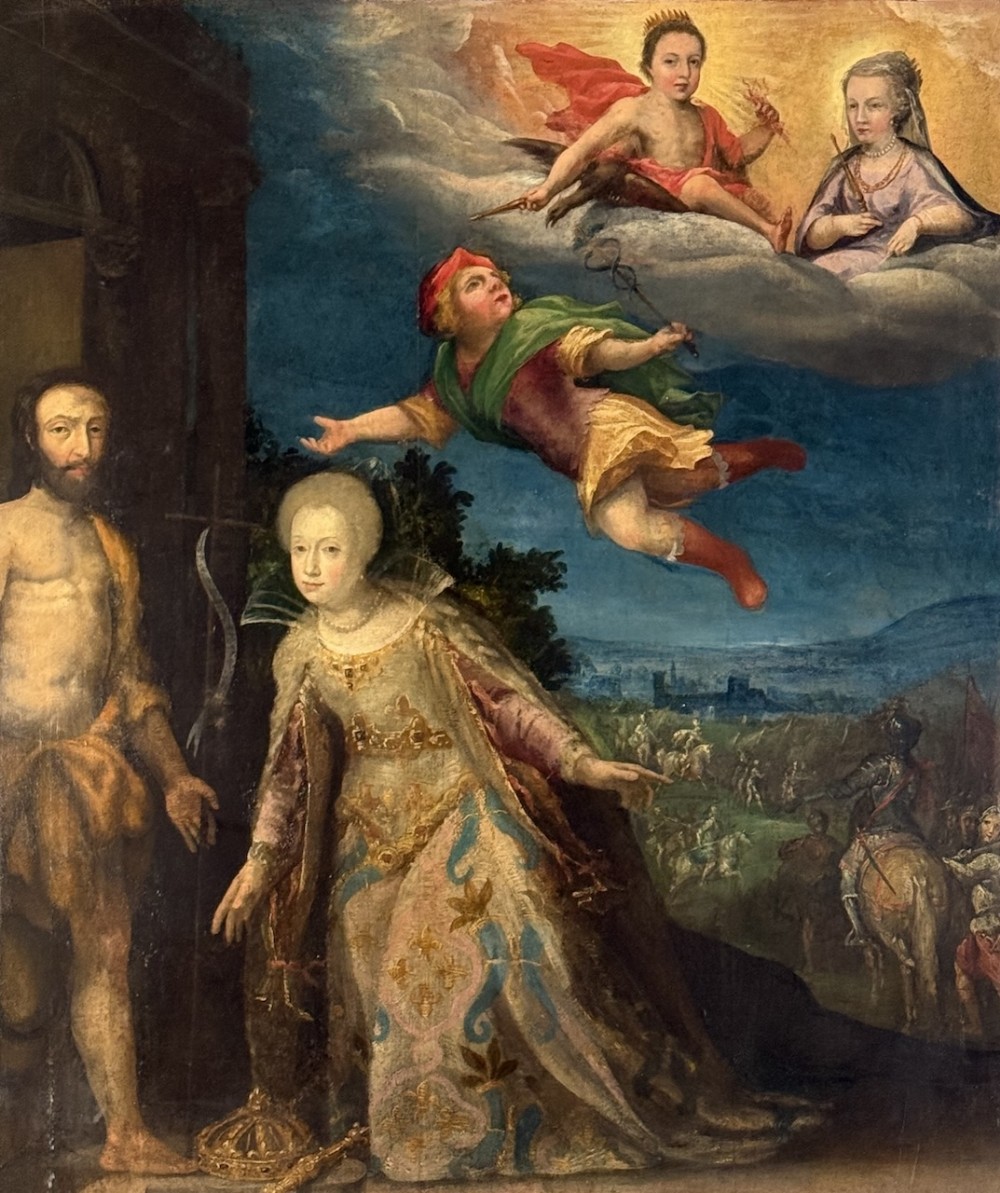
Northern European School (Circa 1585–1615) - Late Mannerist Allegorical Oil on Panel