61,349  PAGES BROWSED TODAY PAGES TODAY • 214 ANTIQUES UPLOADED TODAYNEW ARRIVALS
GIFTS
214 ITEMS ADDED TODAY
Sort Order
Items Per Page
Browse Categories
Sort order
Relevant Links
Items per page
ID #SA1243788
FOR SALE
£48,000
Email Phone Buy
Save
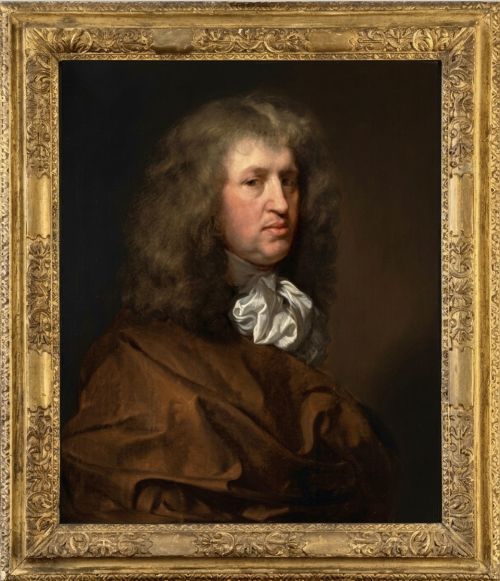
Gerard Soest (C.1605 -1681) - Portrait of a Gentleman / Samuel Butler (1630 -1680)
For sale by Period Portraits
for sale €56,160     $60,960
£48,000
Period Portraits

Period Portraits

Sellingantiques Verified Since Jan 2017
Browse dealers 48 items
  • About Us
    Specialist dealer in portraits from the 17th century to the 20th century. Our stock includes quality oil paintings, drawings, and mezzotints
Id #SA1243788
PDF SHARE
SAVE

Gerard Soest (C.1605 -1681) - Portrait of a Gentleman / Samuel Butler (1630 -1680)

17th century
For Sale by Period Portraits
Description

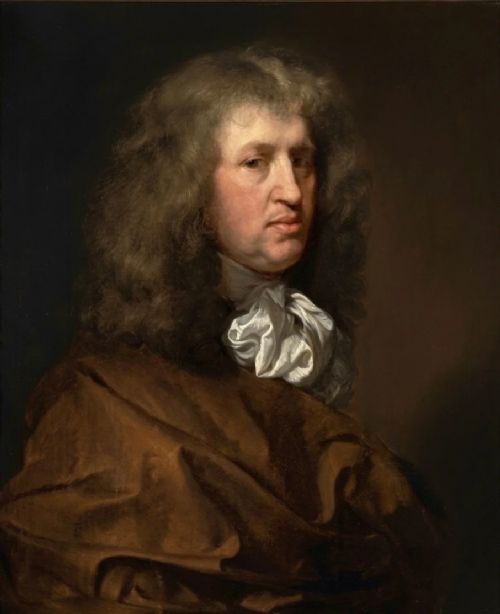
Portrait of a gentleman (Samuel Butler 1630-1680) Half-length, wearing a brown mantle and white cravat

Oil on canvas in a period carved and gilded frame Canvas: 70cm x 65cm / Framed: 86cm x 74cm

Price: £48000

PROVENANCE Collection of the Earls of Thanet By whom sold Messers Christies, Manson & Woods 14th March 1930 Lot 13

(as Sir Peter Lely portrait of the artist in brown cloak with white cravat)

Collection of Arthur Savarin Cohen Maryland USA

By whom sold Potomack Auctions April 22nd 2026 lot 3064 (as circle of Sir Peter Lely) Where acquired by Period Portraits

An exceptional and recently rediscovered portrait by Gerard Soest, recognisable from other depictions as the poet and satirist Samuel Butler (1630-1680). The sitter wears a prominent knotted cravat and rich classical cloak, and this young celebrated literary gentleman of the Restoration court. possesses a sharp, thoughtful, and brooding intensity.

The majority of portraits of this sitter (including NPG 2468 the version acquired by the National Portrait Gallery in 1930) depict Butler at middle age and orientated towards the left of the canvas. Our painting shows a younger figure looking towards the right, and the slightly heavy set of his jaw, the somber, thoughtful curve of his lips, and the deeply individualised shape of his nose all align perfectly with Samuel Butlers known iconography.

As Butler’s Hudibras (1663-1678) was the ultimate anthem of the Royalist cause, and given that this work was preserved for nearly three centuries by the Earls of Thanet (a fiercely Royalist family) it is highly likely that this portrait was commissioned and then hung prominently by them as a trophy of political and cultural allegiance to the Crown.

Gerard Soest (c. 1600–1681) is a highly significant figure in 17th-century art. His career spans a fascinating, turbulent transition in British history: the Interregnum/Commonwealth (1649–1660) and the Restoration of Charles II (1660–1681).

During this period Sir Peter Lely dominated the royal court with his highly idealised, sleepy-eyed and outwardly glamorous portraits. By contrast Gerard Soest honed in on his sitters inner personas and his focus on their character and individuality produced portraits with exactly the same sharp, thoughtful, and brooding intensity that we see here.

Soest conjured drapery with such incredible technical skill that one of his major contributions to the British Baroque style must be his handling of fabrics. The recognisable sharp angular folds that he creates (seen here particularly on the sitters cravat) add a dramatic, shimmering quality to his portraits, and also help to communicate the high status of his sitters.

During a period when likenesses were flattering by design, Lely painted the king, his mistresses, and the high nobility, in portraits used as political propaganda. Gerard Soest however provided a crucial counterpoint with his depictions of the English gentry, scholars, and wealthy merchants. His portraits are both beautiful and honest records of the actual people who built and lived in Restoration-era England.

Notes

See Heinz Ar

Date of Manufacture

Period Portraits has dated this 17th Century Oil Portrait to the 17th Century.
Physical Dimensions
Height
86cm (33.86")
Width
74cm (29.13")
Depth
4cm (1.57")
Reference Numbers
Sellingantiques Reference
SA1243788
Description
Portrait of a gentleman (Samuel Butler 1630-1680) Half-length, wearing a brown mantle and white cravat
“
Oil on canvas in a period carved and gilded frame Canvas: 70cm x 65cm / Framed: 86cm x 74cm.
Period Portraits
fig 1. An oil painting portrait of a 17th-century gentleman wearing a long powdered wig, a white silk cravat, and a brown mantle draped over his shoulders against a dark background.
fig 1. Gerard Soest (C.1605 -1681) - Portrait of a Gentleman / Samuel Butler (1630 -1680)

Price: £48000

PROVENANCE Collection of the Earls of Thanet By whom sold Messers Christies, Manson & Woods 14th March 1930 Lot 13
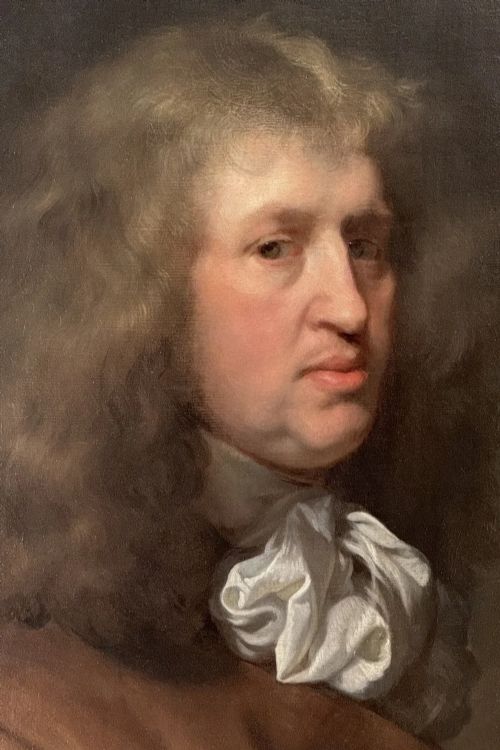
fig 2. An oil painting portrait of a 17th-century gentleman wearing a long powdered wig, a white silk cravat, and a brown mantle draped over his shoulders against a dark background.
fig 2. Gerard Soest (C.1605 -1681) - Portrait of a Gentleman / Samuel Butler (1630 -1680)

(as Sir Peter Lely portrait of the artist in brown cloak with white cravat)

Collection of Arthur Savarin Cohen Maryland USA

By whom sold Potomack Auctions April 22nd 2026 lot 3064 (as circle of Sir Peter Lely) Where acquired by Period Portraits
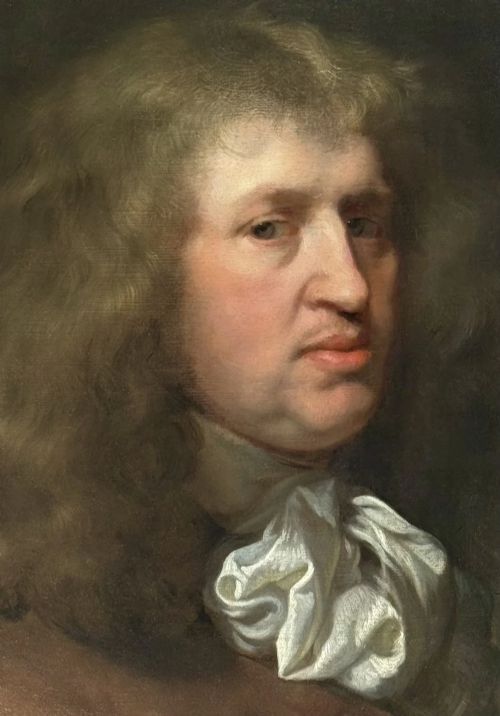
fig 3. An oil painting portrait of a 17th-century gentleman wearing a long powdered wig, a white silk cravat, and a brown mantle draped over his shoulders against a dark background.
fig 3. Gerard Soest (C.1605 -1681) - Portrait of a Gentleman / Samuel Butler (1630 -1680)

An exceptional and recently rediscovered portrait by Gerard Soest, recognisable from other depictions as the poet and satirist Samuel Butler (1630-1680). The sitter wears a prominent knotted cravat and rich classical cloak, and this young celebrated literary gentleman of the Restoration court. possesses a sharp, thoughtful, and brooding intensity.
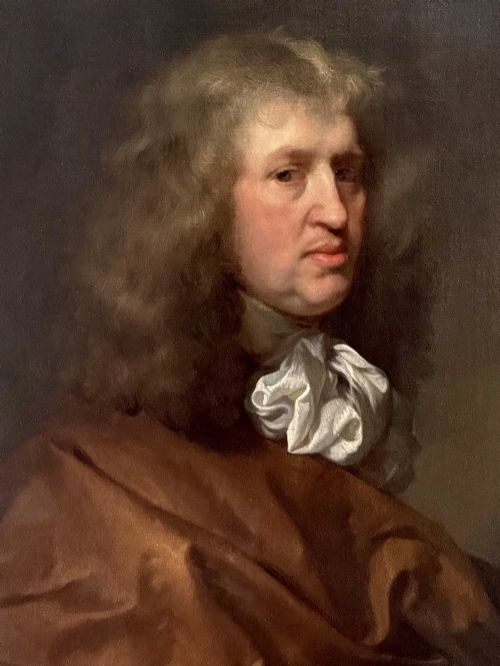
fig 4. An oil painting portrait of a 17th-century gentleman wearing a long powdered wig, a white silk cravat, and a brown mantle draped over his shoulders against a dark background.
fig 4. Gerard Soest (C.1605 -1681) - Portrait of a Gentleman / Samuel Butler (1630 -1680)

The majority of portraits of this sitter (including NPG 2468 the version acquired by the National Portrait Gallery in 1930) depict Butler at middle age and orientated towards the left of the canvas. Our painting shows a younger figure looking towards the right, and the slightly heavy set of his jaw, the somber, thoughtful curve of his lips, and the deeply individualised shape of his nose all align perfectly with Samuel Butlers known iconography.
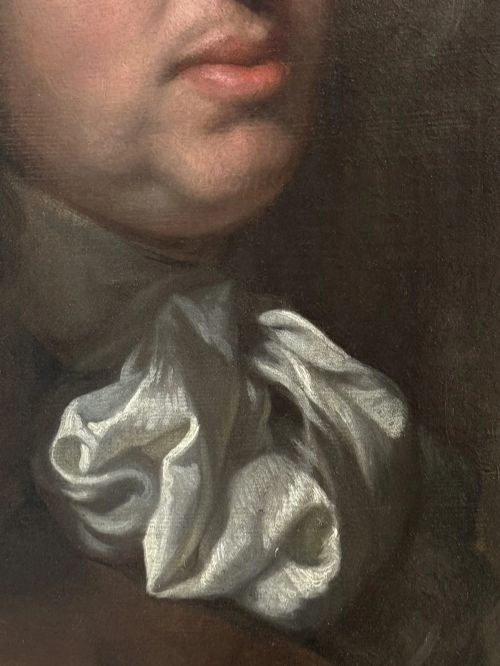
fig 5. An oil painting portrait of a 17th-century gentleman wearing a long powdered wig, a white silk cravat, and a brown mantle draped over his shoulders against a dark background.
fig 5. Gerard Soest (C.1605 -1681) - Portrait of a Gentleman / Samuel Butler (1630 -1680)

As Butler’s Hudibras (1663-1678) was the ultimate anthem of the Royalist cause, and given that this work was preserved for nearly three centuries by the Earls of Thanet (a fiercely Royalist family) it is highly likely that this portrait was commissioned and then hung prominently by them as a trophy of political and cultural allegiance to the Crown.
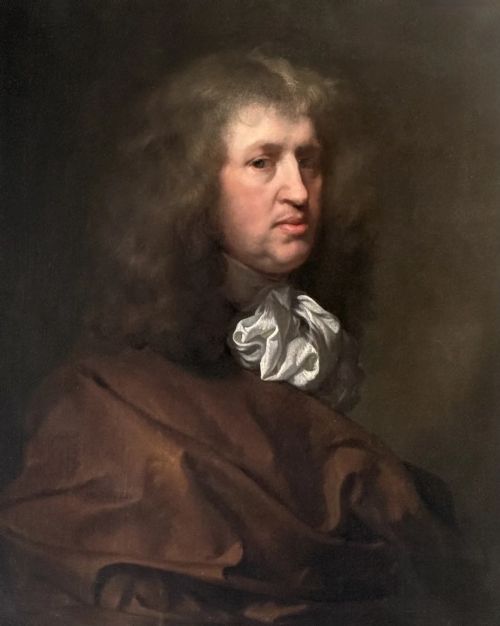
fig 6. An oil painting portrait of a 17th-century gentleman wearing a long powdered wig, a white silk cravat, and a brown mantle draped over his shoulders against a dark background.
fig 6. Gerard Soest (C.1605 -1681) - Portrait of a Gentleman / Samuel Butler (1630 -1680)

Gerard Soest (c. 1600–1681) is a highly significant figure in 17th-century art. His career spans a fascinating, turbulent transition in British history: the Interregnum/Commonwealth (1649–1660) and the Restoration of Charles II (1660–1681).
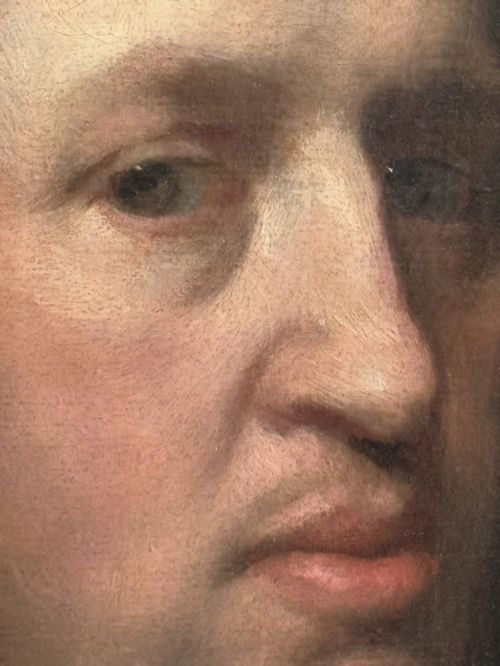
fig 7. An oil painting portrait of a 17th-century gentleman wearing a long powdered wig, a white silk cravat, and a brown mantle draped over his shoulders against a dark background.
fig 7. Gerard Soest (C.1605 -1681) - Portrait of a Gentleman / Samuel Butler (1630 -1680)

During this period Sir Peter Lely dominated the royal court with his highly idealised, sleepy-eyed and outwardly glamorous portraits. By contrast Gerard Soest honed in on his sitters inner personas and his focus on their character and individuality produced portraits with exactly the same sharp, thoughtful, and brooding intensity that we see here.
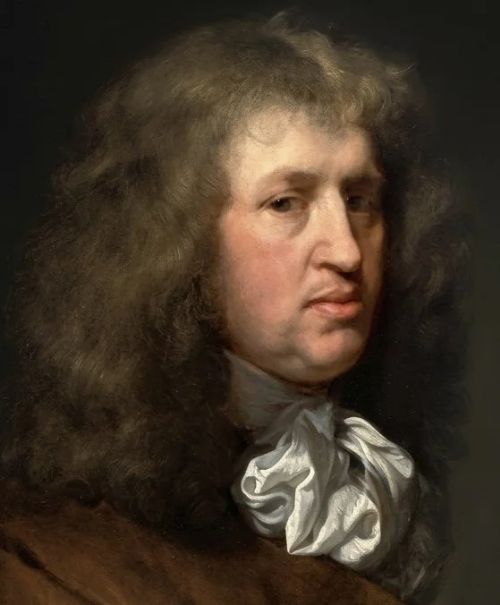
fig 8. An oil painting portrait of a 17th-century gentleman wearing a long powdered wig, a white silk cravat, and a brown mantle draped over his shoulders against a dark background.
fig 8. Gerard Soest (C.1605 -1681) - Portrait of a Gentleman / Samuel Butler (1630 -1680)

Soest conjured drapery with such incredible technical skill that one of his major contributions to the British Baroque style must be his handling of fabrics. The recognisable sharp angular folds that he creates (seen here particularly on the sitters cravat) add a dramatic, shimmering quality to his portraits, and also help to communicate the high status of his sitters.
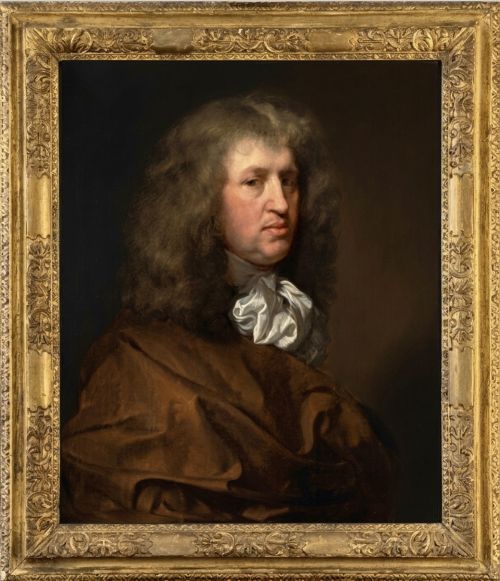
fig 9. An oil painting portrait of a 17th-century gentleman wearing a long powdered wig, a white silk cravat, and a brown mantle draped over his shoulders against a dark background.
fig 9. Gerard Soest (C.1605 -1681) - Portrait of a Gentleman / Samuel Butler (1630 -1680)

During a period when likenesses were flattering by design, Lely painted the king, his mistresses, and the high nobility, in portraits used as political propaganda. Gerard Soest however provided a crucial counterpoint with his depictions of the English gentry, scholars, and wealthy merchants. His portraits are both beautiful and honest records of the actual people who built and lived in Restoration-era England.

Notes

See Heinz Ar

Date of Manufacture

Period Portraits has dated this 17th Century Oil Portrait to the 17th Century.

Height
86cm (33.86")
Width
74cm (29.13")
Depth
4cm (1.57")
Reference Numbers
Sellingantiques Ref
SA1243788
Period Portraits
Period Portraits
Sellingantiques verified Since Jan 2017

Specialist dealer in portraits from the 17th century to the 20th century. Our stock includes quality oil paintings, drawings, and mezzotints

Dealer Profile

You can view the stock and full dealer information on the Period Portraits Profile Page
PDF SHARE
SAVE
An oil painting portrait of a 17th-century gentleman wearing a long powdered wig, a white silk cravat, and a brown mantle draped over his shoulders against a dark background.
1 / 10
Archive I An oil painting portrait of a 17th-century gentleman wearing a long powdered wig, a white silk cravat, and a brown mantle draped over his shoulders against a dark background.

Gerard Soest (C.1605 -1681) - Portrait of a Gentleman / Samuel Butler (1630 -1680)

Archive II An oil painting portrait of a 17th-century gentleman wearing a long powdered wig, a white silk cravat, and a brown mantle draped over his shoulders against a dark background. View II
Archive III An oil painting portrait of a 17th-century gentleman wearing a long powdered wig, a white silk cravat, and a brown mantle draped over his shoulders against a dark background. View III
Archive IV An oil painting portrait of a 17th-century gentleman wearing a long powdered wig, a white silk cravat, and a brown mantle draped over his shoulders against a dark background. View IV
Archive V An oil painting portrait of a 17th-century gentleman wearing a long powdered wig, a white silk cravat, and a brown mantle draped over his shoulders against a dark background. View V
Archive VI An oil painting portrait of a 17th-century gentleman wearing a long powdered wig, a white silk cravat, and a brown mantle draped over his shoulders against a dark background. View VI
Archive VII An oil painting portrait of a 17th-century gentleman wearing a long powdered wig, a white silk cravat, and a brown mantle draped over his shoulders against a dark background. View VII
Archive VIII An oil painting portrait of a 17th-century gentleman wearing a long powdered wig, a white silk cravat, and a brown mantle draped over his shoulders against a dark background. View VIII
Archive IX An oil painting portrait of a 17th-century gentleman wearing a long powdered wig, a white silk cravat, and a brown mantle draped over his shoulders against a dark background. View IX
Archive X An oil painting portrait of a 17th-century gentleman wearing a long powdered wig, a white silk cravat, and a brown mantle draped over his shoulders against a dark background. View X
Enlarged Archival View
Telephone 07889 859729
Location
North Yorkshire
United Kingdom
Verified Since Jan 2017
Items For Sale 48
Items Sold 63
Period Portraits
Period Portraits
Verified Since Jan 2017
View Dealer Info
Location: North Yorkshire, United Kingdom
Verified
Jan 2017
For Sale
48
Sold
63
An oil painting portrait of a 17th-century gentleman wearing a long powdered wig, a white silk cravat, and a brown mantle draped over his shoulders against a dark background.
GERARD SOEST (c.1605 -1681) - PORTRAIT OF A GENTLEMAN / SAMUEL BUTLER (1630 -1680)
Ref: SA1243788
An oil painting portrait of a 17th-century gentleman wearing a long powdered wig, a white silk cravat, and a brown mantle draped over his shoulders against a dark background.
Detail View 1
Detail View 2
Detail View 3
Detail View 4
Detail View 5
Detail View 6
Detail View 7
Detail View 8
Detail View 9
Archival Detail
Every single antique dealer on our platform is individually approved by our internal team. We verify their professional trade history, ethical standards, and photographic quality to ensure a secure, high-standard buying environment. Upon joining, every dealer agrees to a strict 9-point code of conduct. While issues can occasionally arise, our dealers typically resolve them swiftly and directly with the buyer. In fact, since our founding in 2002, Sellingantiques has only had to step in to help resolve an issue on roughly five occasions—a true testament to the quality of our dealers and their dedication to your happiness.
Our dealers are highly experienced in packing and shipping fragile, high-value antiques. Because you are in direct contact with the dealer, you will be able to easily go through all available shipping and insurance options together to ensure your item arrives safely.
Antiques are the ultimate green purchase. By choosing historical pieces over newly manufactured goods, you completely eliminate the carbon footprint of modern mass production while preserving exceptional, timeless craftsmanship.
Written by Sellingantiques from the dealer’s photographs and listing
  • ObjectOil Painting
  • Period17th century
  • StyleBaroque
  • MaterialOil on canvas
  • ColourWarm Brown
  • MotifsPeriwig, White cravat, Draped mantle, Chiaroscuro
  • SizeH 86 cm (34 in) x W 74 cm (29 in) x D 4 cm (2 in)

This 17th-century Baroque oil painting on canvas depicts a gentleman in a long periwig, a white cravat, and a warm brown draped mantle set against a dark background. The artwork measures 86 cm high, 74 cm wide, and 4 cm deep. The painting displays heavy-set jaw contours, a thoughtful lip curve, and an individualised nose shape rendered with chiaroscuro lighting effects and sharp angular fabric folds. In a home today, this piece suits placement above the mantel in a gentleman's library or study. The canvas presents a half-length portrait format housed within a period carved and gilded frame, bringing historical character and traditional portraiture to an interior space.

Baroque portraiture from the 17th century is characterised by the use of chiaroscuro lighting, dark background tones, and formal attire such as linen cravats and draped mantles. Painters focused on capturing realistic facial structures alongside garments that indicated the social standing of the sitter.

Painters during the Restoration era primarily used hand-ground oil pigments mixed with drying oils applied to linen canvas or wood panels. Linen canvas was stretched over timber frames and prepared with traditional gesso or lead-based ground layers.

Authentic 17th-century oil portraits display age-related craquelure patterns across the paint surface, natural oxidisation of historical varnish, and period-appropriate stretcher construction. Scientific examination of canvas weave density and pigment composition also verifies historical accuracy.

Traditional portrait paintings can be displayed as focal points above fireplaces, sideboards, or in library spaces to introduce historical contrast within contemporary rooms. Position the artwork where ambient lighting highlights the painted features without causing direct surface glare.

Oil paintings require climate-controlled indoor environments with stable humidity levels to prevent canvas movement and paint flaking. Direct sunlight and proximity to active heat sources should be avoided to prevent varnish yellowing and heat-induced degradation.
items
Add keywords to the filter
Price
£100
£250000
Era
Period
Style
Material
Origin
Stock Location
Recently Added
Online Payments
Categories